• Skip to primary navigation
  • Skip to main content

The One Percent Almanack

Wit and Wisdom on Investing, Business, and Life

  • Home
  • Members
  • Log In|Log Out
  • Show Search
Hide Search

Life 2.0: What You Need to Achieve Greatness (It’s NOT Talent!)

January 30, 2017

What does it take to be the best? The best manager, the best website designer, the best boxer, the best marketer, or the best investor?

The off-the-cuff answer is 10,000 hours, popularized by the Malcolm Gladwell book Outliers As per Gladwell, 10,000 hours is what you need to become a renowned concert violinist, a brilliant mathematician, a chess grandmaster, a Pulitzer-winning novelist.

In other words, that’s 20 hours a week (or 3 hours a day) for 10 years. Well, you may look at this in one of two ways. You might get depressed looking at the 10,000 hours number and re-consider trying to be great in what you aspire to be. Or you may decide to sit down and start working away those hours.

But there are some serious problems with both of those approaches.

The problem with the first approach i.e., giving up, is that it assumes there’s nothing to be gained between hour 1 and hour 10,000.

“I will be nothing until I’ve mastered greatness,” you might say to yourself, “And the road is too hard and long, so what’s the point?”

The problem with the second approach i.e., settling in to grind the hours out, is that it matters ‘a lot’ what kind of practice you put in for 10,000 hours.

<!–more–>[show_to accesslevel=’almanack-all’]

10,000 hours of studying how to become a great stock picker is easy, but it won’t get you to achieve Buffett-like returns. And even 10 hours of the right kind of practice will bring you something meaningful and interesting, and it builds the foundation for something you can start using today, not 10 years from now.

10 Hours to Greatness?

In his book Talent is Overrated, Fortune Magazine editor Geoff Colvin highlights recent studies that show that greatness can be developed by any man, in any field, through the process of what he calls “deliberate practice”.
But how does one practice deliberately?

Colvin proposes five elements that allow a man to practice deliberately and thus achieve greatness over the long term.

1. Deliberate Practice is designed to improve performance
Most of us practice by mindlessly repeating an activity over and over without any clear goal of what we want to accomplish.

For example, let’s say I want to improve my cricket skills. If I’m like most men (and budding cricketers out there), I’ll just go to the nets and try smacking each delivery to the boundary without thinking much about specific ways I can improve my defence and shot-taking. 300 balls later, I wouldn’t have improved at all. In fact, my shots may have gotten worse.

Deliberate practice, on the other hand, is what Sachin Tendulkar did every time he practiced in the nets. As is widely reported, Tendulkar focused not on hitting every delivery out of the park, but on strengthening his defence. He had a clear objective and goal in mind when he got down to practice, and that is what made him one of the greatest cricketers of all time.

Video: Geoff Colvin on Deliberate Practice

Also Watch: Geoff Colvin – Talent is Overrated

2. Deliberate Practice can be repeated
If you’re a writer, you write a lot. If you are a musician, you know the importance of repeating your notes. If you’re a website designer, you know why it is important to work on great designs again and again.

The idea of ‘deliberate practice’ is to decide about the realm you want to master – like becoming a master investor – and then focus your time there.

You know that there are no short cuts to success. If you want to be the best investor you can be, you’ll have to commit yourself to years of deliberate practice.

3. Deliberate Practice constantly refers to results-based feedback
In the world of investing, this means you aren’t making or losing money in a dummy stock market game. Instead, you’re out there investing with your own hard-earned money.

Constant feedback is crucial for your improvement as an investor. You must see the results of your efforts (the return on your investment) to evaluate if the way you’re doing things is working or if you need to change things up to improve.

4. Deliberate Practice takes significant mental effort
Now this – the significant mental effort required – is the key factor that separates deliberate practice from mindless practice. When you’re practicing deliberately, you’re focusing and concentrating so much on your performance that you’re mentally exhausted after your practice session. And that’s why it is advised that such practice need to be done over small sessions of 60-90 minutes few times a day.

Muhammad Ali said, “I don’t count my sit-ups; I only start counting when it starts hurting because they’re the only ones that count.” You may replace Ali’s physical efforts with the mental efforts of someone practicing a mind sport, and this is what deliberate practice is all about.

5. Deliberate practice isn’t much fun
Colvin writes in his book…

Most people don’t enjoy doing activities that they’re not good at. It’s no fun to fail repeatedly and receive criticism on how you can improve. We’d rather do stuff at which we excel because succeeding is enjoyable, and it strokes our egos. Yet deliberate practice is specifically designed to focus on things you are weak at and requires you to practice those skills repeatedly until you become a master at them.

And focusing on your weaknesses, especially when you are not expected to get positive feedback for an extended time isn’t fun you see.

How Much Deliberate Practice You Need to Master Investing?

The truth is, you don’t need to put in 10,000 hours to be able to become a master investor capable of earning great returns on your investments.

Alternatively, just because you spend a lot of time deliberately practicing how to pick stocks better, you won’t become a master investor.

Like if you’re 5-foot, no amount of practice will allow you to slam dunk like Michael Jordan.

Or if you’re as impatient as a lover, no amount of coaching or drilling on long-term investing will make you a long-term investor.

What the theory of ‘deliberate practice’ suggests is that you’re not as limited by your natural talent as you often think you are. You can make yourself what you will.

Strangely, that idea is not popular. People love having the notion that they would coast to fame and riches if they found their talent. But that view is tragically limiting, because when they hit life’s inevitable bumps in the road, they conclude that they just aren’t gifted. And then, they give up.

As Colvin writes in his book…

Deliberate practice is also not what most of us do when we think we’re practicing golf or the oboe or any of our other interests. Deliberate practice is hard. It hurts. But it works. More of it equals better performance. Tons of it equals great performance.

Remember what you said the last time your portfolio was in the dumps? If you’re like most investors, you must have told yourself, “I’m not made for the stock markets! This isn’t the right place for me.

Of course, trying to become a great stock picker is just too demanding. But the liberating news is that greatness isn’t reserved for a destined few.

It is available to you and to everyone. You just need a vision and deliberate practice to achieve the same.
[/show_to] [hide_from accesslevel=’almanack-all’]

Want to Read More? This content is exclusive for members of Value Investing Almanack. Login to read if you are a member. Else, click here to subscribe.

Benefits to VIA Members
 
  • Spotlight: Big ideas from Value Investing and why applying them in your investment decision making will be a great deal
  • InvestorInsights: Interviews with experienced value investors, learners, and deep thinkers
  • StockTalk: Thorough analysis of business models of companies (without any recommendations)
  • Behaviouronomics: Deep analysis of human behaviour and how it impacts investment decision making
  • BookWorm: Reviews of the best books on Value Investing and related subjects
  • Free Course – Financial Statement Analysis for Smart People (otherwise priced at Rs 5,900)
  • Archives: Instant access to our huge archive from the past three years

Become a VIA Member. Click to Subscribe
[/hide_from]

InvestorInsights: Jatin Khemani

January 20, 2017

Jatin Khemani is Founder & CEO at Stalwart Advisors, a SEBI Registered Investment Adviser. He has seven years of experience in investment analysis and portfolio management. In his last stint with a Delhi-based brokerage house he was solely responsible for the research activities of the organisation right from picking new ideas to tracking the existing portfolio thereby assisting the directors in managing the proprietary book. He is a CFA (US) Charter holder, earned his MBA in Finance from Christ University, Bangalore and graduation in Commerce from Delhi University. Thanks to his admiration for Peter Lynch & Philip Fisher, Jatin has over the years become proficient in scuttlebutt, a primary research method to find out truth about a company or an industry. On weekends, he teaches finance to MBA students and is an active volunteer with The Art of Living since 2006, where he leads state level fund-raising campaigns.

Safal Niveshak (SN): Could you tell us a little about your background, how you got interested in value investing?

Jatin Khemani (JK): I had a decent exposure to how businesses operate since a very young age. My family used to run a manufacturing setup which I often visited, and later on I studied commerce in high school and graduation. But my perception towards equity markets was bad then. I had seen my father trade and lose money. The lesson that got passed on to me was that individuals do not stand a chance in this market, which is manipulated by ‘operators’, dominated by institutional investors, and its nothing less than gambling.

However, that completely changed during my MBA days, when I met my mentor Mr. SG Raja Sekharan. He was a very senior IT professional who had left his fancy job as soon as he became financially independent and started following his passion of teaching and helping others get financially independent. He could do that by smartly investing in real estate as well as great businesses like HDFC Bank, Asian Paints, Pidilite etc. and holding on to them for years, and in some cases decades.

The nirvana moment for me was when I read ‘One Up On Wall Street’ by Peter Lynch and later on was introduced to the writings of legends like Warren Buffett, Charlie Munger and Philip Fisher. That’s when I decided to pursue investing as a career and enrolled myself for CFA (USA), which I eventually cleared in the first attempt and was awarded the charter. I worked two jobs, first at an independent investment research firm, and second as an analyst and later head of research at a Delhi-based brokerage house.

[Read more…] about InvestorInsights: Jatin Khemani

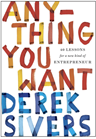
BookWorm: Anything You Want

January 15, 2017

Business and life lessons from a musician who accidentally became an entrepreneur when he found himself running a multi-million dollars business.

Derek Sivers was a full-time musician in 1998 making a comfortable living. One day he decided to sell his music CDs online and found that there was no way for a small-time musician to sell online. So, he learnt to program and built a website to sell his CDs. Very soon his friends started requesting him to list their CDs on the website. That’s how CD Baby was born and 10 years later it was doing $100 million in sales. In 2008 Sivers sold CDBaby.com and gave away the proceeds ($22 million) to a charitable trust.

Sivers never wanted to start a business and when he was running CD Baby, he intentionally wanted to restrict the growth so that he could run it the way he wanted. Ironically, those self-imposed constraints became the trigger for CD Baby’s growth.

Selling my friends’ CDs was starting to take up a lot of my time. I realized I had accidentally started a business. But I didn’t want to start a business! I was already living my dream life as a full-time musician. I didn’t want anything to distract me from that. So, I thought that by taking an unrealistically utopian approach, I could keep the business from growing too much. Instead of trying to make it big, I was going to make it small. It was the opposite of ambition, so I had to think in a way that was the opposite of ambitious.

“The key point is that I wasn’t trying to make a big business. I was just daydreaming about how one little thing would look in a perfect world. When you make a business, you get to make a little universe where you control all the laws. This is your utopia. When you make it a dream come true for yourself, it’ll be a dream come true for someone else, too.

Sivers is the best example of what they call ‘an accidental entrepreneur’ and  Anything You Want is the account of his entrepreneurial journey and the lessons he learnt. I found that a lot of these lessons can be extended for investing success too.

So here are my favourite ideas from the book.

If It’s Not a Hit, Switch

Einstein once said, “The definition of insanity is doing the same thing over and over again and expecting different results.”
[Read more…] about BookWorm: Anything You Want

Behaviouronomics: The Spotlight Effect

January 10, 2017

When you go wrong about something and you feel the spotlight is on you because you blabbered about it in the past, it’s very painful to change your mind even when a significant part of your wealth is at stake.

In a survey, people were asked about their greatest fear. Can you guess what was the number one fear for most people? It wasn’t fear of death.

Fear of public speaking topped the list. Death was second. My guess is that the third one on the list would be a combination i.e. ‘dying while public speaking’. Jokes apart, the act of standing up in front of a crowd and saying something meaningful, for most people, is terrifying.

I remember my first experience. The moment I stood up on the stage, my legs started shaking uncontrollably. Within few seconds my throat went dry as the desert and I was sweating like a pig. I could barely utter a single syllable. I behaved like a deer who suddenly finds itself in front of a hungry and ferocious lion.

The underlying cause of this fear is our intense urge to not look like a stupid. A man would do everything to avoid being in embarrassing situations. This tendency comes from the basic human need to belong to a group, to fit in and not stand out like an odd man out. Social proof is an important behavioural bias which explains why we behave irrationally.

[Read more…] about Behaviouronomics: The Spotlight Effect

Spotlight: An Investors’ Disease Called Rhinophobia

January 5, 2017

A lot of us suffer from the temptation of buying stocks or mutual funds as soon as we have some cash in the bank. Beware! It could be a symptom of a contagious disease called Rhinophobia.

“All of the humanity’s problems stem from man’s inability to sit quietly in a room alone.” ~ Blaise Pascal

“There is an itch to do things, particularly when you haven’t done anything in a while.” ~ Warren Buffett

“Dude! These bank guys have suddenly started giving me too much attention,” my friend told me. He recently had a cash windfall when his startup was acquired by one of India’s leading e-commerce company.

“Of course they would. You are a rich client for them now,” I told him.

“Earlier I had to run from pillar to post to get even the basic account details updated. But now they are after me like anything. Quite a few people from different departments in the bank have approached me and offered their advice for investing my money,” he complained.

“It’s better to stay away from these advisors. They’re the agents of Rhinophobia,” I warned.

“Rhinophobia? Never heard of it before. Sounds like a disease,” he looked at me with furrowed brow.

“It’s an investor’s disease meaning the dread of ever having any cash. These so called expert advisors will convince you that having un-invested cash in the bank is the biggest sin an investor can make,” I explained.

“Sounds interesting. You should write about it in your Value Investing Almanack,” he suggested. I haven’t been in touch with him since some time so I don’t really know if he heeded to my warning about staying away from his bank’s advisors. However, I took his advice seriously. So here I am sharing my thoughts on Rhinophobia.

[Read more…] about Spotlight: An Investors’ Disease Called Rhinophobia

  • « Go to Previous Page
  • Page 1
  • Interim pages omitted …
  • Page 42
  • Page 43
  • Page 44
  • Page 45
  • Page 46
  • Interim pages omitted …
  • Page 72
  • Go to Next Page »

Handcrafted with in India