
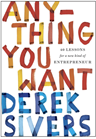
Business and life lessons from a musician who accidentally became an entrepreneur when he found himself running a multi-million dollars business.
Derek Sivers was a full-time musician in 1998 making a comfortable living. One day he decided to sell his music CDs online and found that there was no way for a small-time musician to sell online. So, he learnt to program and built a website to sell his CDs. Very soon his friends started requesting him to list their CDs on the website. That’s how CD Baby was born and 10 years later it was doing $100 million in sales. In 2008 Sivers sold CDBaby.com and gave away the proceeds ($22 million) to a charitable trust.
Sivers never wanted to start a business and when he was running CD Baby, he intentionally wanted to restrict the growth so that he could run it the way he wanted. Ironically, those self-imposed constraints became the trigger for CD Baby’s growth.
Selling my friends’ CDs was starting to take up a lot of my time. I realized I had accidentally started a business. But I didn’t want to start a business! I was already living my dream life as a full-time musician. I didn’t want anything to distract me from that. So, I thought that by taking an unrealistically utopian approach, I could keep the business from growing too much. Instead of trying to make it big, I was going to make it small. It was the opposite of ambition, so I had to think in a way that was the opposite of ambitious.
“The key point is that I wasn’t trying to make a big business. I was just daydreaming about how one little thing would look in a perfect world. When you make a business, you get to make a little universe where you control all the laws. This is your utopia. When you make it a dream come true for yourself, it’ll be a dream come true for someone else, too.
Sivers is the best example of what they call ‘an accidental entrepreneur’ and Anything You Want is the account of his entrepreneurial journey and the lessons he learnt. I found that a lot of these lessons can be extended for investing success too.
So here are my favourite ideas from the book.
If It’s Not a Hit, Switch
Einstein once said, “The definition of insanity is doing the same thing over and over again and expecting different results.”
[show_to accesslevel=’almanack-all’]
In our culture, too much importance is given to the idea of perseverance. There’s a thin line separating ‘persevering’ and ‘being a foolish stubborn.’ For 12 years Derek struggled through his career in music. But the moment he switched strategy and started focusing on helping other musicians, everything changed.
Before that [CD Baby], I had spent twelve years trying to promote my various projects. Trying every marketing approach. Networking, pitching, pushing. It always felt like an uphill battle, trying to open locked or slamming doors. I made progress, but only with massive effort…We’ve all heard about the importance of persistence. But I had misunderstood. Success comes from persistently improving and inventing, not from persistently doing what’s not working…Present each new idea or improvement to the world. If multiple people are saying, “Wow! Yes! I need this! I’d be happy to pay you to do this!” then you should probably do it. But if the response is anything less, don’t pursue it. Don’t waste years fighting uphill battles against locked doors. Improve or invent until you get that huge response.
There’s an important lesson for investors. If an investment is not going as per your initial hypothesis i.e. it’s not growing as fast as you assumed or the management seems to have lost focus, switch. Don’t insist on making money from every stock that you invest. Bite the bullet, cut your losses, and move on. Leverage that experience and find a new business to invest in.
Either “HELL YEAH!” or “No”
Are you spreading yourself too thin by saying yes to every request?
When deciding whether to do something, if you feel anything less than “Wow! That would be amazing! Absolutely! Hell yeah!”—then say “no.” When you say “no” to most things, you leave room in your life to throw yourself completely into that rare thing that makes you say “HELL YEAH!” Every event you get invited to. Every request to start a new project. If you’re not saying “HELL YEAH!” about it, say “no.” We’re all busy. We’ve all taken on too much. Saying yes to less is the way out.
Not every book is worth finishing and not every acquaintance/friend/stranger is worth helping. And for investors, not every blue chip stock recommendation is worth pursuing. Diversification is necessary to protect the downside but sprinkling money on every new investment fad or hot picks is guaranteed to yield mediocre returns.
For a stock to qualify as a potential investment idea you need few basic things. It should be inside your circle of competence. The price should be well below the estimated value and the quality of management and growth prospects of the business should be strong. These filters are very simple but very few businesses pass all of them. And when you find such business, it’s usually no brainer. A “HELL YEAH!”. For the rest, just say no.
Having Enough
Kurt Vonnegut and Joseph Heller were at a party at a billionaire’s extravagant estate. Kurt said, “Wow! Look at this place! This guy has everything!” Joseph said, “Yes, but I have something he’ll never have…. Enough.
When Sivers sold CD Baby he had more than enough money to last a lifetime. So he decided to give away the surplus to a charitable trust for the benefit of music education.
Excess of anything tends to bring unnecessary complexity in life. Money is no different. After a certain point, for most people, having more money becomes a hindrance. It takes away your freedom. It exposes you as an easy target for unfair lawsuits and unnecessary attention.
Happiness is the real reason you’re doing anything, right? Even if you say it’s for the money, the money is just a means to happiness, right? But what if it’s proven that after a certain point, money doesn’t create any happiness at all, but only headaches? You may be much happier as a $1 million business than a $1 billion business.
If the process of making money in itself is not a passion for you, then money is just a means to allow you to do what you want to do. Following your passion, living a comfortable life and leaving enough for your children doesn’t require hundreds of millions of dollars. Warren Buffett once said, “I want to leave enough for my children so they can do whatever they want to do, but not so much that they don’t do anything.”
When I decided to sell CD Baby, I already had enough. I live simply. I don’t own a house, a car, or even a TV. The less I own, the happier I am. The lack of stuff gives me the priceless freedom to live anywhere anytime. So I didn’t need or even want the money from the sale of the company. I just wanted to make sure I had enough for a simple, comfortable life.
For 90 percent of the small investors, the primary goal is to protect their hard earned capital from the corrosive effects of inflation. Which means, 12-18 percent long term CAGR is more than enough to compound their savings for a comfortable retirement.
There’s a Flipside to Everything
This insight comes not from this book but from a short TED talk Sivers delivered.
Look at the image below. What does it look like?
Oh! It’s the world map. But it looks wrong. It’s upside down, isn’t it? But that doesn’t make it wrong. The earth is suspended in the empty space with infinite space expanding to infinity in all directions. So the inverted world map is just another perspective.
Sometimes we get so immersed in our assumptions we forget that the opposite may also be true. There are some doctors in China who believe it’s their job to keep you healthy. Any month you are healthy, you pay them. If you’re not healthy in any month you don’t have to pay your doctor because they failed to keep you healthy. Isn’t that an unconventional way? They get rich not when you fall sick but when you remain disease free. In fact, that’s how all the doctors should run their practice, isn’t it? So don’t forget that whatever brilliant ideas you believe in, the opposite may also be true.

What does it mean for an investor? Don’t look at a business only from the lens of a stock market investor. Does the business add value to the society? Does the business treat its employees fairly? How does it treat its vendors and suppliers? Study the business model using mental models from different disciplines. What ideas can you use from psychology, microeconomics, biology, physics, engineering, social sciences etc. to gain different perspectives on the business?
Conclusion
This is a short book and can be read in less than an hour. But the wisdom it packs will require you to read it multiple times. So don’t just read it and put it aside. Read it again, make notes, and think about how these ideas can change the way you work. Try to connect it with other ideas you have learnt recently.
I hope you find these ideas useful for your own life or business. I also hope you disagree with some of them. Then I hope you email me to tell me about your different point of view, because that’s my favorite part of all.
When you read a business biography you may not agree with the author on everything he says. That’s a good sign. If you agree with everything then you have read the book passively and chances of you remembering and implementing those ideas are slim at best. But when you disagree, you’re thinking. And that’s the purpose of reading a book – to trigger an independent thought. It’s an exercise for the brain muscles. Our brains are not wired to accept ideas which contradict our prior beliefs. Having an open mind towards a contradictory perspective puts stress on our mental machinery. But stress is the origin of growth in all biological systems. So when you find a counterintuitive insight, don’t discard it right away. Grapple with it, toss it around all the corners of your brain. Bounce it with your friends and fellow investors.
Until recently, Derek used to answer every single mail that he received from strangers. He has responded to all the emails which I have sent him and showed a genuine interest in me and my work.
He actively blogs at sivers.org. Every blog post contains penetrating insights. Don’t miss the books section on his blog. It contains reviews and detailed notes on 200+ books that Derek has read in past few years.
[/show_to] [hide_from accesslevel=’almanack-all’]- Spotlight: Big ideas from Value Investing and why applying them in your investment decision making will be a great deal
- InvestorInsights: Interviews with experienced value investors, learners, and deep thinkers
- StockTalk: Thorough analysis of business models of companies (without any recommendations)
- Behaviouronomics: Deep analysis of human behaviour and how it impacts investment decision making
- BookWorm: Reviews of the best books on Value Investing and related subjects
- Free Course – Financial Statement Analysis for Smart People (otherwise priced at Rs 5,900)
- Archives: Instant access to our huge archive from the past three years