
• Skip to primary navigation
  • Skip to main content

The One Percent Almanack

Wit and Wisdom on Investing, Business, and Life

  • Home
  • Members
  • Log In|Log Out
  • Show Search
Hide Search

Life 2.0: In Reading, Choose Depth Over Breadth

December 30, 2016

Seneca was a Roman Stoic philosopher who lived during 4 BC – AD 65. He was a tutor and later advisor to emperor Nero, and was forced to commit suicide for alleged involvement in the conspiracy to assassinate Nero (though some sources state that he may have been innocent).

During the last two years of his life, Seneca spent his time in travelling, composing essays on natural history and incorrespondence with his friend Lucilius. In these letters, 124 of which are available, he covered a wide variety of topics, including true and false friendship, sharing knowledge, old age, retirement, and death.

Here is what Seneca wrote in his second letter to Lucilius – On Discursiveness in Reading – which I am posting as it is here, and which contains the answer to the dilemma most of us face on what to read as investors (by the way, ‘discursiveness’ means moving from topic to topic without order) –

Over to Seneca.

On Discursiveness in Reading
Seneca wrote to Lucilius –

The primary indication, to my thinking, of a well-ordered mind is a man’s ability to remain in one place and linger in his own company.

<!–more–>[show_to accesslevel=’almanack-all’]

Be careful, however, lest this reading of many authors and books of every sort may tend to make you discursive and unsteady. You must linger among a limited number of master thinkers, and digest their works, if you would derive ideas which shall win firm hold in your mind. Everywhere means nowhere.

When a person spends all his time in foreign travel, he ends by having many acquaintances, but no friends. And the same thing must hold true of men who seek intimate acquaintance with no single author, but visit them all in a hasty and hurried manner.

Food does no good and is not assimilated into the body if it leaves the stomach as soon as it is eaten; nothing hinders a cure so much as frequent change of medicine; no wound will heal when one salve is tried after another; a plant which is often moved can never grow strong. There is nothing so efficacious that it can be helpful while it is being shifted about. And in reading of many books is distraction.

Accordingly, since you cannot read all the books which you may possess, it is enough to possess only as many books as you can read.

“But,” you reply, “I wish to dip first into one book and then into another.” I tell you that it is the sign of an overnice appetite to toy with many dishes; for when they are manifold and varied, they cloy but do not nourish. So you should always read standard authors; and when you crave a change, fall back upon those whom you read before. Each day acquire something that will fortify you against poverty, against death, indeed against other misfortunes as well; and after you have run over many thoughts, select one to be thoroughly digested that day.

This is my own custom; from the many things which I have read, I claim some one part for myself.

At the end of this very letter, Seneca also shared his thoughts on the limits of one’s wealth. He wrote –

Epicurus says: “Contented poverty is an honourable estate.” Indeed, if it be contented, it is not poverty at all. It is not the man who has too little, but the man who craves more, that is poor. What does it matter how much a man has laid up in his safe, or in his warehouse, how large are his flocks and how fat his dividends, if he covets his neighbour’s property, and reckons, not his past gains, but his hopes of gains to come?

Do you ask what is the proper limit to wealth? It is, first, to have what is necessary, and, second, to have what is enough.

From Seneca to Sherlock
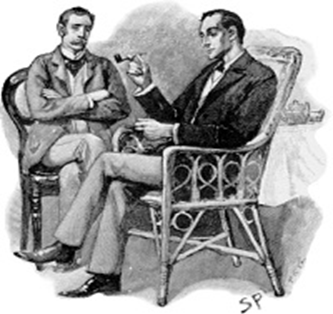

As I was reading Seneca’s letter, I was reminded of what Sherlock Holmes told his accomplice Watson in A Study in Scarlet –

I consider that a man’s brain originally is like a little empty attic, and you have to stock it with such furniture as you choose. A fool takes in all the lumber of every sort that he comes across, so that the knowledge which might be useful to him gets crowded out, or at best is jumbled up with a lot of other things so that he has a difficulty in laying his hands upon it.

Holmes added…

Now the skillful workman is very careful indeed as to what he takes into his brain-attic. he will have nothing but the tools which may help him in doing his work, but of these he has a large assortment, and all in the most perfect order. It is a mistake to think that that little room has elastic walls and can distend to any extent. Depend upon it there comes a time when for every addition of knowledge you forget something that you knew before. It is of the highest importance, therefore, not to have useless facts elbowing out the useful ones.

As years have passed, I have turned from trying my hands at speed reading – acting like Holmes’ fool who takes in all the lumber of every sort that he comes across – to slow, thoughtful reading and re-reading. Slow reading, as a wise man said, is not so much about unleashing the reader’s creativity, as uncovering the author’s.

Often, it’s the same old books – the supertexts – that I refer to again and again…for each time I go through them, I get a few new and brilliant insights that missed my eyes in the previous readings.

Don’t Read…Reread

Vladimir Nabokov, the author of Lolita tells us –

Curiously enough, one cannot read a book: one can only reread it.

When we read a book for the first time, the very process of laboriously moving our eyes from left to right, line after line, page after page, this complicated physical work upon the book, the very process of learning in terms of space and time what the book is about, this stands between us and artistic appreciation.

Only on a third or fourth reading do we start behaving toward a book as we would toward a painting, holding it all in the mind at once.

To bring back Seneca and what he wrote to Lucilius –

Be careful, however, lest this reading of many authors and books of every sort may tend to make you discursive and unsteady. You must linger among a limited number of master thinkers, and digest their works, if you would derive ideas which shall win firm hold in your mind. Everywhere means nowhere.

While it’s a good idea to read stuff across domains and authors, if you are unsure of what to start and where to focus your intellectual capacities on, consider the super-texts. Read them once, and then read them again…and again…and you will do just fine. The idea is to not be in perpetual locomotion and jump from one book or author to another. The idea is to sit back, contemplate, and relate the facts you read to each other. But start reading if you haven’t already, or you would miss out on the huge compounding benefits of the same as years pass.

[/show_to] [hide_from accesslevel=’almanack-all’]

Want to Read More? This content is exclusive for members of Value Investing Almanack. Login to read if you are a member. Else, click here to subscribe.

Benefits to VIA Members
 
  • Spotlight: Big ideas from Value Investing and why applying them in your investment decision making will be a great deal
  • InvestorInsights: Interviews with experienced value investors, learners, and deep thinkers
  • StockTalk: Thorough analysis of business models of companies (without any recommendations)
  • Behaviouronomics: Deep analysis of human behaviour and how it impacts investment decision making
  • BookWorm: Reviews of the best books on Value Investing and related subjects
  • Free Course – Financial Statement Analysis for Smart People (otherwise priced at Rs 5,900)
  • Archives: Instant access to our huge archive from the past three years
Become a VIA Member. Click to Subscribe
[/hide_from]

Super Investor: Seth Klarman on Perils of Top-Down Investing

December 30, 2016

Reading the super texts i.e., words written by legendary thinkers, investor and philosophers is something that one can never get enough of. These texts are so deep and pack such a concentrated dose of wisdom that the only way to benefit from them is to read them again and again. It’s like a giant onion with densely squeezed layers. When you’ve peeled one layer, then and only then, the juicier layer makes itself available.

Seth Klarman is one such super investor and his book Margin of Safety is that super text which needs to be read every year (at least). And every time I read it, I discover a fresh insight and wonder how I missed it during my last read. It happens because once I get a grip on one idea, it increases (slightly) my mind’s ability to receive another idea. And bit by bit, over a period, brain muscles become stronger to imbibe the deeper wisdom.

I would go as far as saying this – if an investor hasn’t read a super text multiple times, he’s as uninformed as the guy who hasn’t read it at all. Warren Buffett’s letters, Benjamin Graham’s The Intelligent Investor, Poor Charlie’s Almanack are some super texts that demand revision multiple times.

<!–more–>[show_to accesslevel=’almanack-all’]

Anyways, coming back to Margin of Safety, I was re-reading Chapter 7 titled “At the Root of a Value-Investment Philosophy” in which Klarman writes –

There are three central elements to a value-investment philosophy. First, value investing is a bottom-up strategy entailing the identification of specific undervalued investment opportunities. Second, value investing is absolute-performance, not relative-performance oriented. Finally, value investing is a risk-averse approach; attention is paid as much to what can go wrong (risk) as to what can go right (return).

In the subsequent pages, Klarman elaborates on the perils of top-down investing and how a bottom-up approach is a much more sensible strategy for a small investor. This is the section where I stumbled upon few remarkable insights which hadn’t broken through my wall of ignorance during previous readings. So, before I start listing those merits and demerits, let’s come to an agreement on the definition of bottom-up investing and what one means by top-down investing.

Top-down investing refers to the process where the investment ideas originate from macroeconomic events like a change in economic policy or an emergence of a new trend in a country or world’s economy. In the Indian context, few examples of such events include the recent decision of demonetization or a political party coming to power with an overwhelming majority. In the global context, it could be events such as the result of US presidential election or Brexit or political unrest in some countries.

In bottom-up investing, no importance is given to macroeconomic changes. The focus is on sifting through the businesses, one by one, and identifying individual investment opportunities. Bottom-up investors search for bargains business by business, analyzing each case on its own merits.

Top-Down is Highly Error Prone

The primary problem with top-down is that it requires an investor to predict the future accurately and then decide based on those predictions. Klarman writes –

“This approach is difficult and risky, being vulnerable to error at every step. Practitioners need to accurately forecast macroeconomic conditions and then correctly interpret their impact on various sectors of the overall economy, on particular industries, and finally on pecific companies.

Take the case of demonetization. When the news came out, many investors (including yours truly) started speculating about which sectors and industries will be affected (positively or negatively) because of this unexpected shock. I figured that NBFC is one industry which is heavily dependent on cash transactions so it’s a good candidate to get hit. Then I further speculated that commercial vehicle finance companies are the ones which will get adversely affected. Should I buy debt funds that own bonds of those companies? Should I directly buy the stocks of such companies? Will the companies recover from this temporary trouble and come out unscathed? Assuming the probability of my assumption being correct in each step is an optimistic 75 percent (which is a hugely overconfident assumption), getting it right finally amounts to 0.75 x 0.75 x 0.75 x 0.75 (four assumptions) i.e., 31 percent. Should I bet my hard-earned money on such a low probability event?

Let’s say that an investor manages to get all the above steps right, the issue is that market inefficiencies emanating from such macroeconomic events are extremely short lived. Seth argues –

It is also essential for top-down investors to perform this exercise quickly as well as accurately, or others may get there first and, through their buying or selling, cause prices to reflect the forecast macroeconomic developments, thereby eliminating the profit potential for latecomers…The top-down investor thus faces the daunting task of predicting the unpredictable more accurately and faster than thousands of other bright people, all of them trying to do the same thing.

Which means top-down investors are always in a hurry to act on their insights. I don’t need to convince you that any decision taken in haste is highly error prone and has very high odds to lead to future troubles. This forced urgency is an unavoidable problem in the top-down approach.

Bottom-up investing is much simpler thus less prone to error. While a top-down investor must make several accurate predictions in a row, writes Klarman, “a bottom-up investor is not in the forecasting business at all.” In fact, non-predictive decision making is a very important mental model and bottom-up investing is its clearest example. In the stock market, randomness, unpredictability, and incomplete information aren’t exceptions but a norm.

Top-Down is a Game of Expectations

Top-down investing is driven by themes or trends and top-down investors are always on the hunt for catching a big wave. They act like surfers who stand up on their surfing board whenever they anticipate an oncoming wave. Since there’s no foolproof way to predict a big wave, top-down investors get burned out by trying to get on to every little wiggle in the sea called the stock market. Moreover, it’s important to get the direction of the way right else you not only miss the wave but run the risk of getting drowned in the same wave. Klarman warns –

Another difficulty with a top-down approach is gauging the level of expectations already reflected in a company’s current share price. If you expect a business to grow 10 percent a year based on your top-down forecast and buy its stock betting on that growth, you could lose money if the market price reflects investor expectations of 15 percent growth but a lower rate is achieved. The expectations of others must therefore be considered as part of any top-down investment decision.

To exploit a trend, for most investors the focus invariably shifts from “what a business is going to do in the future” to “what would catch the fancy of other investors.” In other words, the whole idea of value goes out of the window and investing transforms into a game of guessing. When you buy a stock, believing others will soon be buying the same thing, you’re not investing. You’re speculating.

The only useful aspect of top-down view is when one is trying to assess the value of business. Among many other valuation methods, relative valuation is one where an investor tries to arrive at an estimate of a company by comparing it with other similar companies in the same industry. But that’s also done as means to challenge your own estimate and make one think harder. Other than this, the opinion of others doesn’t mean much to bottom-up investors.

The Cash Confusion

A lot of top-down investors hold cash to time the market which is again an error-prone approach and a slave to accurate predictions.

Bottom-up investors hold cash when they are unable to find attractive investment opportunities and put cash to work when such opportunities appear. A bottom-up investor chooses to be fully invested only when a diversified portfolio of attractive investments is available. Top-down investors, by contrast, may attempt to time the market, something bottom-up investors do not do. Market timing involves making a judgment about the overall market direction; when top-down investors believe the market will decline, they sell stocks to hold cash, awaiting a more bullish opinion.

John Maynard Keynes’ once warned – “The market can remain irrational longer than you can remain solvent.” His warning was for those who use leverage to time the market. I think Keynes’ advice can be extended for cash also. Remember, if you’re holding cash hoping for a crash, it may not come before your patience runs out.

If you permit me, I would like to modify the adage to – “The market can remain irrational longer than you can remain hopeful.” Don’t let the distant hope of a market crash stop you from investing in a great business.

The Difficult Sell Decision

A Japanese knight and a Korean warrior were in a vicious sword fight. After first few minutes, the knight makes a surprise move and swings his katana across the warrior’s face.

The Korean exclaims, “You missed!”

“Wait till you shake your head,” replies the knight.

The moral of the story is that sometimes it’s too late to realize that you made a mistake.

One of the reasons why an investor should sell a stock is when he or she realizes that his or her hypothesis is wrong or things have taken a bad turn. In other words, when you identify your mistake first thing you do is sell your position. If you don’t you’re just compounding the mistake and making it more severe. Klarman writes –

Top-down investors may find it difficult to know when their bet is no longer valid. If you invest based on a judgment that interest rates will decline but they rise instead, how and when do you decide that you were wrong?

Your bet may eventually prove correct, but then again it may not. Unlike judgments about value that can easily be reaffirmed, the possible grounds for reversing an investment decision that was made based upon a top-down prediction of the future are simply not clear.

Conclusion

As per Klarman, the heart of bottom-up investing is this –

The entire strategy can be concisely described as “buy a bargain and wait.” Investors must learn to assess value in order to know a bargain when they see one. Then they must exhibit the patience and discipline to wait a until a bargain emerges from their searches and buy it, regardless of the prevailing direction of the market or their own views about the economy at large.

Bottom-up investing may be a subset of value investing and lot of accomplished and wise value investors may not practice bottom-up investing all the time. However, if you are a small investor, then bottom-up investing is the safest and smartest option for you.

[/show_to] [hide_from accesslevel=’almanack-all’]

Want to Read More? This content is exclusive for members of Value Investing Almanack. Login to read if you are a member. Else, click here to subscribe.

Benefits to VIA Members
 
  • Spotlight: Big ideas from Value Investing and why applying them in your investment decision making will be a great deal
  • InvestorInsights: Interviews with experienced value investors, learners, and deep thinkers
  • StockTalk: Thorough analysis of business models of companies (without any recommendations)
  • Behaviouronomics: Deep analysis of human behaviour and how it impacts investment decision making
  • BookWorm: Reviews of the best books on Value Investing and related subjects
  • Free Course – Financial Statement Analysis for Smart People (otherwise priced at Rs 5,900)
  • Archives: Instant access to our huge archive from the past three years

Become a VIA Member. Click to Subscribe
[/hide_from]

Spotlight: If You Can’t Imagine, You Mustn’t Invest in the Stock Market

December 29, 2016

Apart from observation and deduction, if there’s an important skill that an investor or analyst must bring to the table while making investment decisions, it is ‘imagination’. It is, after all, imagination that helps us make relevant connections that are not entirely obvious, between data or information about a business that may appear disparate at first.

Logic will get you from A to B. Imagination will take you everywhere. ~ Albert Einstein

First comes thought; then organization of that thought, into ideas and plans; then transformation of those plans into reality. The beginning, as you will observe, is in your imagination. ~ Napoleon Hill

Having a five-year-old means that I’m always attuned to what’s new in kids’ entertainment – whether it’s books, movies, or YouTube videos. So, while browsing through the video library on my laptop some days back, I came across this video that was created to celebrate the 150th anniversary of Lewis Carrol’s children’s classic, Alice’s Adventures in Wonderland.

The emphasis in this video was on the use of imagination. The first scene presented Alice and her entire family having a Her family endeavour to convince her otherwise, pointing to possible mundane things that can become magical in their opening song: the rabbits in the field, the father’s pack of cards, or a caterpillar (of course prefiguring some of the best-known scenes in the book). And sure enough, the white rabbit appears, prompting Alice to follow him down the rabbit hole.
[Read more…] about Spotlight: If You Can’t Imagine, You Mustn’t Invest in the Stock Market

InvestorInsights: Jason Zweig

December 20, 2016

Jason Zweig is the investing and personal-finance columnist for The Wall Street Journal.  He is the author of The Devil’s Financial Dictionary, a satirical glossary of Wall Street (PublicAffairs Books, 2015), and Your Money and Your Brain, on the neuroscience of investing (Simon & Schuster, 2007).

 Zweig edited the revised edition of Benjamin Graham’s The Intelligent Investor (HarperCollins, 2003), the classic text that Warren Buffett has described as “by far the best book about investing ever written.” Zweig also wrote The Little Book of Safe Money (Wiley, 2009); co-edited Benjamin Graham: Building a Profession, an anthology of Graham’s essays (McGraw Hill, 2010); and assisted the Nobel Prize-winning psychologist Daniel Kahneman in writing his book Thinking, Fast and Slow. From 1995 through 2008 Zweig was a senior writer for Money magazine; before joining Money, he was the mutual funds editor at Forbes.

[Read more…] about InvestorInsights: Jason Zweig

BookWorm: Shoe Dog

December 15, 2016

Phil Knight’s candid and riveting memoir of how he built Nike from scratch. Knight shares the inside story of the company’s early days as a fearless start-up and its evolution into one of the world’s most iconic, game-changing, and profitable brands.

It was 2005 when I bought my first pair of Nike. I wore them to work, for running, for outings and almost everywhere. I waited five years for those pairs to get torn so that I could buy new ones. They never did. Sturdy brats! I eventually donated them to make way for the new ones – another Nike – and since then I have never used any other brand.

I am sure millions trust Nike for its comfort, sturdiness, innovative designs, and cutting edge technology. Nike’s reputation is simply unparalleled. Its trademark – the swoosh – is more than a logo. It’s one of the few icons instantly recognized in every corner of the world.

However, I never knew that Nike was the brainchild of one man, himself an athlete. He borrowed fifty dollars from his father and launched a company with one simple mission: import high-quality, low-cost running shoes from Japan.

The man was Phil Knight. And  Shoe Dog is Knight’s candid and riveting memoir. He shares the inside story of Nike’s early days as a fearless start-up and its evolution into one of the world’s most iconic, game-changing, and profitable brands. Shoe Dog is nothing less than a business thriller and perhaps the best business book that I have ever read.

[Read more…] about BookWorm: Shoe Dog

  • « Go to Previous Page
  • Page 1
  • Interim pages omitted …
  • Page 43
  • Page 44
  • Page 45
  • Page 46
  • Page 47
  • Interim pages omitted …
  • Page 72
  • Go to Next Page »

Handcrafted with in India