
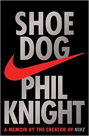
Phil Knight’s candid and riveting memoir of how he built Nike from scratch. Knight shares the inside story of the company’s early days as a fearless start-up and its evolution into one of the world’s most iconic, game-changing, and profitable brands.
It was 2005 when I bought my first pair of Nike. I wore them to work, for running, for outings and almost everywhere. I waited five years for those pairs to get torn so that I could buy new ones. They never did. Sturdy brats! I eventually donated them to make way for the new ones – another Nike – and since then I have never used any other brand.
I am sure millions trust Nike for its comfort, sturdiness, innovative designs, and cutting edge technology. Nike’s reputation is simply unparalleled. Its trademark – the swoosh – is more than a logo. It’s one of the few icons instantly recognized in every corner of the world.
However, I never knew that Nike was the brainchild of one man, himself an athlete. He borrowed fifty dollars from his father and launched a company with one simple mission: import high-quality, low-cost running shoes from Japan.
The man was Phil Knight. And Shoe Dog is Knight’s candid and riveting memoir. He shares the inside story of Nike’s early days as a fearless start-up and its evolution into one of the world’s most iconic, game-changing, and profitable brands. Shoe Dog is nothing less than a business thriller and perhaps the best business book that I have ever read.
[show_to accesslevel=’almanack-all’] In 1962, Knight started selling shoes from the trunk of his beaten up car. In the first year, Knight’s company, which was called Blue Ribbon back then, grossed eight thousand dollars. Today, Nike’s annual sales top $30 billion.
Bill Gates recently recommended this book on his blog. . He writes –
Shoe Dog, is a refreshingly honest reminder of what the path to business success really looks like: messy, precarious, and riddled with mistakes.
Shoe dog is an autobiography in its purest form. Unlike most biographies, this one doesn’t come with any clear-cut lessons. It’s obvious that the author’s intention was never to teach the reader anything. There are no tips, no bullet points, no checklists about how to be a successful entrepreneur. Nevertheless, I picked up few ideas while reading the book. Here are some of my learnings from Knight’s memoir.
Have A Beginner’s Mind
Phil’s book starts with a quote from Shunryu Suzuki -In the beginner’s mind there are many possibilities, but in the expert’s mind there are few.
When Blue Ribbon started, Adidas, a German company, was an established brand among athletes. Adidas had already been dominating the shoe market for a couple of decades. But Knight’s advantage was about having a beginner’s mind. He was willing to experiment and stay on the edge. Adidas had much to lose in terms of its reputation, leadership, money etc. But for Nike, every step was either do or die.
In fact, the brand Nike was born because Knight’s primary Japanese supplier cut him off abruptly. Knight started all over again with a new brand i.e. Nike. And in matter of few decades, Nike was bigger than Adidas.
Let People Surprise You
The first-full time employee hired by Knight was a guy called Jeff Johnson, an old acquaintance from Knight’s Stanford days. Jeff, an athlete himself, was selling Adidas shoes before he started working for Phil at Blue Ribbon. Johnson was constantly coming up with ideas for the company and wanted to talk to Phil about every small decision. However, Phil believed in the philosophy – Don’t tell people how to do things, tell them what to do and let them surprise you with their results. And that’s the strategy Phil adopted not just with Johnson but with all his employees later. Knight recalls –
The typical Johnson letter would invariably close with a lament, either sarcastic or pointedly earnest, about my failure to respond to his previous letter. And the one before that, etc…Don’t tell people how to do things, tell them what to do and let them surprise you with their results. So I didn’t answer Johnson, and I didn’t pester him. Having told him what to do, I hoped that he would surprise me…To Johnson’s credit, though he craved more communication, he never let the lack of it discourage him. On the contrary, it motivated him…he saw that my managerial style gave him freedom. Left to do as he pleased, he responded with boundless creativity and energy. He worked seven days a week, selling and promoting Blue Ribbon.
You Can’t Build Something Big Alone
At every step of Knight’s story, at every challenge, there was someone else who helped him overcome the situation. Johnson, the first employee, who obsessively wrote letters to Knight, was the guy who came with the name ‘Nike’. Woodell, a former track star paralyzed after a boating accident, became Blue Ribbons’s second employee and took care of the operations single-handedly for the first decade. Knight’s coach, Bowerman, was not only his partner but instrumental in improving Nike’s design over the years. Hayes, who Knight met while working in PriceWaterhouse, helped him sail through all the accounting and finance related challenges.
It was an odd mix of employees Knight pulled together to start his company. They were all problem solvers and shared a common passion.
Do You Believe in Your Work/Product?
Nike’s star athlete, Prefontaine, had an untimely death. Right at the time Nike needed loans to support its exponential growth, its bankers closed their accounts. Blue Ribbon’s original Japanese suppliers sued Knight. These were just a few of the many terrifying risks Knight faced along the way. But what made Knight persist was his passion for running. He believed in Nike shoes and he believed that running isn’t just a sport for professional athletes. He turned running into a mainstream activity for everyone. He writes –
Driving back to Portland I’d puzzle over my sudden success at selling. I’d been unable to sell encyclopedias, and I’d despised it to boot. I’d been slightly better at selling mutual funds, but I’d felt dead inside. So why was selling shoes so different? Because, I realized, it wasn’t selling. I believed in running. I believed that if people got out and ran a few miles every day, the world would be a better place, and I believed these shoes were better to run in. People, sensing my belief, wanted some of that belief for themselves. Belief, I decided. Belief is irresistible.

In spite of his stressful days, he rarely missed his evening 6-mile run. He never forgot why he was building the business. It was for the love of running.
Give Luck Its Due Credit
Building a billion dollar business takes more than just hard work and intelligence. You need lots of luck and Knight was fortunate to have loads of it. But what’s special about him is that he acknowledges it very honestly in his book. In fact, his narrative gives an impression that Knight himself was quite amazed at the streak of fortunate events that helped him in his journey.
Recently an Indian e-commerce company spent a whopping a Rs. 200 crore on rebranding their logo and design. Knight paid an art student $35 to design the famous Nike swoosh logo. He didn’t recognize what a special logo it would become. “It’ll have to do,” he said at the time. The decision to call the company Nike was also not Knight’s top choice. He wanted to name it Dimension Six, but his employees pushed him to choose Nike. At the time, Knight agreed but he was not convinced. “Maybe it will grow on us,” he said.
Knight is amazingly honest about the accidental nature of his company’s success, and that’s the most important quality of lucky people. They consider themselves lucky and are grateful for it.
Giving Up Control
Right from its inception, Nike’s business was growing at breakneck speed. For the first decade, he was almost doubling his sales every year. This rapid growth required a huge amount of working capital which came as credit from the banks since there weren’t any venture capitalists in Knight’s time to fund the growth. He could have gone public and raised money but Knight knew how important it was to build the company without any external pressure.
The moment a company goes public, CEOs waste a lot of time answering the public shareholder and institutional investors who usually have little interest in long-term growth of the business. Going public usually means giving up control of your company. Ford Motor did not go public until 1956—a half-century after its founding. Ford stayed private for as long as possible because Henry Ford did not like people telling him what to do. When Edsel Ford attempted to prod his father to take the company public, Henry Ford replied, according to biographers: “I’ll take every factory down brick by brick before I let any of those speculators get stock in the company.”
Today, the success of a startup is known by the size of its VC funding. By the time these startups are done with their series A, B, C…Z funding, the founders’ stake dwindles down to negligible amount and so does their interest in the business.
Knight didn’t allow Nike to go public for first 18 years of operations. This meant Knight was always short of cash and at the mercy of hostile bankers. But this cash crunch, instead of becoming an impediment, brought forward Knight’s creativity and resourcefulness in managing funds. In 1980, Nike did finally go public and in an instant Knight’s net worth jumped to $178 million. Coincidentally, Apple was another company which went public on the same day as Nike.
Conclusion
The book is deeply personal and authentic. The only two things that drove Knight through all the ups and downs of building a worldwide business was his passion for running and his strong desire to create something of his own. Something he could point to and say, “I built this.”
Until this book came out, Knight had always been a mystery. But with this beautifully crafted story, the world now knows how one of the strongest brands came into existence. Reading business biographies makes the businesses look more humane because you get a chance to put a real face behind the inanimate business. Now, whenever I see the swoosh, I can’t help but imagine the blood and sweat that went into it. It makes me appreciate the power of human creativity and enterprising spirit.
In the final pages, despite all of the hardships he experienced along the way, Knight says, “God, how I wish I could relive the whole thing.” And I too wanted to say, “God, I want to read this book again and again.”
[/show_to] [hide_from accesslevel=’almanack-all’]- Spotlight: Big ideas from Value Investing and why applying them in your investment decision making will be a great deal
- InvestorInsights: Interviews with experienced value investors, learners, and deep thinkers
- StockTalk: Thorough analysis of business models of companies (without any recommendations)
- Behaviouronomics: Deep analysis of human behaviour and how it impacts investment decision making
- BookWorm: Reviews of the best books on Value Investing and related subjects
- Free Course – Financial Statement Analysis for Smart People (otherwise priced at Rs 5,900)
- Archives: Instant access to our huge archive from the past three years