• Skip to primary navigation
  • Skip to main content

The One Percent Almanack

Wit and Wisdom on Investing, Business, and Life

  • Home
  • Members
  • Log In
  • Show Search
Hide Search

Special Report

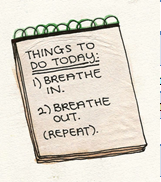
Life 2.0: Breathe In, Breathe Out

August 29, 2015

Some of the greatest things, the greatest discoveries, have come about by serendipity. Let’s explore its magic here.

Few years back while working with a colleague in his cubicle, I noticed that a reminder would pop up on his screen every 10 minutes with just one word written on it – Breathe. I tried ignoring it initially but after some time I had to ask him, “Dude! Do you really need to remind yourself to breathe?”

“It’s not just about breathing!” he replied with a smile.

“Care to throw some light?” I asked him.

He started explaining, “Of course, I don’t need to remind myself to breathe. Nobody needs to. Everyone knows how to breathe. It is something that occurs to us automatically, spontaneously, and naturally. We are breathing even when we are not aware of it.

“However, I do need to remind myself to breathe properly,” he continued, “You might find it foolish that there is a proper and improper way of breathing. I mean how hard is it? Just breathe in, and breathe out. Right?”

“Yeah, right.” I said.

“Wrong! The truth is that most people don’t realize the power of breath. If done properly it can increase your energy and productivity manifolds,” he said.

I was intrigued with his statement, but before he could tell me more about it he had to leave for a meeting. But I couldn’t wait so I went ahead and started reading and researching on my own on this and what I found was remarkably profound and life changing.

Control Switch for Physiology

I guess you would agree with me that our behavior influences our performance and the results we produce.

Now what defines our behaviour? Our thoughts. Isn’t it?

And thoughts are governed by feelings which in turn are controlled by our emotions. Our emotions take shape based on our physiology – health, general state of well-being, breathing, heart-rate, etc. Now this isn’t something new and you probably know about this already.

Most of our physiology is largely seen as an effect rather than cause. A common belief is that our physiology can’t be controlled or changed immediately. But there is one thing which is in our control that can control a lot of other involuntary activities like heart rate, body temperature, etc. And that control button is how you breathe.

Let me share some interesting trivia about where else breathing is a well-known tool for performance.

Tennis players use a certain pattern of bouncing the ball or a breathing pattern to put them in an optimum state of mind also referred as ‘the zone’. Right breathing is an effective tool for not just every sportsperson but for many actors and stage artists also.

Ask any accomplished actor and he will tell you that dialogue delivery is all about breathing in a certain way. I remember Aamir Khan talking about how he can induce an emotion in his body just by changing his breathing patterns. That’s what separates him from others – he doesn’t just act but actually lives the character.
[Read more…] about Life 2.0: Breathe In, Breathe Out

BookWorm: Antifragile – Part 1

July 30, 2015

Antifragile, written by Nassim Nicholas Taleb, contains more than four hundred pages (excluding the appendix) of densely packed insights and concentrated doses of ideas. And it would be very hard for me, and unfair to you, if I try to squeeze in all the learning from this book in one article.

So I am going to split this BookWorm post into multiple parts. This is the first part. We will be covering the second part (and more, if required) in subsequent VIA issues.

Nassim Taleb is one of my favourite authors. Before Antifragile he had authored two other best-selling books – The Black Swan and Fooled by Randomness, both of which are also must-reads. In fact, all three books are quite related to each other, like a trilogy. Many of the ideas that Taleb wrote about in his earlier two books, have found their logical conclusion in Antifragile.

<!–more–>

Want to Read More? This content is exclusive for members of Value Investing Almanack. Login to read if you are a member. Else, click here to subscribe.

Benefits to VIA Members
 
  • Spotlight: Big ideas from Value Investing and why applying them in your investment decision making will be a great deal
  • InvestorInsights: Interviews with experienced value investors, learners, and deep thinkers
  • StockTalk: Thorough analysis of business models of companies (without any recommendations)
  • Behaviouronomics: Deep analysis of human behaviour and how it impacts investment decision making
  • BookWorm: Reviews of the best books on Value Investing and related subjects
  • Free Course – Financial Statement Analysis for Smart People (otherwise priced at Rs 5,900)
  • Archives: Instant access to our huge archive from the past three years
Become a VIA Member. Click to Subscribe

Industry Scan: Hotels

July 30, 2015

It was sometime in 2006, when I first visited Bangalore, and went to meet a friend at Leela Palace. I was in awe of the property – it was grand, and amazingly beautiful. On enquiring, I got to know that the hotel was one of the most expensive locations in India and was still completely booked for the next few months.

The story was same everywhere – most of Leela’s properties were booked for months, despite their premium pricing.

“What an amazing business!” I told myself. “Just imagine the kind of profits these guys must be making. I must have this stock in my portfolio!”

The next day, without trying to know more about the economics of the hotel industry and Leela’s business and financial performance, I bought the stock, expecting it to be a story that was waiting to be unveiled.

Well, it was indeed a story waiting to be unveiled…and for me!

<!–more–>

Want to Read More? This content is exclusive for members of Value Investing Almanack. Login to read if you are a member. Else, click here to subscribe.

Benefits to VIA Members
 
  • Spotlight: Big ideas from Value Investing and why applying them in your investment decision making will be a great deal
  • InvestorInsights: Interviews with experienced value investors, learners, and deep thinkers
  • StockTalk: Thorough analysis of business models of companies (without any recommendations)
  • Behaviouronomics: Deep analysis of human behaviour and how it impacts investment decision making
  • BookWorm: Reviews of the best books on Value Investing and related subjects
  • Free Course – Financial Statement Analysis for Smart People (otherwise priced at Rs 5,900)
  • Archives: Instant access to our huge archive from the past three years
Become a VIA Member. Click to Subscribe

Life 2.0: Sleep

July 29, 2015

Some of the greatest things, the greatest discoveries, have come about by serendipity. Let’s explore its magic here
A wise man once said, “Your future depends on your dreams.” to which a not-so-wise man replied, “So go to sleep”.

That’s an old joke but I believe that there may be some element of truth to it. After all if we spend a third of our lives sleeping, the nature must have a crucial design principle behind it.

I am sure everybody has experienced sleep deprival. Can you recall few such instances in your life? Let me help you – remember those all night movie marathons during college days? Or those night outs spent chatting with your buddies for hours together.

Well, not every night out is for fun. How about those do-or-die project deadlines with unlimited supply of pizzas and coffee but very limited supply of time and tolerance for mistakes?

The only common thread at the end of these kinds of events, apart from bloody red eyes and tired mind, is a burning desire to find a bed and just crash.

Ideally, you shouldn’t lose your sleep over harmful effects of sleep deprival (pun intended), unless it becomes a regular feature of your routine.

On 21st Oct. 2009, 42-year old Ranjan Das, CEO of SAP-Indian Subcontinent and the youngest CEO of an MNC in India, collapsed and died after suffering a massive heart attack. He had returned home after completing a workout at the gym.

Perhaps his body was not prepared to handle overexertion? Actually no! He was as fit as anybody could be at his age. He was very active in sports, was a fitness freak and a marathon runner. So why did an exceptionally active, athletic person succumb to heart attack at a relatively younger age.
[Read more…] about Life 2.0: Sleep

Moats: Some More Thoughts

July 3, 2015

What’s interesting about moat is that if a moat needs to be continuously built, it isn’t a moat at all. How do you know if you’re paying up or overpaying for the moat? This time we invert the conundrum of moat to explore the symptoms of false-moat trap.

Over the past few months, I have spent considerable time studying about business, their longevities, moats, what helps them sustain, and what dilutes them over time.

As an investor in stocks, studying what makes a few businesses really great and their moats sustain over a long period of time, and on the other hand, what makes a majority of businesses bad and their moats, if any, fleeting has been an interesting aspect of my work.

So, while I have not yet arrived at any Eureka moment on how and why some moats sustain over a long period of time, and how can one identify in advance when a moat is shrinking, there have been some thoughts that I have formed through such reading.

I had shared some of those thoughts in my last post in the June 2015 Special Report. This post is a continuation of what else I have learned about moats, and especially about the dark side of investing in either emerging moats or ones that have already had a proven past.

I’m sure you may be wondering, “What could be the dark side of moats?”

Well, without trying to lay down any clear theories on the same, what I will be sharing below are just a few thoughts on the risks of investing in moats that you must keep in mind when you are buying such businesses that seem to be in their full glory and not destined to failure in the future.

But then, like s**t happens in real life, it often happens when it comes to investing…and that’s what makes it such an interesting game where you must keep learning…and evolving.

Let’s Start with…Destruction

When changes in the natural environment accelerate, so do the extinction rates of the Earth’s creatures. It happened to the dinosaurs and again to many species during the Ice Age. Many scientists believe we may be entering another such period.
[Read more…] about Moats: Some More Thoughts

  • « Go to Previous Page
  • Go to page 1
  • Interim pages omitted …
  • Go to page 14
  • Go to page 15
  • Go to page 16
  • Go to page 17
  • Go to page 18
  • Interim pages omitted …
  • Go to page 20
  • Go to Next Page »

Handcrafted with in India