It was sometime in 2006, when I first visited Bangalore, and went to meet a friend at Leela Palace. I was in awe of the property – it was grand, and amazingly beautiful. On enquiring, I got to know that the hotel was one of the most expensive locations in India and was still completely booked for the next few months.
The story was same everywhere – most of Leela’s properties were booked for months, despite their premium pricing.
“What an amazing business!” I told myself. “Just imagine the kind of profits these guys must be making. I must have this stock in my portfolio!”
The next day, without trying to know more about the economics of the hotel industry and Leela’s business and financial performance, I bought the stock, expecting it to be a story that was waiting to be unveiled.
Well, it was indeed a story waiting to be unveiled…and for me!
<!–more–>[show_to accesslevel=’almanack-all’]
When I glanced through the company’s annual report after buying its stock, I saw a business that had been high on debt and low on returns in the past – indicating a management that had been reckless in capital allocation and was willing to put its company on high risk to grow its business.
Anyways, by the time I accepted the fact that I had made a huge mistake of speculating on the stock without knowing that I did not know about its business, the stock was already down around 45% from my purchase price.
With a heavy heart, I sold it off, and thankfully so…as the stock is down another 40% since then, not to forget the time I would have lost owning it.
And not just Leela, almost all the stocks listed in the Indian hotel industry have been wealth destroyers over the past decade.
The largest hotel chain in the country, Indian Hotels, for instance has returned just about 3.5% annual return in the last 10 years. And the reason is not far to fetch – the business has been bad, in fact, gotten from bad to worse.
The problem is not in terms of volume – the number of tourists – domestic and international, business and leisure – has grown at a pace of around 6-7% over the last 15 years. The problem is also not in terms of realizations. Though they have fallen over the past few years, hotels in India are amongst the most expensive in the world, thanks to low supply of quality rooms.
The chief problem the hotels industry suffers from is capital intensity – it’s highly capital intensive (though it works on negative working capital). Huge amount of money needs to be spent on purchasing real estate, constructing a hotel, and then on maintaining and improving it. Plus, this money has cost.
Now, despite Indian hotels earning good gross and operating margins, the situation has been troublesome over the past few years at the net profit level, with most companies reporting net losses. The issue is high depreciation and interest costs.
Consider the first table on the following page from Indian Hotels, which suggests how interest and depreciation has almost eaten into the company’s profits over the past few years.
The situation is no different for EIH (though relatively better than Indian Hotels), another leading Indian hospitality chain (see the second table on the next page).

Now, consider the debt situation of Indian Hotels…

How does a business make money in good times or bad with such a balance sheet? It’s really difficult, as has been proved by most Indian hotel companies over the past few years. And that’s why it has been such a terrible business to own as an investor…and continues to be.
How to Value Hotel Stocks?
It’s difficult, using common valuation techniques like P/E of DCF. Both the E and CF are highly volatile and uncertain.
Since the business is not that good, and if you still wish to value it, you may use my 50,000 Rule. And what’s the rule? It’s simple! Take a price of a can of Coke from the hotel mini-bar and multiply it by 50,000. So if the Coke is priced at Rs 200 per can, the value of every room of the hotel should be around Rs 1 crore. Multiply that by the number of rooms and you have a back of the envelope calculation for the hotel’s valuation.
For instance, if I were to value Indian Hotels this way, considering their room inventory of 15,750 rooms and assuming the average price of a Coke cans in its rooms is around Rs 200, the stock’s valuation should be around Rs 200 x 50,000 x 15,750 = Rs 158 billion. On a per share basis, that’s around Rs 195 per share, or 2x the stock’s current price. But you don’t need to believe this rule. 🙂
On a serious note, one way to value hotels stocks is on NAV or net asset value, or the amount it would take for someone else to set up the same properties as the hotel business being considered. In this method, you need to estimate the cost of setting up a typical hotel room, add cash and investments in the company’s balance sheet, and reduce debt. Divide the result by number of shares, and you get the NAV per share for the hotel.
Using this formula for Indian Hotels, here is how it stacks up –
• Cost of setting up a hotel room for Indian Hotels = Approx. Rs 1.5 crore (it’s around Rs 3.5 crore per room for a 5-star hotel property, but the company also owns budget properties like Ginger)
• Total number of rooms = 15,750
• Cash and Investments at the end of FY15 = Rs 1,050 crore
• Total Debt at the end of FY15 = Rs 4,630 crore
• Shares outstanding = 80.7 crore
Using these numbers, NAV for Indian Hotels will be = (1.5 x 15,750) + 1,050 – 4,630 = Rs 20,045 crore. And NAV per share = 20,045 / 80.7 = Rs 248 per share. The stock is currently trading at less than Rs 98 per share.
Now, please don’t go all out and buy Indian Hotels’ stock, given my above calculations because, as they say, the best software for creating fiction is not Word, but Excel. And I just used an Excel to calculate the above valuations.
Replacement cost as calculated by the NAV method above is a great tool but we need to ask this first – Would I replace this asset as a businessman if I had all the money in the world?
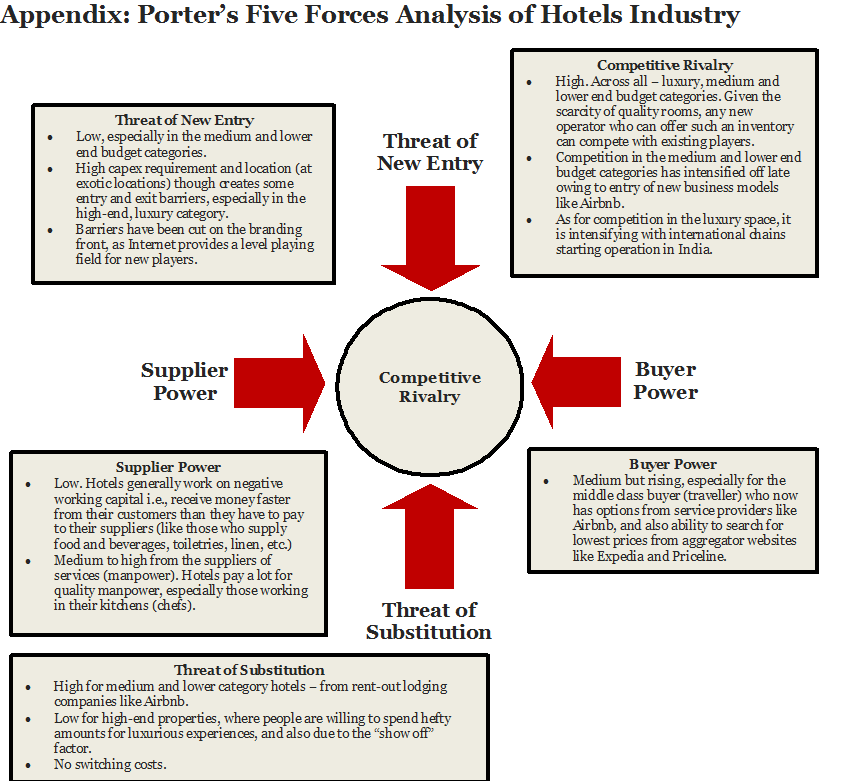
You see, the hotel industry in India with all the headwinds of an economic slowdown, overcapacity, competition, threat from substitutes (home stays, serviced apartments and other affordable staying options), competition to food and beverages business from the high end standalone eateries, high capital intensity, high fixed operating costs and a lot of recurring maintenance capex makes it difficult to figure out the strength of the hotels business. And now the online aggregators are further threatening to take away some part of the pricing power of these hotels.
A great business should have something special, something different to have pricing power in the long run. In my view, the hotel industry in India doesn’t have that. Of course, one tailwind which can happen to the hotels business is sharp recovery in the economy and a surge in the tourists and business travellers’ arrivals. Operating leverage will work in the favour of hotels in that case.
But, it’s important for you as an investor to focus more on the evaluation of a business than its valuation i.e., whether the business lies in the spot where you can make an attempt to value it. If you feel that you don’t understand the business or you are uncomfortable about the business, please don’t try to value it.
Statutory Warning: This is NOT an investment advice to buy or sell shares. Please make your own decision, as blindly acting on anyone else’s research and opinions can be injurious to your wealth. I do not own any stocks discussed above, but despite this, my analysis may be biased, and wrong. I have been wrong many times in the past. I am a registered Research Analyst as per SEBI (Research Analyst) Regulations, 2014 (Registration No. INH000000578).
- Spotlight: Big ideas from Value Investing and why applying them in your investment decision making will be a great deal
- InvestorInsights: Interviews with experienced value investors, learners, and deep thinkers
- StockTalk: Thorough analysis of business models of companies (without any recommendations)
- Behaviouronomics: Deep analysis of human behaviour and how it impacts investment decision making
- BookWorm: Reviews of the best books on Value Investing and related subjects
- Free Course – Financial Statement Analysis for Smart People (otherwise priced at Rs 5,900)
- Archives: Instant access to our huge archive from the past three years