• Skip to primary navigation
  • Skip to main content

The One Percent Almanack

Wit and Wisdom on Investing, Business, and Life

  • Home
  • Members
  • Log In|Log Out
  • Show Search
Hide Search

InvestorInsights: Swanand Kelkar

September 15, 2015

Swanand Kelkar, a professional money manager talks about his journey into the world of investing and shares his insights about picking great businesses.

Swanand Kelkar is Executive Director at Morgan Stanley and portfolio advisor for Indian equities. He joined Morgan Stanley in 2007 and has 10 years of investment experience. Prior to joining the firm, he worked in the equity investment department at HSBC Asset Management. Swanand received his Bachelor’s degree in commerce from the University of Mumbai and an M.B.A. from the Indian Institute of Management, Ahmedabad. He is also an associate member of the Institute of Chartered Accountants of India. Swanand writes a regular column for the Mint newspaper on investing and markets.

Safal Niveshak (SN): Could you tell us a little about your background, how you got interested in investing, and how you’ve evolved over time as an investor?

Swanand Kelkar (SK): I was born and brought up here in Mumbai and my parents were teachers. I am a Chartered Accountant and then went on to do my MBA from IIM Ahmedabad.

Ever since I was a kid, I had this fascination about seeing money grow. Most of my friends used to spend their pocket money but I used to save as much as I could and lend it within my family at usurious rates of interest. My family would playfully indulge me and this bug of seeing a hundred rupees become hundred and ten bit me for life.

My career choices, as you can see, have been related to this. I personally started investing in the equity markets as a twenty year old at the peak of the TMT bubble. Like a classic novice investor, I got sucked in at the top, invested based on hearsay and lost my shirt (two months’ worth of articleship stipend, which seemed like a fortune then). It was baptism by fire really.

It was during my MBA days that I began to figure out the method behind the madness and started understanding the difference between investing and speculation. My tiny portfolio started doing well (it was 2003) and I gained some confidence. I wanted to get into something related to equities after MBA which would convert my passion into my day job. Luckily, I got into the buy side and have now been a professional investor for over ten years, of which eight years were at Morgan Stanley Investment Management.
[Read more…] about InvestorInsights: Swanand Kelkar
BookWorm: The Little Book of Talent

September 10, 2015

An overview of one of the best books about the mental model of Deliberate Practice. If you want to become a better reader and thinker, this is a must read.

“I don’t count my situps, I only start counting when it starts hurting, when I feel pain, that’s when I start counting, because that’s when it really counts.”

I think you can guess who must have said this. The confidence and attitude oozing out of this sentence says that it could be none other than the greatest pugilist that the world has ever seen in the history of boxing – Muhammad Ali.

Ali began training at the age of 12 and won the world championship when he was 22 years old. A child prodigy, born with a gift for throwing lightning fast punches. But was he really born wearing boxing gloves and a knack for knocking people out? Of course not.

Multiple researches have established that talent is determined far less by our genes and far more by our actions: specifically the combination of intensive practice and motivation that produces brain growth.

Ali earned his talent by sweating out countless hours, practicing each and every move, working on his stamina and training his mind. He probably raked in more than ten thousand hours of practice much before he was 22.

The rule of ‘ten thousand hours’, a scientific finding, says that all world-class experts in every field have spent a minimum of ten thousand hours intensively practicing their craft. That’s how a talent is built. This 10,000 hour heuristics was made popular by Malcolm Gladwell’s book Outliers.

So, does it mean anybody who spends ten thousand hours doing something will become a world class expert in that activity? Of course not. There is more to the rule than the number 10,000. It’s Deliberate Practice which holds the key to developing expert level skills.

Deliberate Practice is defined as the form of learning which fuses the notion of attentive repetition with the willingness to operate on the edge of your ability, aiming for targets that are just out of reach. That’s what Muhammad Ali meant when he said – “I don’t count my sit-ups. I only start counting when it starts hurting, when I feel the pain…”

The idea is that development of skill is nothing but brain development. With quality practice, brain builds new and stronger neural pathways that result in dexterity in the skill.

Most of the professional sports people and performers have access to cutting edge techniques for harnessing Deliberate Practice, but majority of us don’t really have that luxury. In fact, how many of us really want to competeand perform at the world class expert level? I guess not many.
[Read more…] about BookWorm: The Little Book of Talent

Behaviouronomics: Illusion of Control

September 5, 2015

False understanding of the world around you can lead you to an illusion where you think you have more control on the things which are truly random.

Happiness and freedom begin with a clear understanding of one principle. Some things are within your control and somethings are not.” ~ Epictetus

Every day, shortly before nine o’clock, a man with a red hat stands in a square and begins to wave his cap around wildly. After five minutes he disappears.

One day, a policeman comes up to him and asks: “Sir! May I ask what you are doing?”

“I’m keeping the giraffes away,” replies the man.

The puzzled police man looks around and tells him, “But there aren’t any giraffes here.”

“Well, I must be doing a good job, then.”

You can safely assume that the man with the red hat wasn’t in the pink of his mental health but is it just a case of misplaced understanding of causation vs correlation? Actually there is more to it. The man is convinced that absence of evidence (giraffes) proves his prowess in controlling the giraffes. The man suffers from what is known as…

Illusion of Control (IOC)

IOC is basically the tendency to believe that we can influence something over which we have absolutely no sway. Where does this behavioural quirk come from? In millions of years of evolution, Mother Nature has hard wired this cognitive bias in human brain to increase the chances of survival in a hunter gatherer environment. It’s nature’s way to deal with uncertainty.

As a result of inability to deal with unknown, cognitive stress is created, and to avoid this stress the human mind tries to get rid of uncertainty, even if it means being wrong. IOC is a nice trick to get rid of this uncertainty.

Having a sense of control over the future has long been considered a fundamental motive and a highly adaptive trait for humans. It is well established that an absence of perceived control leads to depression, pessimism, and withdrawal from challenging situations. In contrast, possessing a general sense of control leads to self-esteem and optimism. Without any sense of control it would be difficult to carry out basic tasks. For that matter, it’s good to have an illusion (confidence) that you would be able to drive back from office to home.
[Read more…] about Behaviouronomics: Illusion of Control

Spotlight: Value Investing During Turbulence

September 3, 2015

The current volatility in the market is creating unfounded panic but at the same time it holds the dangers for others to start loading up recklessly. We explore the current market turbulence in the light of age old wisdom from Buffett and Klarman.

“I don’t know and I don’t care!”

This was my response to a friend who called me last week asking how much more markets could fall. This fellow is a VP in a stock broking company, and was seemingly trying to check on my prediction of the next market move, and how far or close it was to his own prediction.

“Why do you guys make a fool out of people by constantly making horrific predictions?” I asked him.

“What do you mean by horrific predictions? We also make some brilliant ones,” he replied. I laughed out loud and shared with him some brilliant predictions I had recently come across, made by one of his clan –

Nobody Knows

After the crash in 2008 people would ask me, “Well, what are you doing differently now? What are you doing now?” And my answer was, “Well, it’s the same thing I’ve always been doing. I’m looking for cheap stocks.”

It doesn’t really change whether the stock market is rising or it is falling. You would always want to look out for stocks selling at discounts to their intrinsic values, isn’t it? So that activity doesn’t change.

It’s not based on what the US Federal Reserve or India’s RBI is going to do; it’s not based on what China or Brazil is going to do. It’s the same activity throughout market cycles.

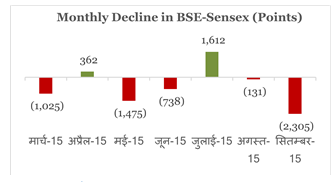
But most people I see in the stock market are made nervous by volatility, especially when stock prices are fast on their way down. The Indian market, as represented by the BSE-Sensex has been falling since February 2015, but the fall has been gradual and with some intermittent rises. The reason people have gotten extremely worried now (starting late-August) is simply given the magnitude of fall.


[Read more…] about Spotlight: Value Investing During Turbulence

How to Retain What You Read

August 30, 2015

A Safal Niveshak tribe member recently sent us this email…

I am a regular reader of your posts for more than 2 years now and a big fan as well. I am amazed by the knowledge you have gained by your rigorous reading and am writing this mail to ask you specifically ONE question.

How do you retain what you read?

I constantly see you quoting the investing greats and other writers from their books, not once but many times in your articles. On the other hand, I can barely remember what I read the next day itself. How do you do it? I am sure it must be an art that you have already mastered.

I am sure this would be the problem of countless tribesmen. Please do share how you do it so that people like me can benefit from this.

<!–more–>[show_to accesslevel=’almanack-all’]

Well, before I try to answer this very important question, let’s imagine a bucket of water. Every time you attempt to fill the bucket, 90% of the water leaks out instantly. So, every time, after all the time you spend waiting for the bucket to fill up, you retain a measly 10%.

Now, my question is – How many times would you keep filling the bucket?

The answer is simple – Just once.

The first time you notice the leak, you’d take action. You’d either fix the bucket or you’d get another bucket, wouldn’t you?

Yet why is that not the way we learn?

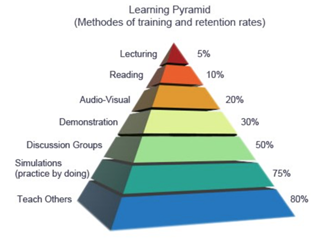
Almost all of us waste 90% of our time, resources and learning time, because we don’t understand a simple concept called the Learning Pyramid, a concept developed way back in the 1960s…which shows something really interesting…


As the pyramid shows, you retain just 5% of what you learn through a lecture (there goes our Investing Workshop model!), and just 10% of what you learn through reading (there goes most of everything else we do at Safal Niveshak!).

Well, not really. As the pyramid also suggests, you retain 80% when you teach. So what we teach through Safal Niveshak helps us much more than it helps you. 🙂

So, my first answer to the above email would be – to retain what you read and learn, teach others.

As far as simulations and discussion groups are concerned, I’m sure students of our Mastermind Value Investing course would concur that they must have learned more by practicing the exercises and participating in the Mastermind Forum than they would have through the lessons they read.

But not everyone attends lectures, or teaches, or participates in discussions…so these avenues are largely restricted. There’s however one piece of the above pyramid that is very relevant to most people of us. And that is reading.

And that’s exactly what the question in the above email focuses on – How to retain what we read (in case the only thing we do is…read)?

First, let me invert the question and answer – Why do we not retain most of what we read?

We don’t retain most of what we read because…

1. We read just with the purpose of entertainment and for the pleasure reading provides.
2. We let it (what we read) pass over us like a warm water bath.
3. We assume what the author is saying must be true.
4. We ignore the portions which we don’t understand and just focus on what we find interesting and in agreement to our pre-conceived ideas.
5. We read at the wrong time of the day.

In short, we don’t retain because we read passively. We’re uncritically letting the author do the thinking for us.

Remember, reading something is just that – reading. It’s not necessarily learning. Learning happens outside of your comfort zone, when you’re little frustrated and confused because you can’t understand something, when you’re fully alert to errors, engaged, reaching out, stretching a bit – it’s not easy and it’s not supposed to be easy. The legendary boxer Muhammed Ali said –

I don’t count my situps. I only start counting when it starts hurting. When I feel pain, that’s when I start counting, because that’s when it really counts.

It’s very important to define your purpose for reading.

Once the purpose is defined we can look at how to crack the ‘how to retain’ code.

Anyways, let’s understand some key ways our brain stores information.

1. Impression

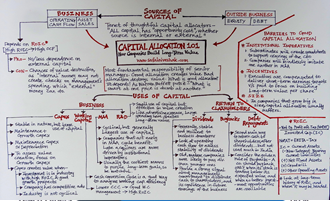
Information in the form of written word is an invention of the modern man. With thousands of years of evolution, our brains have evolved in such a way that it finds it easier to remember images, sounds and smell better than text. So you’re more likely to remember an information if it’s associated with pictures, sound or smell. For example, it’ll be easier for you to remember the concept of ‘capital allocation’ when you see the chart on the bottom-left of this page, instead of when you read a ten page theory on the subject.


Having said that, it’s not easy to imagine a sound or smell, but it’s relatively easier to imagine a picture describing what you just read. So the trick is to stop and picture a scene in your mind, even adding elements like greatness, shock, or a cameo from yourself to make the impression stronger. For some people the sensitivity to information can be greater with sounds rather than visuals so you could experiment reading out loud to see how it works for you.

2. Association

Connecting the dots is an interesting exercise in itself. When you read something new, it always helps to find connection with ideas that you have already read before.

Prior knowledge is a great way to build association. In fact, association is an important tool used by memory champions to remember disconnected information and facts. As they say, it’s not the number of ideas that you know, it’s the number of connections between those ideas.

3. Repetition

Repetition and practice is the mother of skill. Nassim Taleb, author of bestselling book Fooled by Randomness, ,writes –

Any book worth reading, is worth reading twice.

I can vouch for it. It has never happened that I didn’t find something new (and very important) in my second and third iteration through a book. You’ll invariably miss many concepts and ideas on your first pass. But re-reading a whole book is quite an arduous task. So here is a nice trick to make the re-reading process more efficient and easier – read the book while listening to the audio version and play the audio version at 1.5x the speed. I am not a great fan of audiobooks but this trick seems promising and you can give it a try.

Mortimer Adler, in his book How to Read a Book, identifies four levels of reading: Elementary, Inspectional, Analytical and Syntopical. Elementary reading is the way majority of people read. It’s the way we have been taught in school.

Inspectional is way to prime our brain for what’s to come by skimming the text first i.e. reading the covers, table of contents, preface and racing through the book. But last two ways are the ones which increase the retention of what you read. Analytical reading requires you to do following four things –

1. Classify the book according to subject matter.
2. State what the whole book is about. Be as brief as possible.
3. List and then outline the major parts in order and relation.
4. Define the problem or problems the author is trying to solve.

Think about it for a second, if you’re planning to teach somebody about a book then you would essentially need to follow above four steps. And Syntopical reading requires that you read books on the same subject and challenge yourself to compare and contrast as you go. When you start following Adler’s strategy you would notice that key ideas of impression, association and repetition will become very handy.

Own the Book

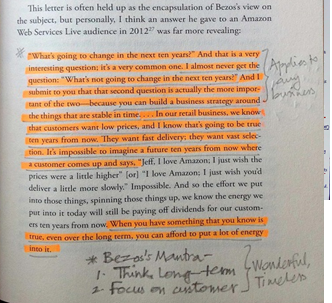
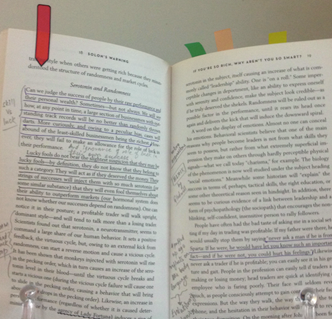
I believe you don’t own the book just because you bought it. You really own the book when you make it your own. When does that happen? It happens when you read the book not just with your eyes but with a pencil or a highlighter.


The book truly becomes yours when you underline or highlight the text. Circle the words that you may need to look up. Use stars, checks, brackets, parentheses, boxes, dots etc. for important points that you think are critical to the argument. Underline anything that strikes you as interesting.

Scribble in the margins as you read (called Marginalia – a lost art). What do you scribble? Any wisps of thoughts that comes in your mind – it could be in agreement with what author is saying or you could even disagree with author’s viewpoint – write it in the margins.

What you write isn’t that important. You may even copy few lines as it is. Writing engages a different part of your brain. Many researches have proven that writing what you have read increases retention manifolds.

I feel I am not giving a book my full attention unless I am hovering over it with a pencil, ready to underline or annotate at the slightest provocation. Sometimes I wonder how many wonderful quotes or passages from great books have been forgotten because I didn’t grab that highlighter.

Bookmark your favourite passages. I love using colourful page marks.

This practice is very useful when you quickly want to recall what you read. You can pick up the book and then read only the highlighted stuff and the marginalia.
If a book has left an indelible mark on your thinking then there is no harm in leaving some of your marks on the book too. It’s like engaging in a conversation with the author.

In fact, you’re virtually having a group discussion here which includes the author, your earlier self (who didn’t know about the ideas that you’re reading in the current book) and your new self (who has just learned the new ideas).

This is one of the reasons I don’t prefer reading borrowed (or rented) books because it takes away the freedom to mark and highlight the text.

One of the common threads which runs across all the serious readers is – taking copious notes. Shane Parrish, author of Farnam Street blog and a serious note taker, says –

After I finish a book, I let it age for a week or two and then pick it up again. I look at my notes and the sections I’ve marked as important. I write them down. Or let it age for another week or two.

Remember the step three of analytical reading? At the end of each chapter, without looking back, write some notes on the main points/arguments/takeaways. Then look back through the chapter and put anything down you missed. This will be tremendously useful when you come back to the book in future.

Even consider writing a review when you’ve finished. You could actually maintain a blog as a repository of your notes.

Share It

No matter how good the explanation in a book, you will not get it completely right the first time because your interpretation varies from the writer. You think you’ve read what you’ve read but the reality is different. You’ve only interpreted what you’ve read, and more often than not, the interpretation is not quite correct. You can only find out how much off the mark you are by trying to implement or teach the concept.

As I said earlier, not everybody has the option of teaching to others, but you can always make use of the Feynman’s technique of learning [1]. Sit down and use a piece of paper as if you are explaining to your friend

In fact maintaining a personal blog about your learnings may serve two purposes. First, as I told you above, is having a repository of your notes and second using it as means to share it with anybody who cares to learn/listen/read. It could be your spouse, sibling, close friend, kids or even your dog. 😉

You could make mind maps [2] to connect new ideas with your prior learnings. It would help if you use a note making system [3].

Make use of the technology – record an audio or video and share it on YouTube. For deeper learning, any concept needs to be discussed, talked, written, and felt.

Today, with digital book reading devices like Kindle, it’s possible to see what others are highlighting in their book copies and soon people will start sharing their responses to a text with other readers, right inside the text itself. Just imagine if you could read the marginalia by your favourite author. I am hoping that day isn’t very far.

Use Your Best Hours for Reading

I hope you don’t treat reading as a spare activity. If reading is a priority for you, then start your day by attending to your priority tasks instead of pushing it back all the way to the end of the day.

If you want to retain well and derive maximum benefit out of reading, you need to make sure that your brain is not tired. Instead of trying to force yourself to read at night when you’re exhausted and feeling sleepy, put the book down and go to sleep so that you can get up early and concentrate with a fresh mind.

Create Your Environment

This is one my biggest personal discovery about reading and learning.

If you’re serious about reading, then you should identify a dedicated place for your learning (if you can afford a separate room or office, nothing like it but getting started with a small corner in your house is perfectly fine). You could put your bookshelf there and reading chair/table.

Use lots of post-it notes having quotes and ideas that you find interesting. Whenever I find an idea that I can implement in some way, I make a note of it in a post-it slip and stick to the wall next to my study table.
The fundamental idea is to create a zone, your magic corner if you will. As soon as you enter your zone, your brain gets the cue to immediately come in the learning mode. It becomes easier to concentrate.

Conclusion

Epictetus, inThe Art of Living writes –

Don’t just say you have read books. Show that through them you have learned to think better, to be a more discriminating and reflective person. Books are the training weights of the mind. They are very helpful, but it would be a bad mistake to suppose that one has made progress simply by having internalized their contents.

Reading with a purpose to retain isn’t an easy task. Charles Darwin’s library had 1,480 books and he made extensive notes on about half of these.

A recent study about his notes and his marginalia has revealed some interesting insights about how the ‘the theory of natural selection’ took shape in Darwin’s mind. [4]

The theory of evolution didn’t pop up in Darwin’s head on one fine day like a Eureka moment. He developed his ideas slowly and painstakingly by postulating new theories, challenging them, accepting and discarding them while he read books.

This is how any useful knowledge base is built in human mind, by putting in lot of hard work and persevering through a lifetime.

Shane Parish argues –

…a better approach is to build a latticework of Mental Models [5]. That is, acquire the core multi-disciplinary knowledge and use that as your foundation. This is the best investment because this stuff doesn’t change and if it does it changes really slowly. This becomes your foundation. This is what you build on. So when you read and connect things to the core knowledge, not only do you have a better idea of how things fit together but you strengthen those connections in your head from use.

One final advice – Don’t set lofty reading goals. Just strive to read slightly more today than you did yesterday.

And remember, there is no point finishing a book you aren’t enjoying. Life is too short for that. Swallow your pride and put it down for good, unfinished.

What’s your best tip for retaining what you read? I’d love to hear your thoughts in the Almanack Forum.

Notes:

[1] Learn Anything Faster With The Feynman Technique

[2] The Brain

[3] The Notecard System

[4] Young Darwin’s Marginalia

[5] Latticework of Mental Models

[/show_to] [hide_from accesslevel=’almanack-all’]

Want to Read More? This content is exclusive for members of Value Investing Almanack. Login to read if you are a member. Else, click here to subscribe.

Benefits to VIA Members
 
  • Spotlight: Big ideas from Value Investing and why applying them in your investment decision making will be a great deal
  • InvestorInsights: Interviews with experienced value investors, learners, and deep thinkers
  • StockTalk: Thorough analysis of business models of companies (without any recommendations)
  • Behaviouronomics: Deep analysis of human behaviour and how it impacts investment decision making
  • BookWorm: Reviews of the best books on Value Investing and related subjects
  • Free Course – Financial Statement Analysis for Smart People (otherwise priced at Rs 5,900)
  • Archives: Instant access to our huge archive from the past three years
Become a VIA Member. Click to Subscribe
[/hide_from]
  • « Go to Previous Page
  • Page 1
  • Interim pages omitted …
  • Page 60
  • Page 61
  • Page 62
  • Page 63
  • Page 64
  • Interim pages omitted …
  • Page 72
  • Go to Next Page »

Handcrafted with in India