
The current volatility in the market is creating unfounded panic but at the same time it holds the dangers for others to start loading up recklessly. We explore the current market turbulence in the light of age old wisdom from Buffett and Klarman.
“I don’t know and I don’t care!”
This was my response to a friend who called me last week asking how much more markets could fall. This fellow is a VP in a stock broking company, and was seemingly trying to check on my prediction of the next market move, and how far or close it was to his own prediction.
“Why do you guys make a fool out of people by constantly making horrific predictions?” I asked him.
“What do you mean by horrific predictions? We also make some brilliant ones,” he replied. I laughed out loud and shared with him some brilliant predictions I had recently come across, made by one of his clan –
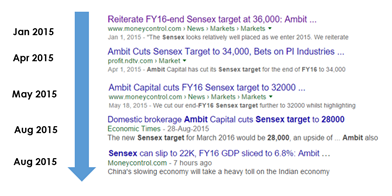
Nobody Knows
After the crash in 2008 people would ask me, “Well, what are you doing differently now? What are you doing now?” And my answer was, “Well, it’s the same thing I’ve always been doing. I’m looking for cheap stocks.”
It doesn’t really change whether the stock market is rising or it is falling. You would always want to look out for stocks selling at discounts to their intrinsic values, isn’t it? So that activity doesn’t change.
It’s not based on what the US Federal Reserve or India’s RBI is going to do; it’s not based on what China or Brazil is going to do. It’s the same activity throughout market cycles.
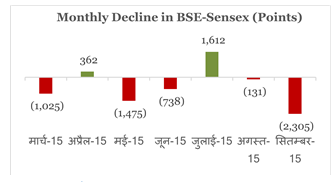
But most people I see in the stock market are made nervous by volatility, especially when stock prices are fast on their way down. The Indian market, as represented by the BSE-Sensex has been falling since February 2015, but the fall has been gradual and with some intermittent rises. The reason people have gotten extremely worried now (starting late-August) is simply given the magnitude of fall.
[show_to accesslevel=’almanack-all’]
It’s the sharp declines like these that scare people away. And then they again turn to the ‘experts’ who provide them a false sense of comfort through their predictions (“Markets have bottomed out, so buy stocks” or “Avoid stocks because the Sensex is going further down”).
Nobody knows what is going to happen to stock prices the next moment, and people are busy predicting (and believing them) as if they have a magic ball that sees it all.
Nassim Taleb was right when he said – “The investment business is full of people who got famous for being right once in a row.”
In fact, having a false sense that you know what Mr. Market is going to do the next day or week and then trying to get one up on him is one of the biggest mistakes you can make in your investment life.
Mr. Market, as Warren Buffett loves saying, is a semi-psychotic creature given to extremes of elation and despair. I am reminded of this every time I see the semi-psychotic behaviour of Mr. Market…and every time I think of him, I am reminded of Keshto Mukherjee, the old Indian movie comedian known for his roles as a drunkard…

Anyways, when you are searching for ways to deal with the psychotic Mr. Market, it pays to read and re-read what Buffett wrote in his 1987 letter to shareholders. I believe, this is one of the most important texts ever written on how to deal with stock prices, whether on their way up or their way down. As a student of value investing, you must have read what follows several times. But then, such super-texts need several readings, and then several more.
Here is what Buffett wrote (emphasis is mine)…
Ben Graham, my friend and teacher, long ago described the mental attitude toward market fluctuations that I believe to be most conducive to investment success. He said that you should imagine market quotations as coming from a remarkably accommodating fellow named Mr. Market who is your partner in a private business. Without fail, Mr. Market appears daily and names a price at which he will either buy your interest or sell you his.
Even though the business that the two of you own may have economic characteristics that are stable, Mr. Market’s quotations will be anything but. For, sad to say, the poor fellow has incurable emotional problems. At times he feels euphoric and can see only the favorable factors affecting the business. When in that mood, he names a very high buy-sell price because he fears that you will snap up his interest and rob him of imminent gains.
At other times he is depressed and can see nothing but trouble ahead for both the business and the world. On these occasions he will name a very low price, since he is terrified that you will unload your interest on him.
Mr. Market has another endearing characteristic: He doesn’t mind being ignored. If his quotation is uninteresting to you today, he will be back with a new one tomorrow. Transactions are strictly at your option. Under these conditions, the more manic-depressive his behavior, the better for you.
But, like Cinderella at the ball, you must heed one warning or everything will turn into pumpkins andmice: Mr. Market is there to serve you, not to guide you. It is his pocketbook, not his wisdom, that you will find useful. If he shows up some day in a particularly foolish mood, you are free to either ignore him or to take advantage of him, but it will be disastrous if you fall under his influence. Indeed, if you aren’t certain that you understand and can value your business far better than Mr. Market, you don’t belong in the game. As they say in poker, “If you’ve been in the game 30 minutes and you don’t know who the patsy is, you’re the patsy.”
Ben’s Mr. Market allegory may seem out-of-date in today’s investment world, in which most professionals and academicians talk of efficient markets, dynamic hedging and betas. Their interest in such matters is understandable, since techniques shrouded in mystery clearly have value to the purveyor of investment advice. After all, what witch doctor has ever achieved fame and fortune by simply advising “Take two aspirins”?
The value of market esoterica to the consumer of investment advice is a different story. In my opinion, investment success will not be produced by arcane formulae, computer programs or signals flashed by the price behavior of stocks and markets. Rather an investor will succeed by coupling good business judgment with an ability to insulate his thoughts and behavior from the super-contagious emotions that swirl about the marketplace. In my own efforts to stay insulated, I have found it highly useful to keep Ben’s Mr. Market concept firmly in mind.
Following Ben’s teachings, Charlie and I let our marketable equities tell us by their operating results – not by their daily, or even yearly, price quotations – whether our investments are successful. The market may ignore business success for a while, but eventually will confirm it. As Ben said: “In the short run, the market is a voting machine but in the long run it is a weighing machine.” The speed at which a business’s success is recognized, furthermore, is not that important as long as the company’s intrinsic value is increasing at a satisfactory rate. In fact, delayed recognition can be an advantage: It may give us the chance to buy more of a good thing at a bargain price.
Mr. Market Remains Incurable
The worth of the above words from Buffett remain as priceless as when they were written almost three decades ago.
Mr. Market continues to suffer from incurable emotional problems (oh yes, these are incurable problems you see!). And he remains endearing as he doesn’t mind being ignored.
But then, the more I see the behaviour of people (in the stock market) around me, the more recklessness I see in they getting constantly influenced by the mood of Mr. Market. So, when he was at his optimistic best just a couple of months ago, investors were taking his advice and buying stocks like there was no tomorrow. “Margin of safety” became a bad word, and “moat” became the buzzword. And now, thanks to events in China and Europe, Mr. Market is feeling dull, and so are investors who are again taking his advice and selling stocks as if there is no tomorrow.
Charlie Munger (or was it Warren Buffett?) was right when he said that “…investing is simple but not easy. Anyone who finds it easy is stupid.”
The simpler part, as I have understood in my limited time in the stock market, is understanding how to find good business and value them. And this is just 1% of the investing game. The remaining 99% – the ‘not easy’ part – is how you behave with the knowledge you have. And that’s why most investors, even the ones who are smart and successful in their careers – often make grave mistakes when it comes to their investing careers.
Dealing with Stock Market Turbulence
Well, if a less than 20% decline in the benchmark index i.e., BSE-Sensex in a few weeks is called ‘turbulence’, we are surely passing through turbulent times as of writing this (middle of September 2015).
Now, while the sharp swings in the stock market in the past few weeks have scared many investors, I find a lot of other investors buying, or let me say, bottom fishing. But then, there are chances that you can hit snags when you bottom-fish, so the key is to act on a plan rather than out of instinct.
Whether Mr. Market is in a good or bad mood, it’s important for you to focus on the process of sound investing, rather than acting on whims and the latest fancies Mr. Market is producing.
Here are five quick rules that I believe can help keep you from making edgy decisions during stock market turbulence –
1. Pull out your watch list – Instead of getting scared by what Mr. Market is doing or, it’s important to focus on the “good stocks I would like to buy at the right prices” list, if you have one made. Michael Shearn, the author of the book The Investment Checklist, suggests tracking a set of stocks you would love to buy if they fell in price.
Some of those stocks might be ones you already own and wish you had been able to buy more of; some might have been recently battered into bargains; others might usually trade at premium prices and have finally become reasonable. Look at them to see if something is worth buying at lower prices.
2. Looking at recent losers – When the broader market crashes 15-20%, a lot of stocks usually fall between 30-50% — including sometimes the ones of high quality companies. Look at those. The big idea here is that using a watch list changes you from being reactive to being proactive. You can say, ‘Let’s go shopping and see what’s on sale.” Then buy the things you like and that you believe are on sale.
Over a period of time, and whatever the markets are doing in the interim, stocks of high quality businesses, if bought cheap or at reasonable valuations, have a high probability of earning you good returns. (See Table 1 below)
But then, avoid buying any business – or averaging down on bad businesses – just because it has fallen in price. (See Table 2 below)
A stock may have or fall to an absolute low price, a low price compared to the past, or a low P/E ratio…but usually the price has to be low relative to the business’s intrinsic value for the stock to be attractive and for the risk to be low.
You must understand the difference between cheapness and value.
3. Avoid trading or making quick, random changes to your portfolio. This is harmful in good times, and horrible in bad.
4. Stop predicting the direction of the stock market or whether they could fall further, or rise from here on. Work on individual businesses and their price vs value equations.
5. Avoid first level thinking, because what’s obvious may not be true.
Now, just because the stock prices have fallen a lot over the past few weeks, doesn’t mean that you wear your ‘contrarian value investor’ hat and cast aside all notions about an extended market decline.
The first thing to worry about is just how lucrative the stock market has been over the past five years. Just before the recent decline, the BSE-Sensex had returned 23% CAGR over a 2-year period, and 17% CAGR over a 3-year period. In fact, the index was up around 44% in a year before the decline started.
Such high returns tend to numb the sense of risk that investors normally feel.
Take Advantage of Margin of Safety (Only IF You Can Find It)
The main underlying principle of value investing is that you should invest in undervalued stocks (intrinsic value > stock price) because they alone offer a margin of safety.
Over time, by again and again avoiding loss, you have taken the first step toward achieving healthy gains. Seth Klarman wrote in one of his letters to shareholders…
Value investors should buy assets at a discount, not because a business trading below its obvious liquidation value will actually be liquidated, but because if you have limited downside risk from your purchase price, you have what is effectively a free option on the recovery of that business and/or the restoration of that stock to investor favor.
If an undervalued stock drops after you buy it and you are confident in your analysis, you simply buy more.
The best investments I have seen people make that, in retrospect, seem like free money, seemed not at all that way when they were made.
When the markets are dropping hard and an investment you believe is attractive, even compelling, keeps falling in price, you aren’t human if you aren’t scared that you have made a gigantic mistake.
The challenge is to –
• Perform the fundamental analysis of the underlying business;

• Understand the downside as well as the upside;
• Remain rational when others become emotional; and
• Avoid taking advice from Mr. Market, who again and again is a wonderful creator of opportunities but whose advice should never, ever be followed.
For you as an investor, it’s important to remain focused on risk aversion, seeking to hold only compelling bargains.
What about Holding Cash during Turbulence?
Cash provides protection in a storm and ammunition to take advantage of newly created opportunities, but holding cash involves the considerable opportunity cost of foregoing presently attractive investments.
Klarman writes –
Given the choice between holding mostly cash awaiting the periodic market tumble or finding compelling investments which earn good returns over time but fluctuate to a certain extent with the market amidst turbulence, we choose the latter.
Obviously, we could not have earned the returns we have from investing, without investing.
The opportunity to invest more money at lower prices will certainly be to your long-term financial benefit. If the financial markets remain turbulent and retrace some of their past gains, you will be in a strong position as you will get a longer runway to buy more of quality stocks at reasonable or low prices.
Against what some value investors would proudly proclaim, it’s important to remember that value investing is not designed to outperform in a bull market.
As Klarman writes…
In a bull market, anyone, with any investment strategy or none at all, can do well, often better than value investors. It is only in a bear market that the value investing discipline becomes especially important because value investing, virtually alone among strategies, gives you exposure to the upside with limited downside risk.
In a stormy market, the value investing discipline becomes crucial, because it helps you find your bearings when reassuring landmarks are no longer visible. In a market downturn, momentum investors cannot find momentum, growth investors worry about a slowdown, and technical analysts don’t like their charts. But the value investing discipline tells you exactly what to analyze, price versus value, and then what to do, buy at a considerable discount and sell near full value. And, because you cannot tell what the market is going to do, a value investment discipline is important because it is the only approach that produces consistently good investment results over a complete market cycle.
Warning – Other Side of Investing During Turbulence
Now, for a sensible mind, it’s largely an easy call to take during such sharp market declines to buy on the dips…and if stocks go down further, buy more. And this is what I have mentioned all over above.
But then this advice can be dangerous for some people, and to most of all who are nearing a big financial goal like retirement. If you’re young, the sudden popularity of the idea that market declines are God-sent should make you nervous, even though it’s right. But if you’re in or near retirement, it should scare you, because it’s wrong.
Warren Buffett says that stocks are like hamburgers, and if you are going to be purchasing them regularly for years to come, you shouldn’t want them to go up in price (and rather want them to go down in prices). In the same way, if you are going to be a net buyer of stocks over the next many years, any drop in the stock market, so long as you have the gumption to take advantage of it by buying more, is good for you.
On the other hand, if you are at or near the age when you need to make regular withdrawals from your portfolio to fund your retirement, a fall in the stock market can be catastrophic, and you need to decrease – not increase – your exposure to it.
That’s not merely because stocks can take years to recover from losses and you have fewer years left as you age. The problem is that the order in which stocks earn good or bad returns can matter — a lot.
Remember, Nobody Knows
If you are not sure where the markets go from here, you are not alone. It would be nice if someone knew what the stock market would go to do next. But no one does. Having the humility to know that you don’t know and to recognize that no one else does either is a huge advantage for long term investors.
It’s not how markets behave, but how you behave in response to them that ultimately determine your success.
Before I close this, here’s what Buffett wrote in his 2014 letter to shareholders (emphasis is mine)…
It is true, of course, that owning equities for a day or a week or a year is far riskier (in both nominal and purchasing-power terms) than leaving funds in cash-equivalents. That is relevant to certain investors – say, investment banks – whose viability can be threatened by declines in asset prices and which might be forced to sell securities during depressed markets. Additionally, any party that might have meaningful near-term needs for funds should keep appropriate sums in Treasuries or insured bank deposits.
“For the great majority of investors, however, who can – and should – invest with a multi-decade horizon, quotational declines are unimportant. Their focus should remain fixed on attaining significant gains in purchasing power over their investing lifetime. For them, a diversified equity portfolio, bought over time, will prove far less risky than dollar-based securities.
To conclude, there are just two kinds of risks in investing – one, the risk of losing money and two, the risk of losing opportunities. Volatility isn’t risk, as it’s otherwise made out to be.
In fact, the markets will continue to remain volatile going forward, which presents both challenges and opportunities. Your idea as a value investor must be to remain focused on risk aversion, seeking to hold only compelling bargains.
Buffett’s following quote helps me keep calm across all market conditions that borders on, or gets on the excess –
The less prudence with which others conduct their affairs, the greater the prudence with which we should conduct our own affairs.
Everyone was happy to buy stocks just six months ago, when valuations all around seemed sky high. Now, with valuations getting reasonable (at least better than six months ago) and some risks already priced in, it’s appropriate to sniff around for opportunities among good businesses – the babies that are being thrown out with the bath water. Are you on the case or not?

Buffett’s following quote helps me keep calm across all market conditions that borders on, or gets on the excess
[/show_to] [hide_from accesslevel=’almanack-all’]
- Spotlight: Big ideas from Value Investing and why applying them in your investment decision making will be a great deal
- InvestorInsights: Interviews with experienced value investors, learners, and deep thinkers
- StockTalk: Thorough analysis of business models of companies (without any recommendations)
- Behaviouronomics: Deep analysis of human behaviour and how it impacts investment decision making
- BookWorm: Reviews of the best books on Value Investing and related subjects
- Free Course – Financial Statement Analysis for Smart People (otherwise priced at Rs 5,900)
- Archives: Instant access to our huge archive from the past three years