
An overview of one of the best books about the mental model of Deliberate Practice. If you want to become a better reader and thinker, this is a must read.
 “I don’t count my situps, I only start counting when it starts hurting, when I feel pain, that’s when I start counting, because that’s when it really counts.”
I think you can guess who must have said this. The confidence and attitude oozing out of this sentence says that it could be none other than the greatest pugilist that the world has ever seen in the history of boxing – Muhammad Ali.
Ali began training at the age of 12 and won the world championship when he was 22 years old. A child prodigy, born with a gift for throwing lightning fast punches. But was he really born wearing boxing gloves and a knack for knocking people out? Of course not.
Multiple researches have established that talent is determined far less by our genes and far more by our actions: specifically the combination of intensive practice and motivation that produces brain growth.
Ali earned his talent by sweating out countless hours, practicing each and every move, working on his stamina and training his mind. He probably raked in more than ten thousand hours of practice much before he was 22.
The rule of ‘ten thousand hours’, a scientific finding, says that all world-class experts in every field have spent a minimum of ten thousand hours intensively practicing their craft. That’s how a talent is built. This 10,000 hour heuristics was made popular by Malcolm Gladwell’s book Outliers.
So, does it mean anybody who spends ten thousand hours doing something will become a world class expert in that activity? Of course not. There is more to the rule than the number 10,000. It’s Deliberate Practice which holds the key to developing expert level skills.
Deliberate Practice is defined as the form of learning which fuses the notion of attentive repetition with the willingness to operate on the edge of your ability, aiming for targets that are just out of reach. That’s what Muhammad Ali meant when he said – “I don’t count my sit-ups. I only start counting when it starts hurting, when I feel the pain…”
The idea is that development of skill is nothing but brain development. With quality practice, brain builds new and stronger neural pathways that result in dexterity in the skill.
Most of the professional sports people and performers have access to cutting edge techniques for harnessing Deliberate Practice, but majority of us don’t really have that luxury. In fact, how many of us really want to competeand perform at the world class expert level? I guess not many.
[show_to accesslevel=’almanack-all’]
However what we do want to learn is –
• How to recognize the talents in ourselves and those near us?
• How do we nurture talent in its early stages?
• How do we gain the most progress in the least time?
• How do we choose between different strategies, teachers, and methods?
If you are reading this, I can bet that you have a keen interest in Value Investing as well as in multidisciplinary learning. Both of these require two basic activities – reading and thinking. The problem is that everybody thinks that they know how to read and think. But very few people understand that reading effectively and thinking deeply require deliberate practice.
So those are the first two areas – reading and thinking – where you can apply the tenets of Deliberate Practice.
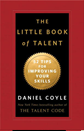
Daniel Coyle’s The Little Book of Talent takes the idea of Deliberate Practice and breaks it down into 52 simple, practical, doable tips that will power your skill development and take it to a whole new level. Whether you want to improve your singing voice, a powerful forehand swing, success in business or persuasive communication skills, the methods discussed in this book, if implemented, will propel you on an express path for unleashing your true potential.
The central idea, Coyle says, is – small actions, repeated over time, transform us. Which resonates pretty well with Charlie Munger’s advice. He recommends that “you should go to bed just a little bit smarter than when you woke up.”
So let me dive straight into the book and touch upon some of the ideas which I have found particularly insightful. Daniel has divided these talent tips into three broad categories.
1. Getting started – Ideas for igniting motivation.
2. Improving skill – Techniques for getting the highest return on efforts.
3. Sustaining progress – Strategies for overcoming plateaus and building long term habits.
Here are some tips to get started on the path of talent development.
Fuel Your Motivation
We each live with a windshield of people in front of us. To ignite your motivation, fill your windshield with vivid images of your future self, and stare at them every day. Your windshield is an energy source for your brain. Use pictures (photos and posters of your role models) or, better, videos to oversaturate your mind with the thoughts of your role model in action.
One idea: Bookmark a few YouTube videos, and watch them before you practice, or at night before you go to bed. Check out this blog post,, which has some new insights (e.g. reading a super-text before sleeping) and a compilation of resources to get you started.
Basically, watch the skill being performed, closely and with great intensity, over and over, until they build a high-definition mental blue print.
The key is to create an intense connection: to watch and listen so closely that you can imagine the feeling of performing the skill.
Steal from Top Performers
As Pablo Picasso put it, “Good artists borrow, Great artists steal.”
All improvement is about absorbing and applying new information, and the best source of information is top performers. Mohnish Pabrai, a very successful fund manager, swears by the idea of cloning which is nothing but copying (of course, after applying your brain) the best investment ideas from people he respects.
Look at every single performer better than you and see what they’ve got that you can use. Then make it your own.
Keep a Journal
From tennis champion Serena Williams to rapper Eminem, a huge percentage of top performers keep some form of daily performance journal. They fill these journals with ideas, observations, goals, wisps of thoughts, problems, etc.
What matters is not the precise form, but your practice of writing stuff down and reflecting on it later. I recently published a post on Safal Niveshak about the importance of journaling as a thinking tool.
I can never put enough stress on the importance of journaling. This practice has a huge potential and can change your life drastically for better.
Austerity
Keep your practice area simple and devoid of any unnecessary luxury (or comfort) items. The point of this tip is not moral; it’s neural.
Simple, humble spaces help focus attention the deep practice task at hand. Choose an austere and basic environment.
Hard Skill Vs Soft Skill
The first step toward building a skill is to figure out exactly what type of skill you’re building. Whether it’s a hard skill or a soft skill?
Hard skills are about repeatable precision especially in specialized physical pursuits. E.g. tennis swing and musical instruments. Soft skills are about being agile and interactive, recognizing patterns and taking smart decisions on the fly e.g. player identifying a weakness in opposition’s defence or an investor identifying an opportunity in a business.
Building hard skills require deliberate practice, careful mastery of basics and fundamentals, completing ten thousand hours of practice and supervision of a coach. Whereas soft skills are built by countless intensive and varied “reaches” and “reps” based on the clear feedback in an endlessly challenging and ever-changing environment.
Soft skill in case of investing means very long feedback loop of years which involves maintaining a decision journal to keep record of why you did or didn’t invest in a stock and revisiting the journal to see where you were right and when you were wrong. Learning from mistakes of commission as well as omission.
Most skills are combination of hard skills and soft skills, for example, executing a perfect cover drive in cricket (like Rahul Dravid) asks for a soft skill of judging the pace, direction, pitch of the ball and perhaps field placement. But at the same time it requires the hard skill of perfect movement of the bat. In such cases, the hard skill needs to be mastered first.
Let’s now move on the second level. This is where you learn to separate shallow practice from deep practice. The key to deep practice is to ‘reach’. This means stretching yourself slightly beyond your current ability and spending time in the zone of difficulty called the sweet spot.
Finding the Sweet Spot
In shallow practice, most of the time is spent in your comfort zone. Which is accompanied by feelings of ease, effortlessness and almost no struggle. Your error rate might be less than 20 percent.
Deep practice means reaching for your sweet spot. Sweet spot is the edge of your ability, where you learn the best and fastest. It’s characterized by sensations of frustration, difficulty, alertness to errors and a complete engagement with intense struggle. As if you’re stretching with all your might for a nearly unreachable goal, brushing it with your fingertips, then reaching again. The error rate in this zone is as high as 50 percent.
How to locate your sweet spot? It does require some creativity but the idea is to seek out ways to stretch yourself. Play on the edges of your competence.
Use Artificial Constraints
Poets and writers shrink the field by using restrictive measures to force themselves into a small creative form – such as micro-writing exercise. Comedy writers use the 140 character arena of Twitter as a space to hone their skills. Many professional soccer players practice with a ball in a small bathroom sized room.
Find out how you can build such constraints to bring in more intensity, urgency and struggle in your practice.
Power Nap
We discussed the importance of sleep in the July issue of VIA. Although the mechanism of sleep is largely an unknown field for modern science but numerous empirical studies have proved that napping is good for the learning brain. It helps to strengthen the connections formed during practice and prepare the brain for the next session.
Albert Einstein was known to take a daily twenty-minute nap post-lunch. Not just him but many other luminaries including Leonardo da Vinci, Winston Churchill, Thomas Edison, and John F. Kennedy were famous nappers.
Developing a talent is less like a 100 meter dash and more like a marathon, a cross country hike, if you will. You will encounter challenges; you will hit snags, plateaus, and steep paths. The final section in the book covers some tips to sustain progress and stay focused on the horizon.
Replace Habits
Habits are tough to break especially the bad ones. Don’t waste time trying to break bad habits – instead, build new ones. When you focus on building new habits, the old habits start losing their grip on your behaviour and their effect is slowly diluted.
Teach to Learn
The best way to learn something is to teach it. This works because when you communicate a skill to someone, you come to understand it more deeply yourself. When you see someone struggle, and help them through it, you improve your ability to deal with your own struggles.
Cultivate Grit
Grit is that mix of passion, perseverance, and self-discipline that keeps us moving forward in spite of obstacles. Consistency and persistency in your efforts builds emotional maturity over long term.
In a world frequently mesmerized by sparkly displays of skills, grit makes the real difference in the long run.
Conclusion
Greatness is not born, but grown through deep practice, no matter who you are. Thus, the new science can be summed up as follows: You want to develop your talent? Build a better brain through intensive practice.
I would like to reiterate that the ideas that I have picked up for this post are just a limited bunch from the book. If you want to derive the real benefit, there is no other way but to read the book cover to cover.
I found this book so useful and practical that I recommend it to everybody. My wish is to gift a copy to everybody I know. But for today all I hope is that you get inspired enough to get your own copy and exploit it thoroughly
[/show_to] [hide_from accesslevel=’almanack-all’]- Spotlight: Big ideas from Value Investing and why applying them in your investment decision making will be a great deal
- InvestorInsights: Interviews with experienced value investors, learners, and deep thinkers
- StockTalk: Thorough analysis of business models of companies (without any recommendations)
- Behaviouronomics: Deep analysis of human behaviour and how it impacts investment decision making
- BookWorm: Reviews of the best books on Value Investing and related subjects
- Free Course – Financial Statement Analysis for Smart People (otherwise priced at Rs 5,900)
- Archives: Instant access to our huge archive from the past three years