
• Skip to primary navigation
  • Skip to main content

The One Percent Almanack

Wit and Wisdom on Investing, Business, and Life

  • Home
  • Members
  • Log In|Log Out
  • Show Search
Hide Search

Life 2.0: Breathe In, Breathe Out

August 29, 2015

Some of the greatest things, the greatest discoveries, have come about by serendipity. Let’s explore its magic here.
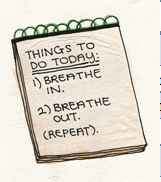
Few years back while working with a colleague in his cubicle, I noticed that a reminder would pop up on his screen every 10 minutes with just one word written on it – Breathe. I tried ignoring it initially but after some time I had to ask him, “Dude! Do you really need to remind yourself to breathe?”

“It’s not just about breathing!” he replied with a smile.

“Care to throw some light?” I asked him.

He started explaining, “Of course, I don’t need to remind myself to breathe. Nobody needs to. Everyone knows how to breathe. It is something that occurs to us automatically, spontaneously, and naturally. We are breathing even when we are not aware of it.

“However, I do need to remind myself to breathe properly,” he continued, “You might find it foolish that there is a proper and improper way of breathing. I mean how hard is it? Just breathe in, and breathe out. Right?”

“Yeah, right.” I said.

“Wrong! The truth is that most people don’t realize the power of breath. If done properly it can increase your energy and productivity manifolds,” he said.

I was intrigued with his statement, but before he could tell me more about it he had to leave for a meeting. But I couldn’t wait so I went ahead and started reading and researching on my own on this and what I found was remarkably profound and life changing.

Control Switch for Physiology

I guess you would agree with me that our behavior influences our performance and the results we produce.

Now what defines our behaviour? Our thoughts. Isn’t it?

And thoughts are governed by feelings which in turn are controlled by our emotions. Our emotions take shape based on our physiology – health, general state of well-being, breathing, heart-rate, etc. Now this isn’t something new and you probably know about this already.

Most of our physiology is largely seen as an effect rather than cause. A common belief is that our physiology can’t be controlled or changed immediately. But there is one thing which is in our control that can control a lot of other involuntary activities like heart rate, body temperature, etc. And that control button is how you breathe.

Let me share some interesting trivia about where else breathing is a well-known tool for performance.

Tennis players use a certain pattern of bouncing the ball or a breathing pattern to put them in an optimum state of mind also referred as ‘the zone’. Right breathing is an effective tool for not just every sportsperson but for many actors and stage artists also.

Ask any accomplished actor and he will tell you that dialogue delivery is all about breathing in a certain way. I remember Aamir Khan talking about how he can induce an emotion in his body just by changing his breathing patterns. That’s what separates him from others – he doesn’t just act but actually lives the character.
[Read more…] about Life 2.0: Breathe In, Breathe Out

InvestorInsights: Amit Arora

August 15, 2015

Prabhakar Kudva, an engineer by education and an investor by choice, chronicles his serendipitous journey in to the world of value investing and shares some useful insights on portfolio construction

Amit Arora is one of the founders and Chief Investment Officer of Eleven Dimension Funds. After two short stints in India he had the privilege to serve United Nations, based out of Europe from 2000 through 2007.

Since 2007 he has been rendering professional consulting services to a number of New Zealand Government organisations such as Ministry of Justice, Ministry of Business Innovation and Employment, Ministry of Social Development, Inland Revenue Department, Regional Health Boards as an Independent Consultant.

Amit started and managed an investment partnership registered in India under Indian Partnership Act 1932 with a selective total of nine partners out of one hundred and fifteen plus who evinced interest in joining, with a successful track record from 2012-2014.

He is passionate about spirituality, investments, technology and a need for well rounded and balanced life to realise human potential.

Safal Niveshak (SN): Could you tell us a little about your background, how you got interested in investing, and how you’ve evolved over time as an investor?

Amit Arora (AA): I chose Commerce in 11th standard and did MBA in Finance. I landed a below-mediocre first job with Peerless General Finance and Investment Company which felt like 10 years, though it lasted only for 10 months. In 1999, I saw IT folks earning more money, much more than me. So, I was working for money, not passion, I chose to go into software development. I trained in C, Java and got sacked along with rest of the team in 2000. I then stayed at home for 4 months. Then, thanks to luck, I got a few months consulting job in United Nations in Italy in 2001 after a brief unemployment period. This contract kept extending every 3-6 months from 2001 until I got bored by 2006.

I was 30 years old in 2006, no social circle, I preferred being alone by nature, I was twice as old as a teenager, so my hormones started to kick in by now, no girlfriend ever by this time, so I decided to get married in arranged marriage manner in India through our parents, and then thought of moving to an English speaking country like the New Zealand, US, England, Australia or Canada. I wanted to try consulting for Indian companies like Wipro of Infosys for some time, but my better half did not, so we moved to New Zealand in 2007.
[Read more…] about InvestorInsights: Amit Arora

BookWorm: Antifragile – Part 2

August 10, 2015

Pat Dorsey’s book is one of the most important text that you can read to untangle the puzzle of moat and competitive advantages.

This is the continuation of our book review which we started in the special report last month. I hope the first part of this review piqued enough interest in you to start reading the book.

This is an extremely rich book, insight-wise, and it took me many weeks to absorb the content.

One of the key distinction that one needs to understand is that organic entities are intrinsically antifragile, while artificial creations are at best robust and likely fragile. Most of the man made things especially mechanical ones are subject to wear and tear and horribly fragile in long term. However, some of the intangible creations of man like ideas, technologies, and businesses exhibit antifragility.

For that matter, if you can find an antifragile business you would be done for life! Let me know if you stumble upon such business model, except of course Berkshire Hathaway 🙂
[Read more…] about BookWorm: Antifragile – Part 2

Spotlight: Capital Allocation – Part 1

August 3, 2015

What’s interesting about moat is that if a moat needs to be continuously built, it isn’t a moat at all. How do you know if you’re paying up or overpaying for the moat? This time we invert the conundrum of moat to explore the symptoms of false-moat trap.

Proper allocation of capital is an investor’s number one job.” ~ Charlie Munger

“Charlie and I have only two jobs…One is to attract and keep outstanding managers to run our various operations. The other is capital allocation.” ~ Warren Buffett

One of the great skills that any investor or businessperson can have is a talent for capital allocation. And when it comes to capital allocation skills, one of the people even supposedly the world’s best capital allocators, Warren Buffett, looks at is Tom Murphy.

“Who’s Tom Murphy?” you may wonder.

Well, I’ll discuss more on my key learnings from Mr. Murphy some other day. But here’s what Buffett once told Lawrence Cunningham, the author of Berkshire Beyond Buffett1 about this man – “Most of what I learned about management and capital allocation, I learned from Murph. I kick myself, because I should have applied it much earlier.”

In fact, Mr. Murphy has been such a great inspiration for Buffett that when you study what the latter has said and written about managing a business, in many cases you are learning indirectly from the former. That is a good thing since Mr. Murphy did not say or write very much in comparison to Buffett. Like many great capital operators (like Henry Singleton) and managers he mostly let his business results speak for themselves, and did not spend any significant time seeking to be noticed by the public.

Along with Buffett himself, Murphy is one of eight CEOs praised in The Outsiders, a cult business classic, which attempts to define what differentiates a small number of leaders who massively outperform the market through their capital allocation skills.

Buffett is quoted in that book as saying that “Tom Murphy and [his long-time business partner] Dan Burke were probably the greatest two-person combination in management that the world has ever seen or maybe ever will see.”

As you can read in the book, the capital allocation formula that Mr. Murphy practiced and what made him so successful, was – focus on industries with attractive economic characteristics, selectively use leverage to buy occasional large properties, improve operations, pay down debt, and repeat.

Anyways, contrast what Buffett says about Mr. Murphy’s capital allocation skills with what he wrote in his 1987 letter3…

“…the heads of many companies are not skilled in capital allocation. Their inadequacy is not surprising. Most bosses rise to the top because they have excelled in an area such as marketing, production, engineering, administration or, sometimes, institutional politics. Once they become CEOs, they face new responsibilities. They now must make capital allocation decisions, a critical job that they may have never tackled and that is not easily mastered. To stretch the point, it’s as if the final step for a highly-talented musician was not to perform at Carnegie Hall but, instead, to be named Chairman of the Federal Reserve.

The lack of skill that many CEOs have at capital allocation is no small matter: After ten years on the job, a CEO whose company annually retains earnings equal to 10% of net worth will have been responsible for the deployment of more than 60% of all the capital at work in the business.
[Read more…] about Spotlight: Capital Allocation – Part 1

BookWorm: Antifragile – Part 1

July 30, 2015

Antifragile, written by Nassim Nicholas Taleb, contains more than four hundred pages (excluding the appendix) of densely packed insights and concentrated doses of ideas. And it would be very hard for me, and unfair to you, if I try to squeeze in all the learning from this book in one article.

So I am going to split this BookWorm post into multiple parts. This is the first part. We will be covering the second part (and more, if required) in subsequent VIA issues.

Nassim Taleb is one of my favourite authors. Before Antifragile he had authored two other best-selling books – The Black Swan and Fooled by Randomness, both of which are also must-reads. In fact, all three books are quite related to each other, like a trilogy. Many of the ideas that Taleb wrote about in his earlier two books, have found their logical conclusion in Antifragile.

<!–more–>[show_to accesslevel=’almanack-all’]

In The Black Swan, Taleb showed that highly improbable and unpredictable events underlie almost everything about our world. In Antifragile he stands uncertainty on its head, making it desirable, even necessary. Antifragile takes the central idea of The Black Swan and expands it to encompass almost every other aspect of life, from the 19th century rise of the nation state to what to eat for breakfast.

Let’s first understand the concept of antifragility. We know what fragile is – something which breaks or disintegrates easily when subjected to a stress or disorder. So what can be the opposite of fragile? ‘Robust’ or ‘resilient’? These are the words that came to my mind when I tried to answer this for the first time.

Think about it, is ‘staying same’ the opposite of the word ‘decrease’? Because that’s what robust or resilient means – something which doesn’t break, i.e., stays the same, under stress. Opposite of fragile should ideally be something which doesn’t just resist stress but benefits from stress; gets better and better. So Taleb coins a new word – antifragile – something which is not just immune to adverse events but thrives on them.

The simplest example of an antifragile system would be a human body or for that matter our bone structure. Our bones grow stronger when subjected to moderate stress. Not only that, in absence of stress bones actually become weak and wither away. So an antifragile body doesn’t just thrive on stress but it needs it to flourish. Wind extinguishes a candle and energizes fire, Taleb says, “Likewise with randomness, uncertainty, chaos: you want to use them, not hide from them. You want to be the fire and wish for the wind.”

Taleb talks about a Triad, something similar to the skill-luck continuum which we saw in Michael Mauboussin’s book The Success Equation, in which ‘robustness’ falls in the middle. At the far left is ‘fragility’ and at the far right is ‘antifragility’.

Hydra, in Greek mythology, is a serpent-like creature and has numerous heads. Each time one is cut off, two grow back. So harm is what it likes. Hydra represents antifragility. In Hindu mythology, there is a similar character called Raktabija. A demon (asura) who has the magic boon that every drop of blood shed from his body gives rise to another Raktabija (literally the blood borne).

It’s worth noting that things are antifragile up to a certain level of stress. Even our so called antifragile body benefits from some amount of mishandling, but up to a point – it would not benefit too much from being thrown down from the Eiffel Tower.

Antifragility in Nature

When you exercise or lift heavy weights, it exerts stress on your body. As a result, muscle fibres break down but how does the body respond to this strain? The body’s response is to overcompensate to the trauma and come out stronger than before. This process of overreaction to stress and harm is how mother nature operates. It is the process of life itself. The reverse holds true as well: Remove stress from a system, and that system grows weak. Stay in bed for three weeks instead of lifting weights, and muscles atrophy.

Forest fires are another great example of how nature removes the fragility. The analogy between forest fire and economy here is quite interesting –

Small forest fires periodically cleanse the system of the most flammable material, so this does not have the opportunity to accumulate. Systematically preventing forest fires from taking place “to be safe” makes the big one much worse. For similar reasons, stability is not good for the economy: firms become very weak during long periods of steady prosperity devoid of setbacks, and hidden vulnerabilities accumulate silently under the surface – so delaying crisis is not a very good idea. Likewise, absence of fluctuations in the market causes hidden risks to accumulate with impunity. The longer one goes without a trauma, the worse the damage when commotion occurs.

Debt Makes You Fragile

Debt not only takes away the safety, it actually makes your finances extremely fragile in the face of unexpected adversity. It is the opposite of redundancy. . Taleb quips –

When you don’t have debt you don’t care about your reputation in economic circles – and somehow it is only when you don’t care about your reputation that you tend to have a good one.

Isn’t this obvious that the first recommendation of any sensible personal finance advisor should be to get rid of personal debt and create an emergency fund. This will make sure that you don’t get wiped out in the face emergency and have sufficient cushion to build your financial strength again. Now while are on the topic of fragility, it’s appropriate to introduce the term Fragilista, coined by the author, which in short refers to the one who makes you engage in policies and actions, all man-made, in which the benefits are small and visible, and the side-effects potentially severe and invisible.

Non-Predictive Decision Making

The mental model of antifragility is very useful in dealing with uncertainty in various human affairs including business, politics, medicine and life in general. A system of non-predictive decision making is required in any situation where there is randomness, unpredictability or incomplete understanding of things. And how do you deal with this uncertainty? You don’t need to forecast the rare, high impact events (Black Swans). You only need to figure out if your systems are fragile. Taleb suggests –

..we can almost always detect antifragility (and fragility) using a simple test of asymmetry: anything that has more upside than downside from random events (or certain shocks) is antifragile; the reverse is fragile.

In a discussion of the earthquake and tsunami that produced the 2011 Fukushima nuclear disaster in Japan, Taleb writes –

Not seeing a tsunami or an economic event coming is excusable; building something fragile to them is not…It had been built to withstand the worst past historical earthquake, with the builders not imagining much worse – and not thinking that the worst past event had to be a surprise, as it had no precedent.

…In the wake of Fukushima disaster, instead of predicting failure and the probabilities of disaster, these intelligent nuclear firms are now aware that they should instead focus on exposure to failure – making the prediction or nonprediction of failure quite irrelevant. This approach leads to building small enough reactors and embedding them deep enough in the ground with enough layers of protection around them that a failure would not affect us much should it happen – costly, but still better than nothing.

Antifragility of the Aggregate

Mind you, when we talk about antifragility in human affairs, the antifragility of a system as whole is more important and relevant than an individual. We can mistake the antifragility of the system for that of the individual, when in fact it takes place at the expense of the individual. I’ll let Taleb explain it –

For the economy to be antifragile and undergo what is called evolution, every single individual business must necessarily be fragile, exposed to breaking – evolution needs organisms (or their genes) to die when supplanted by others, in order to achieve improvement, or to avoid reproduction when they are not as fit as someone else. Accordingly, the antifragility of the higher level may require the fragility – and sacrifice – of the lower one. Every time you use a coffeemaker for your morning cappuccino, you are benefiting from the fragility of the coffee-making entrepreneur who failed. He failed in order to help put the superior merchandise on your kitchen counter.

So it’s easy to see how the aviation industry benefits from a plane crash. Every small error lowers the odds of future mistakes and makes the air travel much safer for future. Whereas in a badly designed system (like banking) where the individual entities are networked and hopelessly entangled with each other, an error (bank crash) in this complex system increases the odds of chain reaction.

Antifragility in Business

Here is a very insightful excerpt from the book –

Some businesses love their own mistakes. Reinsurance companies who focus on insuring catastrophic risks (and are used by insurance companies to “re-insure” such non-diversifiable risks), manage to do well after a calamity or tail event that causes them to take a hit. If they are still in business and “have their powder dry” (few manage to have plans for such contingency), they make it up by disproportionately raising premia – customers overreact and pay up for insurance. They claim to have no idea about fair value, that is, proper pricing, for reinsurance, but they certainly know that it is overpriced at times of stress, which is sufficient to them to make a long term shekel. All they need is to keep their mistakes small enough so they can survive them.

Warren Buffett probably understood this and that’s why he refused to participate in the race for mindless growth for his insurance subsidiaries. A relentless focus on underwriting profitability made sure that he had his “powder dry” when other fragile competitors would routinely get wiped out in the event of one bad year. Buffett’s Berkshire, in my opinion, is the epitome of an antifragile business.

Caveat Emptor

I would like to be honest with you here. I don’t agree with everything that Taleb proposes in his book. In fact my copy is heavily marked with my own comments refuting author’s conclusions at many places. In spite of that or perhaps because of that, I found this book immensely insightful and I loved reading it. For a book like Antifragile, it’s just not possible, at least not for me, to summarise the ideas in few pages. It’s a thought provoking book which needs to be read and re-read. In fact every time I open a chapter, I do that from time to time to get that kick, I find new connections and insights.

I’ll present some more stuff from this book in the next issue of Bookworm, but I suggest don’t wait until then. Get a copy for yourself and read it.

[/show_to] [hide_from accesslevel=’almanack-all’]

Want to Read More? This content is exclusive for members of Value Investing Almanack. Login to read if you are a member. Else, click here to subscribe.

Benefits to VIA Members
 
  • Spotlight: Big ideas from Value Investing and why applying them in your investment decision making will be a great deal
  • InvestorInsights: Interviews with experienced value investors, learners, and deep thinkers
  • StockTalk: Thorough analysis of business models of companies (without any recommendations)
  • Behaviouronomics: Deep analysis of human behaviour and how it impacts investment decision making
  • BookWorm: Reviews of the best books on Value Investing and related subjects
  • Free Course – Financial Statement Analysis for Smart People (otherwise priced at Rs 5,900)
  • Archives: Instant access to our huge archive from the past three years
Become a VIA Member. Click to Subscribe
[/hide_from]
  • « Go to Previous Page
  • Page 1
  • Interim pages omitted …
  • Page 61
  • Page 62
  • Page 63
  • Page 64
  • Page 65
  • Interim pages omitted …
  • Page 72
  • Go to Next Page »

Handcrafted with in India