
• Skip to primary navigation
  • Skip to main content

The One Percent Almanack

Wit and Wisdom on Investing, Business, and Life

  • Home
  • Members
  • Log In|Log Out
  • Show Search
Hide Search

BookWorm: Your Money and Your Brain

September 15, 2016

Jason Zweig shows what happens in your brain when you think about money and tells investors how to take practical, simple steps to avoid common mistakes and become more successful.

Jason Zweig is an investment journalist and a long time investing columnist for Wall Street Journal. He is best known for editing and adding commentary to the revised edition of Benjamin Graham’s investment classic The Intelligent Investor. Graham’s book, considered as investing bible by many, was first published in 1949 and stays on top of every value investor’s reading list. In his commentary, Zweig has made Graham’s principles easier to understand and implement.

Your Money and Your Brain is Zweig’s attempt to demystify the subject of behavioural economics. The hypothesis that our emotions interfere with our rational thinking isn’t a hypothesis anymore. Zweig writes –

… over the past few years, scientists have made stunning discoveries about the ways the human brain evaluates rewards, sizes up risks, and calculates probabilities. With the wonders of imaging technology, we can now observe the precise neural circuitry that switches on and off in your brain when you invest.

[Read more…] about BookWorm: Your Money and Your Brain

Behaviouronomics: Hot Hand Fallacy

September 10, 2016

Human brain is a pattern seeking machine. When we see something that looks like order we usually attribute it to human intelligence and skill. Hot hand fallacy is a proof of how easily we get fooled by randomness.

One of the most embarrassing moments in my childhood days was when my class teacher asked me something about Sachin Tendulkar. I replied, “Who is Sachin Tendulkar?” It was 1992 and I was in 6th standard. The whole class, including the teacher, burst into laughter. That was the day when I started taking active interest in cricket. Of course the motivation was to avoid looking like a fool in a cricket crazy nation.

“Dravid is not in form these days,” claimed one of my friends.

“I hope he comes back in form soon else he will be dropped from the national team,” argued another friend.

I nodded in agreement. I was faking. Because one thing that still baffled me was the idea of a player being “in-form” or “out-of-form.”

“What’s this in-form and out-of-form business?” I asked my best friend. He was the only who I didn’t feel the need to impress with my cricket knowledge.

“Well, if a player plays consistently well for many innings, he’s said to be in good form. Otherwise he’s considered as out of form,” he explained. “An in-form player is always in demand because he’s expected to continue playing well.”

Why does an in-form player play well? The form was based on his past performance so how does that ensure his future performance? Isn’t this form business based on a circular logic?

These were some intelligent questions that I should have asked from my best friend but I wasn’t really very inquisitive as a child so I left it that.
[Read more…] about Behaviouronomics: Hot Hand Fallacy

Spotlight: When to Sell Your Stocks

September 5, 2016

If you are a long-term investor, the very thought of selling a stock comes with a host of emotions and dilemmas. In this post, we bring in experienced investors to share their thoughts on how they have managed to overcome the issues surrounding selling their own stocks.

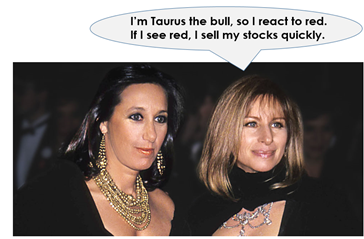
Barbara Streisand, an American singer and actress found a new occupation for herself in 1999, during the heydays of the dot com bubble. She became a stock picker. What’s more, she started managing funds of her close friend Donna Karan, a leading US fashion designer, of the DKNY fame.

Times were so good then, that in just five months of intense trading, Streisand turned Karan’s investment of US$ 1 million to US$ 1.8 million.

Now, for all her dabbling in the risky territory of stock trading, Streisand admitted that the volatility made her nervous. As she confessed then to a friend, “I can’t stand to see red in my profit-or-loss column. I’m Taurus the bull, so I react to red. If I see red, I sell my stocks quickly.”

Well, for a die-hard fan of Streisand or a stock trader, this rule of selling stocks – whenever they are in the red – may sound like a gospel truth. In fact, some of the smartest and most successful traders would agree to the fact about cutting their losses as soon as possible.
[Read more…] about Spotlight: When to Sell Your Stocks

Life 2.0: Writing, the Warren Buffett Way

August 30, 2016

There is no greater agony than bearing an untold story inside you.” ~ Maya Angelou

One of the key characteristics of the world’s most charismatic men is their uncanny ability to engage people. After all, this is what makes them charismatic.

All these men – like Warren Buffett or Jack Welch – engage people like no one else. As they speak their first words, the world is all ears.

Take Buffett for instance. He is inarguably the world’s best investor. After reading his annual reports for the past ten years, I also count him among the most charismatic writers I’ve ever come across.

Buffett’s annual letters to shareholders are masterpieces, year after year. And he’s writing those plain-white zero-graphic booklets for the past five decades.

Pick up any annual report other than Berkshire’s (Buffett’s company), and you will know what I’m talking about. Almost 99% of other annual reports follow the ‘safe, bland, reassuring’ route. The ‘letter to shareholders’ are written by expert writers (and not CEOs themselves), and most contain language that is best fit for a dull, dreary advertisement.

<!–more–>[show_to accesslevel=’almanack-all’]

Buffett, on the other hand, writes each and every word of his ‘letter to shareholders’. And this is the reason his letters carry the touch that other annual reports miss. Take a look at his 2015 letter to shareholders and you’ll know what I mean.

So what is it that makes Buffett stand apart from other CEOs? Why are his letters so engaging?

The answer – There are some rules of good writing that Buffett follows, which makes his investors and others (like me) await eagerly for his letter to shareholders every year, and gorge on it as soon as it comes out.

Warren Buffett’s Rules of Writing Brilliantly

Here is what makes Buffett’s writing awesome and engaging:

1. Tells stories: Very much like Steve Jobs was, Buffett is a master storyteller. Reading his letters is like sitting across a dining table with an old pal who possesses both intelligence and insatiable curiosity.

In his 2010 letter, here’s how Buffett described his intention to buy companies with his company’s excess cash – “We will need both good performance from our current businesses and more major acquisitions. We’re prepared. Our elephant gun has been reloaded, and my trigger finger is itchy.”

Which other CEO would describe his company’s cash as an ‘elephant gun’ and himself having an ‘itchy trigger finger’? But this is how Buffett makes difficult explanations look simpler, because this is the way people understand and this is what they like to read.

2. Uses vivid language: We are not natively smarter than we were when our country was founded nor do we work harder. But look around you and see a world beyond the dreams of any colonial citizen. Now, as in 1776, 1861, 1932 and 1941, America’s best days lie ahead.

Notice how he takes the reader to the distant centuries and raises hopes of the Americans who are currently facing tough economic conditions. Vividness is what best describes how Buffett discusses situations, good or bad. And vividness is what makes reading his annual reports such an entertaining affair.

3. Brings in people: “We love our employees.” “We are an employee-friendly organization.” “We take care or all our employees’ needs.” This is how most CEOs talk about their employees in their annual reports. But Buffett is different. He doesn’t talk about his view on his employees. He shows it.

Here’s an example of how he shows his appreciation for one of his long-time employees, Ajit Jain –

From a standing start in 1985, Ajit has created an insurance business with float of $30 billion and significant underwriting profits, a feat that no CEO of any other insurer has come close to matching. By his accomplishments, he has added a great many billions of dollars to the value of Berkshire. Even kryptonite bounces off Ajit.

When someone writes about people using such words, how can you not keep reading?

4. Uses humour: “Our team resembles a baseball squad composed of all-stars having vastly different batting styles. Changes in our line-up are seldom required.”

This is how Buffett describes his top management guys. Or take for matter his description of an opportunity where his various companies are eyeing the same company to acquire – “Competition for the few opportunities that are available tends to become fierce. The seller has the upper hand, as a girl might if she were the only female at a party attended by many boys. That lopsided situation would be great for the girl, but terrible for the boys.”

Every letter that Buffett writes brims with jokes. He’ll even shock you by bringing in humour where you’d least expect it. This is what only a master writer can do.

5. Shows enthusiasm: Good writing is good description that begins in the writer’s imagination and ends in the reader’s. An enthusiastic writer leads to an enthusiastic reader. This is a simple rule of good writing that Buffett understands very well.

His enthusiasm about going to work every day, even at his ripe age, shines brightly through his letters. As he writes, “The good news: At 76, I feel terrific and, according to all measurable indicators, am in excellent health. It’s amazing what Cherry Coke and hamburgers will do for a fellow.”

Well, as an aside, Buffett today completes 86 years.

Read Buffett to Become a Better Writer

I have been reading Buffett’s letters actively since 2006, and have read all his letters dating back to 1959, when he was managing an investment partnership. This was before Berkshire came into his life.

Even after reading so much of him, I look forward each March to the arrival of his brand new letter and thoroughly enjoy reading every word of it. I now suggest that if you want to improve your writing and become a good writer, you must read Buffett…and a lot of him.

Finally, here’s a golden piece of advice on becoming a good writer, from Buffett himself:

Write with a specific person in mind. When writing Berkshire Hathaway’s annual report, I pretend that I’m talking to my sisters. I have no trouble picturing them: Though highly intelligent, they are not experts in accounting or finance. They will understand plain English, but jargon may puzzle them. My goal is simply to give them the information I would wish them to supply me if our positions were reversed. To succeed, I don’t need to be Shakespeare; I must, though, have a sincere desire to inform.

No siblings to write to? Borrow mine: Just begin with “Dear Doris and Bertie.

10 Steps to Become Better at Writing

Here are the 10 simple steps that have helped me become better at writing engaging stuff over the years. I find no reason these won’t help you as well.

1. Write.
2. Write more.
3. Write even more.
4. Write even more than that.
5. Write when you don’t want to.
6. Write when you do.
7. Write when you have something to say.
8. Write when you don’t.
9. Write every day.
10. Keep writing.

Simple, isn’t it? 😉

Further Reading

Even as you practice writing on your own, here are a few great books that will teach you how to write engaging, cornerstone content. I suggest you pick each one of these and read and re-read them.

The Elements of Style(Strunk & White)
Originally written almost 93 years back, ‘The Elements of Style’ by William Strunk Hr. & E.B. White is one book that must be in the library of every budding writer. It is a definitive writing guide that talks about the rules of usage of the English language. It’s a small book (104 pages, in print version), so you might take no more than a day to read this magnificent work on writing.

Influence: The Psychology of Persuasion (Robert (Robert Cialdini)
This bestseller from Robert Cialdini, a social psychologist, is not just for writers. It’s also for consumers and investors. For writers, it suggests how to better understand human nature that make responding (by consumers) in a given way almost irresistible. For consumers, it’s about knowing how he can be manipulated based on human behavioural tendencies, and how he can defend himself from these techniques.


Scientific Advertising (Claude Hopkins)
Scientific Advertising by Claude C. Hopkins is a timeless classic written many years ago but a book whose powerful principles still ring true to this day. It contains 21 chapters of timeless strategies you don’t want to ignore in your advertising and writing efforts. In fact, David Ogilvy once said: “Nobody, at any level, should be allowed to have anything to do with advertising until he has read this book seven times.” Through this book, Hopkins shares the secrets of successful marketing that are just as relevant today as they were almost a century ago when this book was originally published (1923). It delves on the importance of salesmanship, why businesses must offer service, what makes headlines effective, understanding customer psychology, the impact of negative advertising, and much more.

On Writing (Stephen King)
This is not a full-fledged book on how to write. It is instead the autobiography of Stephen King, one of the best known American horror fiction writers. King has used this book to also talk about his experiences as a writer. It contains some simple (yet brilliant) advice on writing, from tips on grammar to ideas about developing plot and character. King describes it as a guide for how ‘a competent writer can become a good one’. He stresses on the point that a writer must edit out unwanted details and thoroughly avoid the use of unnecessary adverbs. King is very easy to read, and writes like a friendly mentor chatting to you over a dinner table. Overall, this book is entertaining and packed with invaluable advice.

Happy writing!

[/show_to] [hide_from accesslevel=’almanack-all’]

Want to Read More? This content is exclusive for members of Value Investing Almanack. Login to read if you are a member. Else, click here to subscribe.

Benefits to VIA Members
 
  • Spotlight: Big ideas from Value Investing and why applying them in your investment decision making will be a great deal
  • InvestorInsights: Interviews with experienced value investors, learners, and deep thinkers
  • StockTalk: Thorough analysis of business models of companies (without any recommendations)
  • Behaviouronomics: Deep analysis of human behaviour and how it impacts investment decision making
  • BookWorm: Reviews of the best books on Value Investing and related subjects
  • Free Course – Financial Statement Analysis for Smart People (otherwise priced at Rs 5,900)
  • Archives: Instant access to our huge archive from the past three years
Become a VIA Member. Click to Subscribe
[/hide_from]

Super Investor: Howard Marks on Second Level Thinking

August 30, 2016

The environment we live in today is pretty complex. No moment is exactly the same. History, as they say, never repeats itself. You can never claim confidently that a set of causes will always replicate the same set of effects unless you’re dealing with hard physical laws.

Even if you do something with good intentions, the inherent complexity of the world will tend to produce results which you could never have anticipated. The world is complex and unfair. Here’s an anecdote to prove my point.

During the British government in India, the city of Delhi was facing the problem of too many venomous cobra snakes. To deal with the issue, government officials offered a bounty for every dead cobra. Initially this was a successful strategy as large numbers of snakes were killed for the reward. Eventually, however, enterprising people began to breed cobras for the income. When the government became aware of this, the reward program was scrapped, causing the cobra breeders to set the now-worthless snakes free. As a result, the wild cobra population further increased. The apparent solution for the problem made the situation even worse.

<!–more–>[show_to accesslevel=’almanack-all’]

Samuel Johnson aptly said, “The road to hell is paved with good intentions.” This story about cobras could be apocryphal, but it brings forth a very important learning about how the world around us works and responds to our actions. It tells us that every action has consequences, intended and unintended. Which means no matter how carefully we plan, we can’t anticipate everything.

This phenomenon is also known as the law of unintended consequences. In simpler words, the law states that sometimes in an attempt to solve one problem, we end up manufacturing another one, perhaps even a bigger than the original problem.
Charlie Munger understood the risks of unintended consequences while dealing with social systems. When asked about corporate responsibility for social problems, he answered –

I’m all for fixing social problems. I’m all for being generous to the less fortunate. And I’m all for doing things where, based on slight preponderance of the evidence, you guess that it’s likely to do more good than harm…What I’m against is being very confident and feeling that you know, for sure, that your particular intervention will do more good than harm given that you’re dealing with highly complex systems wherein everything is interacting with everything else.

The complexity and unpredictability that infects the world around us, pervades through the world of investing too. An investment approach may work for a while, writes Howard Marks, “but eventually the action it calls for will change the environment, meaning a new approach is needed. And if others emulate an approach, that will blunt its effectiveness.”

Just in case you haven’t heard of Howard Marks, let me tell you who he is so that you realize how important his words are. Howard Marks manages US$ 90 billion hedge fund called Oaktree Capital and has more than four decades of investing experience. And this what Warren Buffett says about the memos that Marks regularly writes to his clients –

When I see memos from Howard Marks in my mail, they’re the first thing I open and read. I always learn something, and that goes double for his book.

So today we are going to pick Howard Marks’ brains on dealing with this problem of unintended consequence. He recommends something called second level thinking. What’s second level thinking?

If you were thinking like government officials announcing the reward scheme for killing the cobras, you indulged in something called first level thinking. Most people practice first-level thinking. First-level thinkers tend to favour the most obvious and straight answer to a problem. This kind of linear thinking is simplistic and superficial.

If you want to detect signs of first level thinking in your own mind, just ask WHY a couple of times and dig deeper. In most cases, the reasoning led by first-level thinking turns out to be more of an opinion rather than a well thought argument.

However, if one could reason beforehand that, among many other possibilities, one possible outcome of rewarding people for killing cobras is triggering of perverse incentives resulting in cobra-breeding, he or she would be called a second level thinker.

Marks writes –

Remember, your goal in investing isn’t to earn average returns; you want to do better than average. Thus, your thinking has to be better than that of others – both more powerful and at a higher level. Since other investors may be smart, well-informed and highly computerized, you must find an edge they don’t have. You must think of something they haven’t thought of, see things they miss or bring insight they don’t possess. You have to react differently and behave differently. In short, being right may be a necessary condition for investment success, but it won’t be sufficient. You must be more right than others…which by definition means your thinking has to be different.

Gone are the days when access to important information was a privilege. In fact, it would be naive to think that you know more than others just because you have read a company’s annual report and few related articles on the internet. Information technology and internet has democratized the access to information. Any and perhaps all kinds of information is just a click away or rather a touch away, if you have a smartphone. That’s a great advancement but the paradox is, since everyone has access to it, information doesn’t create edge anymore.

Today, the real edge comes from deriving superior insights based on the same facts that everyone has. Edge comes by looking at same things but thinking different thoughts. Edge comes from second level thinking.

Remember what the veteran value investor (the anonymous investor having three decades of experience), who we interviewed in last issue of Almanack, said? Let me pull out his words from VIA archives. He said –

The idea that through numbers and through models you can capture the entire reality is not true. In investing it’s through judgement…If you want to become a better investor, what you really got to focus on is this ability to sharpen your mind in terms of how it processes information…the quality of information is not relevant beyond a point. You’ve got to have what you need to really understand better. Quality is how much it allows you to improve your understanding and interpretation of what you know so that you can translate your interpretation into better judgment which leads to superior behaviour. Because information first needs to be interpreted. That’s the first stage. And understood. So if you can interpret information better than other people, you have an advantage there itself.

Notice the words that I have highlighted in bold above. What those words are saying, repeatedly, is that beyond a point quantity and quality of information ceases to matter. And that threshold point of information is easily available to everyone today. What matters more is the depth and quality of inferences drawn from the public data. The ability to generate superior insights is what separates men from the boys in stock market investing. And second level thinking is the stepping stone for finding superior insights.

Here are a few concrete examples about how second level thinking works in investing, straight from Marks –

First-level thinking says, “It’s a good company; let’s buy the stock.” Second-level thinking says, “It’s a good company, but everyone thinks it’s a great company, and it’s not. So the stock’s overrated and overpriced; let’s sell.”

First-level thinking says, “The outlook calls for low growth and rising inflation. Let’s dump our stocks.” Second-level thinking says, “The outlook stinks, but everyone else is selling in panic. Buy!”

First-level thinking says, “I think the company’s earnings will fall; sell.” Second-level thinking says, “I think the company’s earnings will fall less than people expect, and the pleasant surprise will lift the stock; buy.

Second-level thinking requires you to account for multiple factors. You have to look at a problem from different vantage points. In fact, the foundation of second-level thinking rests more on asking intelligent questions rather finding right answers. For example –

• What is the range of likely future outcomes? (Requires imagination)
• Which outcome do I think will occur? (Requires knowledge and experience about the domain; Requires knowledge of probability and statistics)
• What is the probability that I’m right? (Requires you to be brutally honest about your skills)
• How does my expectation differ from consensus? (Requires knowledge of human behaviour and crowd psychology)
• How does the current price for the asset comport with the consensus view of the future, and with mine? (Requires knowledge of business analysis)
• Is the consensus psychology that’s incorporated in the price too bullish or bearish?
• What will happen to the asset’s price if the consensus turns out to be right, and what if I’m right? (Understanding the risk and the size of potential reward; Ability to handle uncertainty)

For that matter, Porter’s five force analysis model is another great tool to trigger second-level thinking in business analysis. It zooms out your vision to look at the industry and takes your focus away from overly simplistic parameters like P/E ratios.

Second-level thinking is deep, complex, convoluted and pretty heavy duty. Isn’t it? Well, beating the average stock market returns is not easy. And it’s not supposed to be easy, says Munger, “Anyone who finds it easy is stupid.”

First-level thinkers, by definition, can never outperform the market on a consistent basis. Marks argues –

First-level thinkers think the same way other first level thinkers do about the same things, and they generally reach the same conclusions. By definition, this can’t be the route to superior results. All investors can’t beat the market since, collectively, they are the market.

Conclusion

If someone argues that he bought the stock because he had a good experience with the product, you know you are not talking to a second-level thinker.

Generating satisfactory investment returns i.e., at par with broader market, isn’t too complicated. It’s as simple as buying an index fund.

However, the moment people extrapolate this simplicity along with expectation for market beating returns, they forget Albert Einstein’s advice who said –

“Everything should be made as simple as possible, but not simpler.”

I’ll leave you with this final thought from Marks –

“Those who consider the investment process simple generally aren’t aware of the need for – or even the existence of – second level thinking. Thus, many people are misled into believing that everyone can be a successful investor.

Not everyone can. But the good news is that the prevalence of first-level thinkers increases the returns available to second-level thinkers.”

Unlike Olympics, thinking is one skill where your eyes should always be set on the second level than first.

[/show_to] [hide_from accesslevel=’almanack-all’]

Want to Read More? This content is exclusive for members of Value Investing Almanack. Login to read if you are a member. Else, click here to subscribe.

Benefits to VIA Members
 
  • Spotlight: Big ideas from Value Investing and why applying them in your investment decision making will be a great deal
  • InvestorInsights: Interviews with experienced value investors, learners, and deep thinkers
  • StockTalk: Thorough analysis of business models of companies (without any recommendations)
  • Behaviouronomics: Deep analysis of human behaviour and how it impacts investment decision making
  • BookWorm: Reviews of the best books on Value Investing and related subjects
  • Free Course – Financial Statement Analysis for Smart People (otherwise priced at Rs 5,900)
  • Archives: Instant access to our huge archive from the past three years
Become a VIA Member. Click to Subscribe
[/hide_from]
  • « Go to Previous Page
  • Page 1
  • Interim pages omitted …
  • Page 47
  • Page 48
  • Page 49
  • Page 50
  • Page 51
  • Interim pages omitted …
  • Page 72
  • Go to Next Page »

Handcrafted with in India