
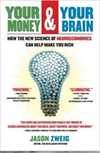
Jason Zweig shows what happens in your brain when you think about money and tells investors how to take practical, simple steps to avoid common mistakes and become more successful.
Jason Zweig is an investment journalist and a long time investing columnist for Wall Street Journal. He is best known for editing and adding commentary to the revised edition of Benjamin Graham’s investment classic The Intelligent Investor. Graham’s book, considered as investing bible by many, was first published in 1949 and stays on top of every value investor’s reading list. In his commentary, Zweig has made Graham’s principles easier to understand and implement.
Your Money and Your Brain is Zweig’s attempt to demystify the subject of behavioural economics. The hypothesis that our emotions interfere with our rational thinking isn’t a hypothesis anymore. Zweig writes –
… over the past few years, scientists have made stunning discoveries about the ways the human brain evaluates rewards, sizes up risks, and calculates probabilities. With the wonders of imaging technology, we can now observe the precise neural circuitry that switches on and off in your brain when you invest.
[show_to accesslevel=’almanack-all’] Advancement in technology has added another dimension of neuroscience to the field of behavioural economics. Neuroeconomics is thus the hybrid of neuroscience, economics and psychology. The electrical activity inside our brains gives very important clues.
The 100 billion neurons that are packed into that three-pound clump of tissue between your ears can generate an emotional tornado when you think about money. Your investing brain does not just add and multiply and estimate and evaluate. When you win, lose, or risk money, you stir up some of the most profound emotions a human being can ever feel…the neural activity of someone whose investments are making money is indistinguishable from that of someone who is high on cocaine or morphine.
Before we delve deeper, a caveat is in order. Immediately after Daniel Kahneman won Nobel Prize for his pioneering work on behavioural finance, the market was flooded with books on the subject of behavioural biases and human irrationality. Suddenly our emotional brain was declared a villain by all the self-proclaimed behavioural experts. Taking behavioural economics to the extreme is not exactly an intelligent idea either.
And it’s not as if emotion is the enemy and reason is the ally of good financial decisions. People who have suffered head injuries that prevent them from engaging the emotional circuitry in their brains can be terrible investors. Pure rationality with no feelings can be as bad for your portfolio as sheer emotion unchecked by reason. Neuroeconomics shows that you will get the best results when you harness your emotions, not when you strangle them.
Although Zweig too primarily talks about how our emotions undermine the quality of decisions relating to money, he also recommends a balanced approach. When markets are either silent or moving slowly, it’s not too difficult for someone to practice rationality. Reading annual reports and thinking about business fundamentals is easy when stock market is going sideways. In fact, that’s the time to cut some slack to our emotions. Because these are the very emotions which make us human. Challenge comes when a sudden spike or drop creates tremors in the market. That’s the time to be watchful of our reflexive brain’s (what Kahneman calls System 1 thinking) tantrums.
Reflexive Brain Vs Reflective Brain
Reflexive brain is that part which works on autopilot. It’s fast, effortless and intuitive. Intuition can yield wondrously fast and accurate judgments, but only under the right conditions— when the rules for reaching a good decision are simple and stable. Unfortunately, investing decisions are rarely simple and hence a good investment thinking process requires intervention from the Reflective brain. Kahneman has termed this reflective brain as System 2 thinking.
…Intuition has a legitimate role to play in investing —but it should be a subordinate, not a dominant, role. Fortunately, you can make your intuitions work better for you, and you do not have to invest by intuition alone. The best financial decisions draw on the dual strengths of your investing brain: intuition and analysis, feeling and thinking.
Relying too much on the reflective brain is also very dangerous. Zweig writes –
In the financial markets, people who rely blindly on their reflective systems often end up losing the forest for the trees —and their shirts as well…I have met engineers who spend two or three hours a day analyzing stocks. They are often convinced that they’ve discovered a unique statistical secret that will enable them to beat the market. Because they have squelched their intuition, their analysis fails to alert them to the most obvious fact of all: There’s always something to measure on Wall Street, which spews out a torrent of statistics on everything under the sun. Unfortunately, at least 100 million other investors can view the same data, taking away most of its value —while, at any moment, an unforeseen event can blindside the market, rendering anyone’s statistical analysis at least temporarily useless.
In fact, over reliance on reflective brain can open a backdoor for the evil side of reflexive brain to make an entry in form of overconfidence bias. For example, many investors, in the name of rational analysis, spend disproportionate amount of time investigating a stock, digging out every possible information about the company. The “sunk cost” feeling for the efforts then becomes a justification for investing in the stock.
“Since both systems have their strengths and weaknesses, the challenge for you as an investor is to make your reflective and reflexive sides work better together, so that you can strike the right balance between thinking and feeling.”
Let me highlight some of the insights which I encountered for the first time in a behavioural economics book.
Denominator Blind Reflexive Brain
Imagine a small bowl and a large bowl full of jelly beans. The small bowl holds 10 jelly beans, of which 9 are white and 1 is red. The large bowl contains 100 jelly beans of which 95 are white 5 are red. You are blindfolded, so you can’t really see the colour of jelly bean while you’re picking it up but you’ll earn Rs. 100 if you end up picking a red one. Which bowl would you choose?
As you can figure out, the smaller bowl has 10 percent red jelly beans; and the bigger one has only 5 percent red jelly beans. But many people still prefer to pick from the bowl that they “know” has lower odds of success, because they “feel” it offers more ways to win.
This error of judgement, the so called jelly bean syndrome, is also known as denominator blindness. The reflexive brain finds it harder to deal with relative numbers (percentages) and gets fooled by absolute numbers. In above example, people compare the 5 red jelly beans available in bigger bowl to the single red jelly bean available in the smaller bowl.
…it’s the denominator that matters; that’s where the real money is. After all, the sum total of your wealth is a much more important number than the amount by which it rose or fell on any given day. Even so, many investors fixate on the numbers that change the most, overlooking the much larger amounts of money that are at stake overall…The jellybean syndrome hits home in other ways.
The fees and expenses charged by mutual funds are a small number —typically less than 2% a year —while performance can be a big number, sometimes surpassing 20% a year. And the expense figures barely fluctuate at all, while the performance numbers are forever flashing up and down.
No wonder individual investors consistently say that they consider past performance to be much more important than current expenses when they pick a fund.
Risk, Perception of Risk, and Pascal’s Wager
When it comes to risk, there is a huge gap between our reflexive brain’s perception of risk and the real risk. Zweig writes –
If you unquestioningly trust your intuitive perceptions of risk, you will chronically take gambles you should avoid and back away from bets you should embrace…Many investors who think they like big financial gambles often end up miserable once they actually lose money. Elderly widows can take huge financial risks, while some young single men invest like complete cowards.
Have you ever filled a risk assessment survey offered by a financial planner before? Do you notice that instead of assessing your real risk, they focus on what you feel about your own risk taking abilities? Risk assessment questionnaires are probably one of the dumbest ideas pervading in the investment industry.
…problem with these questionnaires is that they assume you already know how much risk you are comfortable with. If you knew that, why would you need to take a quiz?
For most people, the perception of risk depends on their current mood and recent events. Anxiety makes us shy away from extra risk and euphoria increases your risk tolerance quite a bit.
The real risk that comes from losing something is dependent on what’s the size of the loss as compared to your total wealth/portfolio. One of the best examples to illustrate the idea of risk is Pascal’s Wager.
When you’re on fire with the hope of striking it rich on some investment, remember to consider not just how much you will make if you are right but how much you will lose if you are wrong. In what’s known as “Pascal’s Wager,” the mathematician and theologian Blaise Pascal provided a model for how to think about this problem. Since God’s existence is a matter of faith, not scientific proof, how should you live? Let’s say you gamble that God exists, so you lead a virtuous life —but it turns out that there is no God. You miss enjoying a few sins while you are alive, but that’s all your gamble costs you. Now let’s say you gamble that there is no God and sin your way through life without a qualm— and it turns out that God does exist. The payoff on this gamble is a few decades of cheap thrills— then an eternity burning in Hell. In Peter Bernstein’s words, Pascal’s Wager shows that whether you should take a risk depends not just on the probability that you are right but also on the consequences if you are wrong. To make reliably good decisions, you must always weigh how right you think you are against how sorry you will be if you turn out to be mistaken.
The most unexpected section in Zweig’s book was on the topic of happiness. Although Daniel Kahneman spends quite a bit of time on the same topic in his book Thinking Fast and Slow,, I really enjoyed reading Jason’s take on the subject of happiness. If you could read just one chapter in this book, Chapter 10 should be it.
Conclusion
Many of the books that I have read on behavioural finance, get so busy talking about cognitive biases that they end up presenting a lopsided view. When I first started learning about human biases, I overdosed too much on them. It’s true that cognitive biases lead us to make systematic errors of judgement but these are the very same biases which make us human. Without them we won’t be able to function even for a minute in this world. In fact, being rational truly means acknowledging the relevance of reflexive brain and using it wisely. According to Zweig, to become a successful investor one needs to strike a right balance between rational thinking and intuitive thinking.
Someone who was officially chosen to write the commentary on Benjamin Graham’s seminal book, doesn’t need my stamp of approval. But that won’t stop me from saying this – Jason Zweig is an outstanding writer and a brilliant thinker.
Let me wrap up here with my standard disclaimer.
Reading this book review is by no means a replacement for the book. This is meant to rekindle the fire of curiosity inside you. I am sure the bookworm in you will find this book worth reading.
The importance of reading books can never be overemphasized. The purpose of reading isn’t just for becoming more knowledgeable but to become a better human being.
Remember, there is no secret to reading more. It’s all about the game of setting the right priorities. You just have to change your perception so that reading becomes an extension of who you are and what you do.
Happy reading!

- Spotlight: Big ideas from Value Investing and why applying them in your investment decision making will be a great deal
- InvestorInsights: Interviews with experienced value investors, learners, and deep thinkers
- StockTalk: Thorough analysis of business models of companies (without any recommendations)
- Behaviouronomics: Deep analysis of human behaviour and how it impacts investment decision making
- BookWorm: Reviews of the best books on Value Investing and related subjects
- Free Course – Financial Statement Analysis for Smart People (otherwise priced at Rs 5,900)
- Archives: Instant access to our huge archive from the past three years