
If you are a long-term investor, the very thought of selling a stock comes with a host of emotions and dilemmas. In this post, we bring in experienced investors to share their thoughts on how they have managed to overcome the issues surrounding selling their own stocks.
Barbara Streisand, an American singer and actress found a new occupation for herself in 1999, during the heydays of the dot com bubble. She became a stock picker. What’s more, she started managing funds of her close friend Donna Karan, a leading US fashion designer, of the DKNY fame.
Times were so good then, that in just five months of intense trading, Streisand turned Karan’s investment of US$ 1 million to US$ 1.8 million.
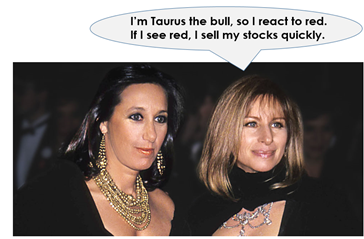
Now, for all her dabbling in the risky territory of stock trading, Streisand admitted that the volatility made her nervous. As she confessed then to a friend, “I can’t stand to see red in my profit-or-loss column. I’m Taurus the bull, so I react to red. If I see red, I sell my stocks quickly.”
Well, for a die-hard fan of Streisand or a stock trader, this rule of selling stocks – whenever they are in the red – may sound like a gospel truth. In fact, some of the smartest and most successful traders would agree to the fact about cutting their losses as soon as possible.
[show_to accesslevel=’almanack-all’]
But if you are a long-term investor, the very thought of selling a stock comes with a host of emotions and dilemmas.
You see, if you simply throw darts at stock tables, you can hit any one of the thousands of stocks listed, and then buy it. Should you hesitate for some reason or other, and miss the opportunity, you’ve lost nothing; your cash, purchasing power, is still available until another choice is available.
To take the same approach to selling is obviously absurd. The situation is no longer casual or random, and hesitation can cost you big. The rest of the thousands of stocks that your dart missed now are not your concern. For better or worse, you are obliged to confront exclusively and continually the stocks you own.
The problem would not be too severe if you could merely turn the buying process upside down and operate on the simple basis that whatever influenced you to buy the stock in the first place will, in reverse, indicate the time and price at which to sell that stock.
No matter what the stock did in the past, it assumes a new life once you start owning it. And this new life brings with it a host of psychic dilemmas, with the stock owner’s ego, superego, and reality in a state of constant battle…especially since, in the stock market, one is never quite sure what the reality is.
Consider these nagging questions –
• If the stock has gone up, will it go up more? Or is this the time to sell?
• If it has gone down, will it slide some more or turn around and go up at last, probably the minute after it is sold?
• Should I take a small loss now?
• Could I swallow such a huge loss or should I at least wait for a rebound?
• Now that it is finally rebounding, should I hold until I’m even?
• Now that I’m even, shouldn’t I reward my (although forced) patience by aiming for a gain?
The decision not to sell maintains hope, thereby preserving a future. Indeed, the thought of selling a stock and thus abruptly ending the dream is so paralyzing that for every conceivable market situation there are readymade excuses for holding on at least a little while longer. And these excuses invariably are based on the desire to believe that the future will be better than the present.
Any excuse, however absurd, becomes convenient as long as it postpones the necessity to act. Those in unhappy marriages will understand that.
Anyways, to help you get over some of the excuses and dilemmas of selling your stocks, we have roped in a few experienced investors and have asked them to share their own thoughts on how they make their selling decisions. Without further ado, let’s start right away.
Prof. Sanjay Bakshi
(Adjunct Prof, MDI Gurgaon)

The sell decision is tougher than the buy decision primarily because of the emotions involved. The person who is yet to buy a stock which he doesn’t own is prone to be far less emotional than the person who is contemplating selling something he has owned for a while.
If, for example, the stock has gone nowhere, or has declined, the seller is likely to be prone to loss aversion which means that most people are super-sensitive to losses than to equivalent gains. And if the loss is severe, he is likely to go into a denial mode and even refuse to look at the situation dispassionately, including comparing it with other opportunities that might be available to him at the time.
He is also likely to be a victim of what Robert Cialdini called bias from commitment and consistency. Everyone likes to believe that he is a good decision maker. So, if the stock is down, he is prone to assume that the market is wrong and that he is right. A strong belief in the market behaving like a voting machine, instead of a weighing machine will help him justify his decision to hold on to a losing position for too long. Man, as they say, is not a rational animal, he is a rationalising one.
If the stock has gone up a lot, there will be huge reinforcement effects that come from the rewards of ownership of a profitable investment and one of the consequences of this that the human brain gets extra doses of dopamine much as a cocaine addict does when he is high on the drug. The man who is sitting on extraordinary profits is no different from the man who is high on cocaine. Both want more.
Why should someone rationally sell a stock? Well, if you think about this carefully, then the only answer is that one should sell a stock if there is better use of the money elsewhere. Need the money for some urgent personal commitment? Sell. Found something far better? Sell. Made a mistake? Sell because going into cash is better than to hold on.
So the only real reason to sell is that there are other more compelling opportunities (which include the need to sell for some personal commitments).
How to make the sell decision much less prone to emotions than is normally the case?
Different people use different methods. My own method which, by the way, only applies to the kind of value investing that interests me (moats) and not to other types of value investing like Graham-and-Dodd bargain securities, risk arb, workouts, activism etc, draws inspiration from three people: Philip Fisher, John Maynard Keynes and Benjamin Franklin.
If the job has been correctly done when a common stock is purchased, the time to sell it is-almost never. – Philip Fisher
The spectacle of modern investment markets has sometimes moved me towards the conclusion that to make the purchase of an investment permanent and indissoluble, like marriage, except by reason of death or other grave causes, might be a useful remedy for our contemporary evils. For this would force the investor to direct his mind to the long-term prospects and to those only. – John Maynard Keynes
When facts change, I change my mind.” — John Maynard Keynes
Keep your eyes wide open before marriage, half shut afterwards.” — Benjamin Franklin
This is something I had sent to you in an earlier note, which I reproduce here.
Text from Earlier Note
The decision to buy is not the same as the decision to hold on to something that’s really worked for you for exactly the reasons you envisaged before you bought it in the first place.
Let me explain how that works.
In my final Relaxo lecture, , I had articulated my thoughts about determining expected return of an investment operation involving the buying and holding the business for a decade. In order to make that estimate, I built in several sources of “redundancies” to act as sources of margin of safety.
First, I applied the method to a business model with is suited to that method (easy to understand, moated businesses, with a dominant market position and strong long-term growth prospects derived from both business volume growth as well as realisation growth). It would be foolish to apply this method to every business model.
Second, while making assumptions about owner earnings a decade later, I used assumptions which were conservative as compared to the actual performance of the business in the past.
Finally, while determining the exit multiple 10 years later, I used an exit multiple of well below 20x — a cap I use for all expected return models as an exercise in discipline, even though I know that many businesses would be worth a lot more than 20x earnings a decade from now, given their profitability and growth potential even beyond 10 years.
The idea behind the above is to create multiple sources of margin of safety. The first point delivers a margin of safety by keeping you away from bad businesses. Investors should recognise that margin of safety, apart from a low price, can also come from a high quality business.
The other two points help you think about reasonable valuation a decade from now.
To be sure, no one knows what the value of the business will be a decade from now. But, by exercising caution using the method I described above and in my lecture, one can come up with some notion of “expected return”.
Now, all that one has to do is to figure out if it makes sense to buy the stock or not by calculating the expected return and comparing it to other opportunities available to you at that time.
Now, let me tell you my thoughts on the other decision I mentioned earlier — the decision to hold on to a business which works well for you for reasons you have articulated in the original investment thesis. The big lesson here is to not focus on the stock price but to focus on performance of the underlying business. As Mr. Buffett says, focus on the playing field, not the scoreboard. Too many investors look at the score board instead of the playing field. That is, they tend to focus on the current stock price, the current P/E multiple or the percentage gain in the stock price in relation to the gains in some index or some other stocks. And, if they own the stock, they start thinking along the following lines:
1. OMG its gone up so much so quickly, so I better sell. (Anchoring to cost)
2. It’s selling at xyz P/E multiple which is so high compared to the past P/E multiple history of the stock, or the P/E multiple of the stock market, or the P/E multiple of other similar businesses, so I better sell. (Anchoring to historic or near term P/E Multiple)
3. If I plug in the assumptions that I used in my original expected return model, then at the current stock price, the model will predict a very low future expected return, and so I should sell. (Anchoring to ultra-conservative assumptions used before buying despite seeing far better performance).
That kind of thinking works well with other types of value investing, in particular, with classic Graham-and-Dodd style of value investing. But I don’t think it applies to moat investing.
What’s the big lesson in common stock investing? The big lesson is to buy great businesses at reasonable valuations and then to sit on them for a long-long time. If you take a sample of 100 very successful investors who have compounded their capital at a high rate for a long-long time, you will find that an overwhelming majority of them simply did not sell the great businesses they had bought by giving in to any of the three temptations I listed above. In particular, they did not overdo the excel modelling to keep calculating the future expected returns based on current stock price. Nor did they worry about selling a stock simply because it was not quoting at a P/E multiple which made the stock look expensive. Rather they followed Philip Fisher’s advice who wrote this in his classic book on investing titled “Common Stocks and Uncommon Profits.”
At this point the critical reader has probably discerned a basic investment principle which by and large seems only to be understood by a small minority of successful investors. This is that once a stock has been properly selected and has borne the test of time, it is only occasionally that there is any reason for selling it at all. However, recommendations and comments continue to pour out of the financial community giving other types of reasons for selling outstanding common stocks. What about the validity of such reasons? Most frequently given of such reasons is the conviction that a general stock market decline of some proportion is somewhere in the offing. In the preceding chapter I tried to show that postponing an attractive purchase because of fear of what the general market might do will, over the years, prove very costly. This is because the investor is ignoring a powerful influence about which he has positive knowledge through fear of a less powerful force about which, in the present state of human knowledge, he and everyone else is largely guessing. If the argument is valid that the purchase of attractive common stocks should not be unduly influenced by fear of ordinary bear markets, the argument against selling outstanding stocks because of these fears is even more impressive. All the arguments mentioned in the previous chapter equally apply here.
This brings us to another line of reasoning so often used to cause well-intentioned but unsophisticated investors to miss huge future profits. This is the argument that an outstanding stock has become overpriced and therefore should be sold. What is more logical than this? If a stock is overpriced, why not sell it rather than keep it?
Before reaching hasty conclusions, let us look a little bit below the surface. Just what is overpriced? What are we trying to accomplish? Any really good stock will sell and should sell at a higher ratio to current earnings than a stock with a stable rather than an expanding earning power. After all, this probability of participating in continued growth is obviously worth something. When we say that the stock is overpriced, we may mean that it is selling at an even higher ratio in relation to this expected earning power than we believe it should be. Possibly we may mean that it is selling at an even higher ratio than are other comparable stocks with similar prospects of materially increasing their future earnings.
All of this is trying to measure something with a greater degree of preciseness than is possible. The investor cannot pinpoint just how much per share a particular company will earn two years from now. He can at best judge this within such general and non-mathematical limits as “about the same,” “up moderately,” “up a lot,” or “up tremendously.” As a matter of fact, the company’s top management cannot come a great deal closer than this. Either they or the investor should come pretty close in judging whether a sizable increase in average earnings is likely to occur a few years from now. But just how much increase, or the exact year in which it will occur, usually involves guessing on enough variables to make precise predictions impossible.
Under these circumstances, how can anyone say with even moderate precision just what is overpriced for an outstanding company with an unusually rapid growth rate? Suppose that instead of selling at twenty-five times earnings, as usually happens, the stock is now at thirty-five times earnings. Perhaps there are new products in the immediate future, the real economic importance of which the financial community has not yet grasped. Perhaps there are not any such products. If the growth rate is so good that in another ten years the company might well have quadrupled, is it really of such great concern whether at the moment the stock might or might not be 35 per cent overpriced? That which really matters is not to disturb a position that is going to be worth a great deal more later.
If the job has been correctly done when a common stock is purchased, the time to sell it is-almost never.
So, if you want to emulate Fisher, you should use the rudimentary model I described in my lecture to help you decide if you want to buy the stock or not, that model should not be the one to use to help you determine if you should hold or sell. This is key. People use the same models for everything. I see it all the time when I see people using pre-designed templates to analyse every business. You see it in most sell-side research reports. It reminds me of Charlie Munger’s favourite quote that to man with a hammer everything looks like a nail.
What model one should use to make the hold or sell decision? After much reflection, my thoughts on this subject have evolved over the years.
The first thing to ask is whether the business is delivering what you envisaged. Here it’s important to not measure this performance every quarter. This is another mistake many analysts make. They look at performance every quarter. Why do they do it? Well, the key reason is that the information is there. That’s an illustration of availability bias. But you don’t have to use the information that is there because that information may be noise.
Imagine, for example, that companies were required to provide, not just quarterly performance numbers but also monthly ones. Indeed, let’s take it to the extreme and imagine that you had available daily performance numbers? How important would those numbers be? I would argue they would be close to useless. More data does not result in more insights. Often, it results in bad judgments.
You really have to train yourself to observe if, by and large, the business is delivering performance in line with your long-term projections. Some slippages must be tolerated. Some mis-allocation of capital decisions must be tolerated too. The approach is similar to Ben Franklin’s advice that you should “keep your eyes wide open before marriage, half shut afterwards.”
Equally important is to determine that the performance is coming from variables you had envisaged and not some other factor. What you’re trying to determine, roughly speaking, is whether directionally, the business is delivering the long-term numbers you imagined, which if it continues to do will easily enable it to command the valuation a decade or so from now that your rudimentary model came up with.
If the answer to that is overwhelmingly yes— as happened with Relaxo — then the model you use to help you decide to hold or sell must allow the very strong possibility that in great businesses, you tend to get good surprises and they tend to do better than you envisaged. (BTW, in the case of Symphony that has been stunningly true).
In the case of Relaxo (and I am using it just as an illustrative example) this has turned out to be the case. So, to help you determine if you should hold or sell a business that’s really working for you, you should use what I call as blue sky scenario. While I don’t have time to explain this in detail, basically it means that you should not use the same assumptions you used when you bought the stock. This is especially true when the business you bought into is doing far better than you had anticipated.
If you bought the right type of business, then there is likely to be tendency for it to deliver better than what you envisaged. If you see that tendency play out after you have invested, don’t ruin it by staying with the original model. Your model has to be adaptive. If the performance is far better (or worse) than you envisaged, you have to change the model unless the improvement (or deterioration is likely to be temporary).
As Keynes used to say, when facts change, I change my mind. You have to have the same mindset when it comes to investing in both directions. That is, if the business is delivering far poorer performance than what you had envisaged earlier, and that performance is likely to continue because the moat is impaired, then your original model needs to be re-worked and it may well turn out to be the case that you should sell the stock. You have to have the ability to be detached from the outcomes, based on dispassionate analysis of real, meaningful data (not noise).
One last point: If something is working for you, and you don’t have cash and if something else turns up and you like it a lot, then you should sell what’s working for you only when what you want to buy will give you a significantly higher expected return. Otherwise, just hold on to your great businesses and let them compound your capital for you.
To summarise, you should follow the advice of John Maynard Keynes, Ben Franklin, and Philip Fisher. Keynes said
The spectacle of modern investment markets has sometimes moved me towards the conclusion that to make the purchase of an investment permanent and indissoluble, like marriage, except by reason of death or other grave causes, might be a useful remedy for our contemporary evils. For this would force the investor to direct his mind to the long-term prospects and to those only.
Franklin advised that you should “keep your eyes wide open before marriage, half shut afterwards.”
And Fisher wrote “If the job has been correctly done when a common stock is purchased, the time to sell it is-almost never.”
Some readers may be very uncomfortable by reading what I wrote above. Their discomfort will arise from questions like:
How can rules to hold on to a stock differ from rules to buy it in the first place?
If you won’t buy the stock now, then why would you hold it? Isn’t that illogical and an example of endowment effect?
Those would be very valid questions. And maybe I will address them one day. For now, all I will say is that the overwhelming evidence out there tells us that true wealth over the long term from owning equities is created by listening to the advice of Keynes, Franklin, and Fisher.
Ankur Jain
Value Investor and Investment Advisor

Buying and selling businesses in my view, are like Siamese twins. Conjoint up to a certain extent and divergent beyond that.
When I think about buying a business; its quality and its associated risks come first, every time and always. Management and its valuation come later, every time and always.
Similarly, when I think about selling, the business and its associated risks comes first. If I come to a conclusion that I have made a mistake in my analysis or a business that I am holding has deteriorated in quality, I would be inclined to sell my position. Some of those risks could be devastating in nature and may have the ability to decimate the business and its earnings power to a large extent. In those cases, once I recognize and become uncomfortable about the risks, I sell my position swiftly irrespective of the buying price anchor. In other cases, where the risks are benign in nature, I wait and watch for further developments to decide whether to sell.
So, the first reason why I would be inclined to sell is a mistake in the original investment thesis or emergence of risks in the business.
Then comes the management. If the business continues to be good but the management shows signs of unethical attitude or there is some problem with succession or continuous poor capital allocation decisions, then also I would be inclined to sell. This is rare because a lot of effort has already gone into the buying decision where I have satisfied myself on the quality of the management. But mistakes can occur in due diligence and management quality can become inferior with time.
So, the second reason why I would be inclined to sell is deterioration in quality of the management.
Then comes the presence of relative opportunities. If there is a relative opportunity available which is comparable with the quality of the existing business/ management and valuations are relatively attractive, then also I think about selling.
However, there is an inherent risk in the new opportunity because I might have gained sound understanding of the existing business with time which might not be the case with the new idea. The new idea is relatively untested and the chances of making a mistake in the new idea are higher. So, the expected returns from the new idea have to be much higher than the existing one to make that switch.
So, the third reason why I would be inclined to sell is the presence of a compelling relative opportunity.
The last and the toughest reason to sell the position is when valuations become unsustainable. The business continues to be good, the management continues to be good, the risks to the business seem to be minimal but the valuations stretch just too high. It’s quite subjective to decide what is “too high” but in my view, if the valuation already captures my best estimate growth for the next 20-25 years, I would be inclined to sell the position and convert to cash. But that is the last resort and the argument in favour of selling should carry a lot of weight. One needs to be careful about that decision else one may end up selling a well bought position.
So, the last reason why I would be inclined to sell is if the valuation of the existing business stretches beyond my imagination.
The mental models or thoughts I remind myself when thinking about selling are:
• As Munger advises: “This is not a game of rummy we are playing that we throw one card down and pick the other card up.” That’s the guiding principle for me so that I don’t buy and sell positions actively. The idea should be to buy positions after a lot of thinking and sell, too, after a lot of thought has gone behind the decision.
• At the same time, I remind myself that my job as an investor is to deploy capital effectively. If that requires selling a position at an appropriate time, then it has to be sold. I am quite inspired by Mr. Ajay Piramal in this particular aspect. He is attached to a business to the extent of giving his best, creating a world class business and creating maximum value but at the same time he is detached to the point of letting go of a business when the business has matured or the valuations have peaked. So, I need to learn to be attached and detached at the same time. Then, I will be able to take decisions of better quality, both about buying and selling.
• Another aspect that I remember is the clear demarcation between process and outcome. No matter what process I follow, there would be certain undesirable outcomes. The positions may move up substantially after I sell or may go down considerably after I decide to hold. My job is to focus and improve the process and not fret over the outcome.
Ian Cassel
Microcap Investor and Founder –MicroCapClub.com

Before I dive into my four basic rules for selling, I’d like to give them some context. I’m a full-time microcap investor investing in the smallest 5% of public companies. My goal is to own the smallest, most illiquid, least institutionally owned, best businesses I can find that are run by intelligent fanatics. All great companies started as small companies, and I want to find and buy great companies early.
Over the last ten years I’ve bought and sold over two hundred companies in my portfolio. When I look back at my tax records from just seven-eight years ago, greater than 75% of my capital gains income was short-term (bought and sold within 12 months). Although I looked for similar business characteristics as I do today, I wasn’t concentrating on sustainable businesses and my holding period was much shorter. I was looking for unique businesses within a trend or fad that would create a scarcity in the market place that would propel the stock price over the next 12-months. I would sell the positions when I felt the run in the stock and valuation was overextended. Often times it would occur within a year of my initial purchase.
Many of the companies I bought and sold back then were similar to cigar-butt companies where their businesses were tied to one product or a fad that lasted 2-4-8 quarters and then fell apart. During this time period I also watched a few companies do extremely well long after I had sold them. I realized they had high quality sustainable businesses. It didn’t take me long to realize this was a much better, healthier, and fun way to invest.
Many microcap investors today invest the way I did ten years ago, and I don’t blame them. It is really hard to find great quality sustainable businesses in the microcap space. But this also provides a real edge to someone with a business quality focus combined with a longer time horizon. You will have an edge on most investors if you make investments based on expected 3-5 year returns instead of 6-12 month returns.
Over the last two years, roughly 80% of my capital gains income is long-term. The amount of activity in my portfolio has dropped significantly. In fact, in the last two years I’ve only purchased one new company in my portfolio. This phenomenon is partially due to the current bull market that is reducing great buying opportunities, but also because I’m becoming more disciplined as an investor.
All successful investors have two things in common. They are extremely disciplined and they understand the downside of their investments. Extraordinary returns follow extraordinary discipline in buying, holding, and selling. It’s not what you do randomly that will produce long-term returns; it’s what you do consistently. You need to have the right mental models and framework to sell for the right reasons.
One of the biggest mistakes or wrong reasons to sell a stock is boredom. Don’t be a bumble bee buzzing around from one position to the next. Find a few great companies early and FOCUS on evaluating their business performance, not stock performance. The hardest part of achieving multi-baggers is having the patience and conviction to hold through multi-year periods of under-performance. Successful investors can disconnect emotion from investment decisions and can differentiate business performance from stock performance.
I was asked in a recent interview, “Do I believe in holding forever?” The principle of holding forever is good in theory, but it’s likely not realistic for microcap investing unless you truly find that rare 100-bagger. The unfortunate truth is that most microcap successes are often 3-5-10-20 baggers that occur over a five-year time horizon. The company ultimately outgrows the management, mistakes occur, and the company starts its slide back to mediocrity.
Microcaps are small, emerging, often times impressionable companies. They are like children. You can’t let your four-year-old child alone for several hours or days because you don’t know what will happen. You need to watch them. The same can be said for microcaps. You need to be constantly watching and conducting maintenance due diligence on microcaps so you are aware when things change for better or for worse and can react before others. You have to anticipate how other people’s thinking is going to change before they know it themselves. This is also why the most important thing for microcap investors is to know your positions better than most.
I sell a position for four main reasons:
1. Sell when the story changes: My experience has shown me that when you start to see cracks in your investment thesis, you sell immediately or someone else will. What constitutes the “story changing”? Normally it’s timelines being continually pushed out or scuttlebutt research that has unearthed something. It could also just be the tone or body language of management. 70% of communication is transmitted by body language, 23% voice tone & inflection, and 7% spoken words. This is why periodically talking to management on the phone or in person is very important. The “story changing” could also be a transformational acquisition involving lots of equity dilution.
2. Sell when you find something better: When evaluating new opportunities, you are constantly evaluating them against what you already own. Often times the best opportunities are already in your portfolio. You already know them. There is a real time value in accumulating knowledge on a position. A new opportunity can’t have similar upside to your stable of investments, it needs to have considerably more upside to replace the “trust” in what you already know. Keep your hurdle rate high for new investments. Eventually, you will find something that is so compelling that you’ll need to sell an existing position to buy it.
3. Sell at the first sign of management incompetence or unethical behavior: The management team is the head or brain of an operation and the sales, marketing, distribution, product, service is the body. If the head is deaf, dumb, and blind, the body is useless. Life is too short to be investing in management who aren’t rational and trustworthy. The biggest test of management’s rationality is the decision on how to allocate cash. Leadership author and speaker John Maxwell says, “Most people have uphill dreams but have downhill habits.” You want to find and invest in intelligent fanatics that have the habits of winners.
4. Sell when the company gets overvalued: I believe that holding on to your winners and cutting your losers is the key to investment success, but there are times when reality and expectations become too imbalanced. On a few occasions (not often enough ) I’ve owned companies trading at single digit PE’s that got discovered by institutions and they ran up the stock 1,000% in a year and all of a sudden they were trading at 80 P/Es (priced for perfection).
In my experience, almost all stocks that go up 10x in a year will have at least a 50% pullback at some point. It’s just what happens. In these times it’s ok to sell it and buy it back when the valuation is right.
There will be some instances when the best checklist or mental model won’t stop you from making a wrong decision. These four rules are no different.
For example, I might interpret the story changing for the worse on a business when in reality it changed it for the better. My judgements on selling will never be 100% correct just like my batting average in picking winners will never be 100%.
But when I stick to these simple four rules for selling, I’ve found them to be accurate 80%+ of the time. I’m “still” a full time private investor today not because of the gains I’ve made but because of the losses I haven’t taken.
Amit Arora
Founder and Chief Investment Officer – Eleven Dimension Funds

At a high level, the reasons for selling are very standard:
• When original investing thesis proves wrong;
• When a relatively more attractive investment opportunity comes along;
• When current investment is overpriced or the rationale for investment has played out;
• When funds are required.
To be able to sell a stock, for me, it’s quite important to know:
• Why one bought the stock in the first place. (Unlike dart throwing approach).
• Second, it’s quite important to be dispassionate. Stocks don’t know you own them. One should not care about personal prestige or stay consistent with peers or associates for the sake of supporting original research, sunk cost and time spent in research. If the idea does not live up to one’s original hypothesis one should reconsider after every quarter results and re-evaluate. One should be willing to change mind any time and be flexible about cutting weeds.
Coming to your first question on how have I made my sell decisions in the past, it was quite simple then. When a stock touched 25/30x PE, I would move on to the next stock which was mathematically/statistically cheaper. Buying cheap stocks also works quite well but one has to continue to find cheaper equity ideas. They are scarce now, especially with 0% interest rates.
Sometimes I would move on just because money had 50% or doubled in a particular investment idea.
Since I am constantly on the lookout for ideas, the prime reason for selling now is to invest in something that is more attractive within next 1-2 years. I am more interested in next 1-2-3 years. It’s good to have ideas that are multi-generational. I do that for my personal portfolio and don’t care if they do not move for 3 years. But for other people’s money, I need the money to move up in 1-2-3 years. So, there you go, a bias already.
On your question about the lessons I drew from my decisions that backfired, well as the realization occurred that stocks can grow several fold, the lesson was to hold on to high quality ideas and sail through the turbulence of stormy emotional quotations.
Lesson was, one should not trade down to low quality ideas just because a high quality idea appears to be correctly valued, especially if there is clear sailing ahead / years of growth ahead.
Another lesson, and this I have not yet learnt fully, is to keep physical checklist. I like to do things in the head and because I nearly think most of the time about either stocks or metaphysics outside of consulting I don’t like to increase more paperwork and typing work than I already do.
The buying process for stocks need to be more robust. If the buying is more robust then you are likely to always exit at profit. Whether you exit at 20% or 200% or 2000% profit, its fine. Buying process needs to be more solid. Because if the buying process is checklist based, then sell decisions can trigger from within buying decision tree. For example, company sells output which are dependent on monsoon, or input raw material such as cotton is 70% of finished product. Then news can enable one to reduce or increase position weight.
Selling too soon is an area that backfires for me constantly. I have improved some in this area but now tend to hold on to a few laggards as well for a bit longer than I should. But I have to shake myself up and take minor losses and move on to more promising opportunities. What I remind myself is that I am choosing to buy a stock today in the morning, regardless of when it actually entered in the portfolio. A fair appraisal of the stock should occur quarterly as if one acquired it today after the quarterly result. Whether it is 40% down or 400% up, it does not matter.
Another lesson, is to have two more columns in the spreadsheet of your portfolio.
• Column to indicate how low would you be willing to take a quote from Mr. Market. (40% lower or something like that than current market price), this will prevent you from selling, if it comes down. Otherwise newbies are likely to sell in panic.
• How high do you think this stock can go? (10X, 20X, 50X), this will enable you to hold, if it runs up.
Now, one sell decision that succeeded for me and where I took a minor loss was Vikas WSP. The company cancelled a dividend of Rs 13 crore, and yet it gave away Rs 100 crore cheque to charity. So, shareholder interests were not aligned.
Another one that worked was selling Cera Sanitaryware last year. It may have a way to go, but 15% growth at 50 times earnings is not fair deal in my opinion given the alternatives. So, “probabilistic thinking” is required, Probability * Certainty / Confidence.
On your question about the key mental models that I bring to the table while making my selling decisions, well one of them is Process over Outcome. I am trying to apply this more. No stock should go over certain threshold. I can invest sometimes up to 30% in a single idea. But I want to go through a better process and better portfolio construction approach. I have analysed that with the ideas available to me in the past 8-9 years that I have spent in investing with more ‘deliberate practice’, I would have been better off investing in ~25-35 ideas than ~10 ideas that I generally do. So, process for investing is key. Outcomes will take care of themselves over time. However, if one does not have the time to turn stones all the time, nothing wrong with owning just six stocks.
Regret avoidance is another mental model I use here. You will always sell before it has peaked. It does not matter. 290 stocks in Australia went up over 100% in the 52-week period, that number is ~240 for India, so should an investor beat up himself up for not investing in them. This is quite unproductive. Same logic should be applied to the ideas, one has sold.
In fact, you should delete them from your watch list for a year. It’s good to double money every year but it’s not sustainable. So, if one works on the process, then get-rich-for-sure in the long term is definite, unlike the hope of buying a lottery ticket. In that sense investors should have long term horizon.
Anchoring, it’s good to not anchor to entry price, but do a fresh re-evaluation of an idea. A stock can be good at both Rs 1,000 now and at Rs 7,000 after four years.
John Huber
Portfolio Manager, Saber Capital Management, LLC

1. How have you made you sell decisions in the past?
My investment approach is generally focused on buying high quality businesses at attractive prices. So my reasons for selling usually fall into three categories: 1) the stock appreciates to fair value; 2) I realize I made a mistake in my analysis (the business wasn’t as good as I initially expected); 3) the business deteriorates during the time I own it.
There is also a fourth reason to sell, but I try to limit this as much as possible: 4) if I am fully invested I may consider selling a stock that I consider to be undervalued if I find an especially attractive opportunity (i.e. sell something cheap to buy something cheaper).
2. If some of those decisions backfired, what lessons did you draw from them?
I almost always find that inactivity is often the best—both with buying (initiating a position) and selling. So selling something to buy something cheaper sounds good in theory, but often doesn’t work out as well. I have often found that I would have been better off keeping the stock I sold.
Sometimes both stocks work out okay, but the stock I sold did better than the one I replaced it with. I think this is due to the fact that you often know the stocks that you own better than the companies you don’t own—so selling one of the familiar names often results in replacing it with a company you don’t know as well. This can lead to mistakes.
Part of the art of investing is determining what is a temporary issue and what is a permanent issue. When a stock price falls (outside of normal market fluctuations), there is almost always some fundamental reason attributed to that decline. The key is determining whether it is short-term (temporary and fixable), or whether things have changed permanently. If the latter, then it is wise to sell.
3. If some of those decisions succeeded, why do you think they worked?
I think John Maynard Keynes was right when he said in response to a question about why he flipped his position on a particular stock: “When the facts change, I change my mind. What do you do, sir?”
I think it is wise to always be honest with yourself, and unbiased about the investments you hold. There will always be mistakes—and so recognizing mistakes early is a key to limiting damage from those mistakes.
4. What are the key mental models that you bring to the table while making your selling decisions?
One general test I often use: If I wouldn’t buy the stock today, then why do I still own it? Some investors cite tax reasons (not wanting to sell a stock due to the deferred tax liability associated with the unrealized capital gain).
I think about taxes a lot too, but I try to neutralize the tax aspect of the investment and just think about the business and whether I’d still want to buy it today if I didn’t already own it. If the answer is no, then it is usually wise to consider selling.
Rohit Chauhan
Value Investor

In the past, I have followed a fairly quantitative approach to buying and selling. As a novice investor, I under-appreciated the qualitative aspects of a business and hence ended up buying when stocks appeared cheap. This thought process, carried forward into selling and hence once a company hit a certain valuation level, I would start selling down the position.
This turned out be a big mistake as I ended up selling companies like Marico and Asian Paints based on quantitative thresholds and ignored the quality of their franchise and the durability of their competitive position. Looking back, I realized this opportunity loss costed me more than all the losses I have ever made.
My thought process has now changed to account for business quality and weigh more in my decision. Of course one can always not quantify these variables and hence I prefer to work in band. I am open to holding a stock if it over-valued by a certain margin assuming that the market is not fully discounting the long term quality of the company. However, at the same time, there is a range beyond which I will start selling a position to ensure that I do not become over optimistic about a company and justify an extreme valuation.
A mental model I have found useful is to think probabilistically about a company. At all point of time, I try to quantify the odds/probability of a company exceeding a certain threshold of expected returns. As new developments occur, this probability will keep changing. If the odds fall too much, then again the company is a candidate to sell.
Finally, if any core drivers or assumptions about a position are wrong, then it is a candidate to sell right away. That of course is always easier said than done.
Shyam Sekhar
Founder, iThought

In the early years of my investing, I had limited financial freedom. I needed regular income from my investing. It was my investing that sustained me. There was no salary. This necessitated regular profit booking. It sure made the taxman happy. But, more often, I would end up being unhappy and for a very serious reason. A compulsive urge to sell got into my investing habits. The need for income created a need for selling. This did little good for my investing. I always ended up selling too early.
Another major reason for selling was an inventory mindset. Once I made a decision to sell a stock, I would inevitably sell out of the stock. No residual holding or retention of profits as shares was practiced by me. This ended up cutting the runs of several successful ideas short. The two big mistakes of my early years were setting sell targets and carrying an inventory mindset. Thankfully, I got out of both habits.
I don’t set sell targets anymore when I buy. That was something I did until a decade ago. Sell targets were actually set in an era when making profits was a dire necessity and the markets went through several years of doing little. I had little financial freedom then. But, sell targets became passé as I grew my book and as I started to have the luxury of exercising my financial freedom. Over the years, I have only set milestones that I expected a stock to hit. At every milestone, I review the prospect of the stock as an investment. If I don’t find a strong investment rationale to invest in it, I create a sell list on which I put the stock. I then continue to debate the decision for a while and seek counsel from my sounding boards. Once I have enough reasons to believe that a stock has run its potential, I move out of it over a period of time.
Decisions do backfire. When they do, I actively critique myself and arrive at the reasons for my behavioral lapses. Writing out the reasons will give better clarity of thought. Fatigue is a common reason. Ideas can go through long years of time correction and very swift rise in valuations. Running out of patience can happen just when one should not do so. Often, the size of a position has been the reason for my selling it. If it is too small, I lose interest. Over the years, I have learnt to respect my positions on merit rather than on size or holding period. This has greatly helped me hold onto smaller positions that gave better returns than my bigger positions. I have clearly understood and imbibed the merits of staying invested for very, very long periods of time.
Selling a stock from my sell list is always triggered by a concept I actively follow. It is the principle of ‘switching’. I identify a stock and then pursue buying it actively. The stock I want to sell become the source of capital for my new idea. Once I make up my mind, I step out of execution and leave it to my dealing team to finish the job. Another reason why selling worked well is that I decided a level beyond which I would be very uncomfortable with the valuations. Once a stock breached it, I started to actively consider how much I should reduce my holdings. I also began to think of the replacements to that stock. A strong replacement is a good catalyst to execute a sell decision. This has always worked for me. A desire to own a stock can be used effectively to sell another. One has to ensure that both are well reasoned and not emotional decisions.
One strong mental model to a sell decision is to put every idea on a ‘decision scale’. This decision scale helps me position every idea, decide on when I should start to buy or sell it, and the best time to scale it up or down. A stock may start anywhere on my decision scale and move either towards a high conviction Sell zone or a high conviction buy zone on the extremes of the scale. This transition from one extreme decision zone into another extreme presents me with immense opportunities. I position an idea on my scale and closely monitor its positional moves. When a stock moves towards either extreme, I become more active and make decisive moves.

Neeraj Marathe
Value Investor

1. One must accept that the decision of when to sell is more of an art, with lots of room for error. It is more difficult than the buy decision in my view.
2. There is no ‘one size fits all’ kind of rule for the decision to sell. Different situations demand different mental rules and discipline to sell
3. I think that it’s a must to have a view about when you want to sell the stock, while buying itself. This is because you may have bought with a certain hypothesis in mind, which will not always be the same. One must be conservative in one’s assumptions about the decision to sell. I am personally comfortable selling early than selling late, which really screws up the decision making process.
4. Few reasons due to which selling becomes a must, irrespective of the price: when your buying hypothesis no longer holds true (business cycle has turned for the worse, some event you were foreseeing like restructuring etc. is not going to happen, etc.), when there is any kind of fraudulent activity in the company, when material events happen that you did not foresee or discount for and do not fit into your hypothesis (management going for acquisitions out of the blue, cut in dividend etc.). One has to be extremely disciplined about it.
5. In special situations, which are a hope investment, I also put in a ‘time stop loss’. e.g. if I am the view (after much study) that in a certain company, demerger will happen and I buy the shares based on this hypothesis, I put in a time stop loss, where I decide that if the event does not happen over a period of let’s say next 2 years, I will sell the stock come what may.
Now to answer your specific questions:
1. How have I made my sell decisions in the past? I have a view on the sell decision while buying itself. Then, as time progresses and the business develops, I keep on revisiting my sell decision, but throughout the buying as well as holding period, I have one eye on what price I want to sell. One simple thing I think of; will the company’s market cap double over the next 3 years? If the answer I get is a resounding NO, I will sell. To that extent, I do not think too far ahead in the future. Another thing I look at: Is there another very obvious opportunity which is better than the ones I have.
2. A lot of my sell decisions have backfired enormously. I am a valuations driven person and I have been too conservative while selling too. After I sold, the stock price shot up like crazy many times. I have started thinking that my selling is an excellent catalyst for the stock price to go up. On a serious note, I have realised that while I can judge to some extent how the business will perform (EPS growth), I cannot judge how the market might rerate it (PE growth). I have missed re-rating in several cases and I continue to struggle with it. The lesson I have learnt is to concentrate on what I can judge and let go of the stuff I can’t judge. Also, I am trying to be a bit less conservative and stingy while taking the sell decision. Prof. Sanjay Bakshi has excellent thoughts on the decision to ‘hold’
3. I think my sell decisions that have succeeded are driven by valuations. I have learnt that howsoever great the story might sound, valuations are a primary tool for taking these decisions.
4. Mental models for selling: I won’t define any single mental model as such, but here are a few pointers: While buying itself, define when would you sell and why would you sell. Revisit this periodically. While taking the sell decision, don’t let market noise affect you, for it is when the noise is at its peak, the sell decision should be made. Be clear that you cannot standardize the sell decision framework for all situations. Depending upon your hypothesis to buy, the sell decision should be made. Be clear about stuff that you have bought due to mis-pricing (which will require a different sell framework) and stuff which you have bought due to the underlying business. Construct your framework accordingly. Also remember that given a choice, it’s always better to sell early than to sell too late. Mentally accept this fact.
Conclusion
Before I end, here is a thought from Ajay Piramal that he shared in an interview recently, and which sort of summarizes the thoughts on selling stocks shared above.
We take dispassionate view of our investments. Does it mean that we are looking out to monetise the investment, that is not correct. But if we get an offer that we cannot refuse as I say, then it is not that we are not, that we will still hold on to the investment.
Let me take the classic case of the branded generic business which we sold in 2010. We were not sellers. We were investing in that business till the last day. But when we got an offer which was like 30 times of EBITDA and it was 9.5 times sale, then it made sense for us, again as I said as a trustee, that was in the best interest of all concern and that is why we did it.
So we continue to work in each business as if it is there forever but if there are such situation or if a business does not work out, I mean let me take another example, everybody only talks about successful exit, we were doing basic drug discovery in research and we had spent more than 10 years in that space and then we realised that the risk was too high and the reward was not adequate and therefore we actually scaled it down, so it is both ways.
Someone rightly said that we’re not rational animals, but rationalizing ones. We will easily go to extremes in order to fool ourselves into believing that we’re right about things about which we are really wrong. We will also get obsessed with what it cost us to buy an investment – the sunk cost fallacy.
So when we make an investment, the cost we pay for it is not just a financial commitment made by us, but also an emotional commitment (“Come what may, we shall never part!”).
We like to think we were right. So if the price of a stock moves up after I buy it, I will take it as an evidence of my intelligence and investing skills.
However, if a stock falls well below my cost, I will overlook the negatives about the company that I may learn subsequent to my purchase. I will cheat myself into believing that the adversity my company is facing is only of a short-term nature, and that it’s only a matter of time when the stock will soar.
Josh Billings, an American humourist of the nineteenth century, said…
It ain’t ignorance causes so much trouble; it’s folks knowing so much that ain’t so.
Unfortunately, too many investors have this idea that stock prices react to gravity – if they have been rising, it must mean they are due to fall soon. But always remember this – As long as the business remains great and you believe in its underlying fundamentals, there is no reason to sell any more than is necessary to rebalance your portfolio.
The reason to own a stock is that you want to become a partner in a great business. That’s the formulation of Buffett’s mentor, Benjamin Graham, and it is the starting point of all market wisdom. And then, you need to know what makes a business great. If you do, it will be much easier for you to determine when the business is no longer great and it’s time to sell the stock.
But please, please don’t sell stocks like Barbara Streisand as soon as you see red…even if you are Taurus the bull!
[/show_to] [hide_from accesslevel=’almanack-all’]- Spotlight: Big ideas from Value Investing and why applying them in your investment decision making will be a great deal
- InvestorInsights: Interviews with experienced value investors, learners, and deep thinkers
- StockTalk: Thorough analysis of business models of companies (without any recommendations)
- Behaviouronomics: Deep analysis of human behaviour and how it impacts investment decision making
- BookWorm: Reviews of the best books on Value Investing and related subjects
- Free Course – Financial Statement Analysis for Smart People (otherwise priced at Rs 5,900)
- Archives: Instant access to our huge archive from the past three years