• Skip to primary navigation
  • Skip to main content

The One Percent Almanack

Wit and Wisdom on Investing, Business, and Life

  • Home
  • Members
  • Log In|Log Out
  • Show Search
Hide Search

Life 2.0: Experimenting with Water

February 28, 2016

Scientists say that water constitutes 70% of human body. Of course a quantum physicist would argue that 99.99% of our bodies is nothing but empty space. But I guess whatever is left out from that empty space, 70% of that is water.

From a great skin to fat loss, the benefits of drinking adequate water are universally known. I am not going to harp on the benefits of drinking sufficient water every day. There is enough information on the Internet and hundreds of books have already been written, read and forgotten on this subject.

In this post I am going to share my finding based on a 3-months long personal experiment to increase my daily water intake.

According to one scientific study you should drink 0.033 of a litre of water per day for every kilogram of bodyweight. So if you weigh 65 kg, that is 65 * 0.033 = 2.145 litre of water per day. But that’s bare minimum.

<!–more–>[show_to accesslevel=’almanack-all’]

For every glass of coffee or tea you consume, you need to have an extra glass of water, as caffeine will dehydrate you. Similarly, if one takes alcohol, the water requirement goes up because alcohol also dehydrates. If you do physical exercise or do more than normal physical activity, then your water requirements would be more.

According to the formula I should have been ingesting at least 2 liters of water every day. But in spite of being aware of this fact my daily water intake continued to be horribly low.

What I am going to share here is a set of few tricks, hacks if you will, that I discovered as a result of my personal experiments to increase my water intake.

Calling it an experiment may seem like an exaggeration but it plays an interesting trick on our mind. It sounds like a lot of fun when we start looking at our activities like an experiment. It brings out the curious child in us. If you label something as an experiment, we start enjoying what you’re doing.

The famous management theorist Peter Drucker observed – “What gets measured gets managed.” So the first step in designing my experiment was to measure my water intake accurately.

Four glasses, 1.5 bottle, 5 times a day are all inaccurate ways of measuring. They are just estimates and estimates don’t really inspire much. So that was the first problem to solve. How do I measure the water intake accurately without really carrying a measuring cup everywhere?

Experiment – Version 1.0

I started with a small cup (200ml) and kept it next to my water bottle. Instead of sipping water directly from the bottle, I would pour the water in the cup and then drink it. I then logged the amount in my mobile (in simple notes application).
It was obvious that this process was cumbersome (the extra steps of pouring in cup and logging it in the notes in mobile) and lead to even lesser water consumption because my mind, subconsciously, started to avoid the hassle associated with each sip.

This version of experiment needed serious improvements. However, now I had a fair idea that my daily intake was less than 1 litre and it was a sufficient motivation to continue with the experiment.

Experiment – Version 2.0

First step in improving the experiment design was to remove the extra step (pouring in a cup). So I measured the size of my gulp/sip (15-35ml) and would just count the number of gulps I was taking during each time. Although this trick simplified the process but introduced an element of inaccuracy because of the variable sip/gulp size.

Over a span of 10-12 intakes during the day, I could potentially add up an error of 350-400 ml. So the next two hurdles to remove were inaccuracy and easier logging process.

Experiment – Version 3.0

I found an app (iDrinkwater in iOS) which simplified the logging process quite a bit (not completely though). The app allows me to set reminders too with pretty interesting alarm tones like sound of swooshing water. The reminder tone itself makes you want to drink more.

However, the act of taking many readings (10-12) in a single day was still harrowing for me.

I initially thought of buying a sports bottle which comes with measurement marks, but they were too expensive and the marks were not sufficiently small. For accuracy I needed the marks to be at 20 ml difference. So I marked my drinking bottle using a permanent marker. The smallest measurement size on my bottle is 20 ml. The small plastic measuring cups which come with the cough syrup bottles came handy in calibrating my bottle.

Another interesting hack that I found on the internet is to mark your bottles with time-goals. I haven’t tried it but I think it would be quite effective.
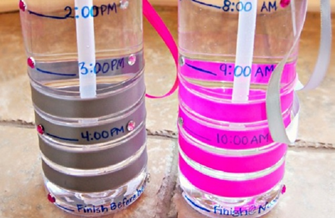
The second change that I brought in was to remove the extra step of pouring in the cup. The idea is to make it easy for you to sip the water. If you know that you have to first open the bottle cap, drink and then close it, you’ll probably skip it. So the bottles that I use has a flip top (Tupperware, available on Amazon) which can be opened with flick of your thumb.
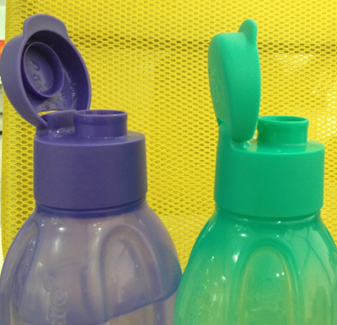
It’s a hurdle if you have to remove and close the bottle cap by screwing and unscrewing the top. With these bottles I don’t have to think twice before taking a sip.

Experiment – Version 4.0

Now that I was drinking and logging the intake easily, I had to slowly increase the consumption.

I read somewhere that the purpose of setting a goal is to push yourself. Since daily goals are difficult to chase, I set a goal of consuming 1 litre/day averaged over a week.

The app is useful here since you can set water consumption goals in it. At the end of the week I would increase my target a little bit. I used a post-it slip to keep a track of daily consumption number in front of me (out of sight out of mind).

The experiment lasted for about 3 months and at the end of it my average daily water intake was more than 2.5 litre.

I have figured that I need to finish a 500 ml bottle of water in the morning before leaving for office. I carry two 850 ml bottles to office which I finish before I reach back home in the evening. This makes sure that I consume 2.2 litres by 7.30 pm. After that it’s just having few more gulps before sleep and I am done with my daily water target.

Now I need neither the marked water bottle nor the app. The idea behind using those tools was to build the habit.

Here are couple of important things which made this experiment successful.

1. Notice that I didn’t increase my water intake abruptly. Doing that would have surprised my body and could create discomforts. Your body needs some time to adjust to a new drinking patterns. It was a gradual change which uses the principle of slow contrast effect and increases the chances of bringing a lasting change.

2. I was tracking the progress which kept the motivation high. The biggest reason people fail to bring in change is that they can’t see immediate progress or results. Logging your activity may create an illusion of progress and would keep your mind interested.

3. I always make sure that a water bottle is well within reach. I never left my home without a marked water bottle. Sometimes we don’t drink water, even if we are thirsty, just because it’s not readily available at that moment.

Can You Overdose on Water?

A 28-year-old California woman died after competing in a radio station’s on-air water-drinking contest. After downing some six liters of water in three hours, Jennifer Strange vomited, went home with a splitting headache, and died from so-called water intoxication. The condition is called hyponatremia, or dilution of the blood caused by drinking too much water.

Every hour, a healthy kidney at rest can excrete 800 to 1,000 milliliters, of water and therefore a person can drink water at a rate of 800 to 1,000 milliliters per hour without much risk.

One can die with overdose of anything, including oxygen. So don’t worry about overdosing on water. The chances of accidentally overdosing on water are pretty slim.

Conclusion

If I had to single out just one thing to improve water intake, it would be to keep a bottle of water with you at all times.

Get used to drinking water, which is refreshing, delicious and healthy.

Water is the secret elixir of a healthy and energetic life.
[/show_to] [hide_from accesslevel=’almanack-all’]

Want to Read More? This content is exclusive for members of Value Investing Almanack. Login to read if you are a member. Else, click here to subscribe.

Benefits to VIA Members
 
  • Spotlight: Big ideas from Value Investing and why applying them in your investment decision making will be a great deal
  • InvestorInsights: Interviews with experienced value investors, learners, and deep thinkers
  • StockTalk: Thorough analysis of business models of companies (without any recommendations)
  • Behaviouronomics: Deep analysis of human behaviour and how it impacts investment decision making
  • BookWorm: Reviews of the best books on Value Investing and related subjects
  • Free Course – Financial Statement Analysis for Smart People (otherwise priced at Rs 5,900)
  • Archives: Instant access to our huge archive from the past three years
Become a VIA Member. Click to Subscribe
[/hide_from]

BookWorm: How to Get Lucky

February 28, 2016

A wise man once said “I am a great believer in luck. The harder I work, luckier I get.”

I am sure you’ve heard of this saying a number of times in the past. It’s usually quoted by those who belong to the meritocratic school of thought which says, “If you’re good, you don’t need luck.”

If you’re successful it’s a natural human tendency to assume the credit for your success. After all you must have worked hard for it and you surely deserve it. But when I think of my life, I have seen and met many individuals who always worked harder and yet they sadly remain unsuccessful.

Goes with saying that I have also met those who achieved great heights with significantly less effort. These are the people who manage to attract much more than their fair share of luck. Usually we look down on such people with disdain. It’s assumed that any success founded on element of luck is inherently undeserving.

Do you know someone who always manages to find himself in the right place at the right time? Before you label him as lucky, ask yourself – do you think his luck is out of pure randomness? May be he has a knack for reaching to the right place at the right time.

<!–more–>[show_to accesslevel=’almanack-all’]

Common sense tells us that luck can’t be controlled and it’s all about chance and probability. But what if someone told you that there was a way to control luck? Not in an esoteric way but in a rational way. If you feel like scoffing at such an idea, I would urge you to have an open mind. Just for the sake of curiosity.

In his book, How To Get Lucky, Max Gunther argues that luck, although may not be controlled, can surely be manipulated. He writes –

You cannot control your luck in a precise way. You cannot say, “I want the next card I draw to be the queen of diamonds, “…and have any reasonable expectation of that outcome. Luck isn’t amenable to fine-tuning of that kind. To hope for such control is dream of magic. It doesn’t happen.

But you can bring about a substantial and even startling improvement in the quality of your luck. You can turn it from mostly bad to mostly good, from pretty good to better.

Gunther explains 13 techniques which can improve your chances of being found by good luck. Here are some of my favourites –

Finding the Fast Flow

In the business world, the big breaks flow through contacts between people. Not necessarily close friendships, just contacts – sometimes tenuous ones. So the trick is to surround yourself with a churning mass of people and things happening. The lucky personality gets to know everybody in sight: the rich and the poor, the famous, the humble, the sociable and even the friendless and the cranky.

Going where events flow fastest simply means making contact with people. Getting involved. Don’t be a sideliner, watching events flow past. Plunge into the events yourself. Go out of your way to make yourself known in your company and outside it.

To be singled out as a lucky target, you must make something of yourself known to those who are your primary links in the network. These links must be strong enough so that people know who you are, what work you do, what your interests are, what kinds of rewards you look for in life.

The worst thing you can do is withdraw from the network of friendships and acquaintanceships at home and work. If you aren’t in the network, nobody is ever going to steer anything your way. All that is necessary is that you meet a lot of people and let them know just who you are.

Risk Spooning

Popularly, there are two extremes to the idea of risk taking. One is where the risk is out of proportion to the rewards being sought. And the other is to take no risks at all. Lucky people avoid both extremes. They cultivate the technique of taking risks in carefully measured spoonful.

If you feel good luck has been avoiding you, it is far more likely that you lean in the direction of too little risk taking rather than too much. What you must do is learn the technique of risk spooning.

Assess the risk and determine if it is really as big as you supposed it is, and if the hoped-for reward is small, then avoid it. But if it is minor and the potential reward is big, then place the bet.

Warren Buffett gives an important clue about the kind of risks one should avoid. Let’s say there is gun which has a million chambers and only one of those chambers has a bullet. If you’re offered a billion dollars for putting that gun on your head, just for once, and pulling the trigger. Should you take that bet? Answer is no. In spite of the outcome being extremely rare (1 in a million chance) the consequence of that rare event is too severe and unacceptable.

Similarly, any bet which has the potential to ruin you financially shouldn’t be made, which means never bet the farm even if you’re supremely confident of the outcome. However, once you have determined that there is a certain amount which you’re comfortable losing, then an aggressive bet can be (and should be) played with that money.

So the idea is to be hyper-conservative (extremely risk averse) with those resources which you need for maintaining your lifestyle. And being hyper-aggressive with those resources which are residual and you can afford to lose them. Nassim Taleb has termed it as a Barbell strategy.

Luck Selection

When facing failure, the most common dilemma people have is – should they hold on and hope for an improvement in luck some day in an unknowable future? Or should they cut their losses right away, free themselves and seek better luck somewhere else?

People have tendency to stick to their decisions even when the evidence suggests that the results haven’t turned well. It’s called ‘sunk cost fallacy’. Warren Buffett says, “If you find yourself in a hole, the first thing you should do is stop digging.”

A typical unlucky complains that fate has dealt him a bad hand, but that usually isn’t the problem. The difference is that the unlucky don’t have the knack of selecting luck. Incapable of discarding a bad hand, they can only sit and suffer while bad luck becomes worse luck.

Lucky people remain aware that any risk taken can lead to loss or gain, but in the event of loss, they’re not shy about admitting their mistakes. This makes it easy to cut losses in time. In a souring situation, with no compelling reason to think things will get better, you’re always right to cut your loss and go.

Serendipity Vs Goals

Many a times, in business, too much emphasis is given to goal setting. Goal orientation is undoubtedly a good thing in moderate doses. But the lives of the lucky seem to say you should be wary of overdoing it.

Never take long-range plans seriously. Use them for general guidance as long as they seem to be taking you where you want to go, but whatever you do, don’t get stuck with them. Throw them in the trash heap as soon as something better comes along.

The purpose of goals is to start the ball rolling and provide a general direction for proceeding but if a piece of potential good luck drifts your way, you should not summarily reject it simply because it doesn’t fit some pre designed plan.

The lucky are aware that life is always going to be turbulent sea of opportunities drifting randomly past in all directions. If you put blinders on yourself so that you can see only straight ahead, you will miss nearly everything.

Serendipity, the faculty or habit of seizing lucky breaks that you weren’t looking for, is another way of describing the zigzag life route characteristic of lucky people. You need to allow the serendipitous forces of nature to manifest your desires in whatever ways possible. Getting attached to a specific way/goal is to limit the options in which success and good luck can reach you.

The Closed Mouth

The lucky strive for maximum flexibility in their affairs, keeping themselves free to deal with those unknowable events in whatever ways seem appropriate at the time. Too much talk can constrict that valuable freedom and flexibility. Talk can tie you up, lock you into positions that seem right today but may be wrong tomorrow. A statement that seems safe today may become dangerous in the changed circumstances of tomorrow.

So the lucky guard against unnecessary talk. They are particularly careful when talking of subjects that have great personal importance to them. They don’t reveal no more of their thinking than they have to.

Avoiding excessive communication frees from the need to explain and justify actions to other people. If you talk too much about a venture this year, you may find you’ve given away your freedom when you want to get out of it next year.

In life you can never predict what actions you will need to take, it is best to say as little as possible about what you are doing and thinking. Then, when action is required, the only person you must argue with is yourself.

As the saying goes, “The wise say something because they have something to say, the fool does so because he has to say something.”

So the luck favours those who avoid unnecessary talk about their problems, plans, and feelings.

Get Busy

The luckier are the busier. Lucky people always seem to have many ventures going on at the same time. Even at the height of success in a major venture such as a career, the lucky man or woman will usually have secondary ventures going or in preparation or under study – sometimes in bewildering variety.

An unlucky person is narrowly focused and expects the luck to come in a specific way. A lucky person knows that the more ventures he gets himself into, the better are the odds that some kind of lucky break would come his way.

Luck by its very nature isn’t amenable to prediction. You cannot guess in advance what shape it will take or in what quarters it will strike. For that matter you never know what seemingly unpromising activity is going to be the one that catches fire for you. All you can know is that the more activities you have going on, the greater is the likelihood that something good will happen.

Conclusion

The techniques prescribed by Max Gunther don’t offer any guarantees. What they do give you is an edge. It shifts the odds in your favour. These tricks increase the probability of having the blessings of Lady Fortuna.

In the end it doesn’t matter how well you practice these techniques, you can still be brought to your knees by a terminal disease, get run over by a truck or struck by lightning. So be grateful for you what you have and if you’re breathing, you’re lucky. Which brings us to the most important trait of lucky people.

Lucky people are those who are able to see how lucky they are. This realization is the most important step to get lucky. You may not be doing too well at work, but still have a loving family and good health. Shouldn’t you count your blessings and be grateful for that?

Let me wrap up here with my standard disclaimer.

Reading this book review is by no means a replacement for the book. This is meant to rekindle the fire of curiosity inside you. I am sure the bookworm in you will find this book worth reading.

The importance of reading books can never be overemphasized. The purpose of reading isn’t just for becoming more knowledgeable but to become a better human being.

Remember, there is no secret to reading more. It’s all about the game of setting the right priorities. You just have to change your perception so that reading becomes an extension of who you are and what you do.

Good luck and happy reading!

[/show_to] [hide_from accesslevel=’almanack-all’]

Want to Read More? This content is exclusive for members of Value Investing Almanack. Login to read if you are a member. Else, click here to subscribe.

Benefits to VIA Members
 
  • Spotlight: Big ideas from Value Investing and why applying them in your investment decision making will be a great deal
  • InvestorInsights: Interviews with experienced value investors, learners, and deep thinkers
  • StockTalk: Thorough analysis of business models of companies (without any recommendations)
  • Behaviouronomics: Deep analysis of human behaviour and how it impacts investment decision making
  • BookWorm: Reviews of the best books on Value Investing and related subjects
  • Free Course – Financial Statement Analysis for Smart People (otherwise priced at Rs 5,900)
  • Archives: Instant access to our huge archive from the past three years
Become a VIA Member. Click to Subscribe
[/hide_from]

InvestorInsights: Gaurav Jalan

February 20, 2016

Gaurav Jalan, an enterprising and inspiring young value investor shares his invaluable insights and experiences in sensible, long-term investing.

Gaurav has 14 years of experience in management consulting and investment management. He manages investment portfolios for high net worth individuals and companies as Chief Investment Officer at Avant Garde Wealth Management. Previously, he was an Investment Analyst at Fidelity International in Mumbai and also worked as a Senior Associate Consultant at Bain & Co., New York. Gaurav completed his MBA from Columbia Business School, New York in 2006 and his B.A. in Economics and Computer Science from Amherst College, Massachusetts in 2001.

In his interview with Safal Niveshak, Gaurav shares his wide investment experience and how small investors can practice sensible investment decision making.

Safal Niveshak (SN): Could you tell us a little about your background, how you got interested in value investing?
[Read more…] about InvestorInsights: Gaurav Jalan

BookWorm: The Hard Thing About Hard Things

February 15, 2016

Building a business is hard and there are no easy answers to the tough problems business throws at you every day. A high technology entrepreneur and a venture capitalist shares an honest and straight talk based on his experience in starting, running and selling a billion-dollar company.

While many people talk about how great it is to start a business, very few are honest about how difficult it is to run one. In fact, calling it difficult would actually be an understatement.

Building a company inevitably leads to tough time. It’s just hard and the hard thing about it is that there is no formula to deal with those hard things.
[Read more…] about BookWorm: The Hard Thing About Hard Things

Behaviouronomics: Zeigarnik Effect

February 15, 2016

Outstanding tasks gnaw at us until we complete them or get rid of them. But there’s another way to relieve the stress of unfinished without finishing it.

What is not started today is never finished tomorrow.~ Johann Wolfgang von Goethe

The most interesting and exciting thing about behavioural economics and psychology is that it’s not very difficult to experimentally test the validity of theories. You don’t need expensive lab instruments. The world is your lab and its inhabitants i.e., people, including yourself, are your test subjects (read guinea pigs).

So here is a simple experiment that you can try on your next visit to any restaurant. It’s not uncommon to find waiters who don’t really write down your order. They seem to have this wonderful ability to recall the order for each table. Even if there are half a dozen orders with every order consisting of many different dishes (including special request like – I want less sugar, don’t add mushrooms in my Pizza etc.) these waiters rarely goof up. Well that’s their part of the job and with years of practice they have exercised their mental muscles so much that they develop a super-sharp memory. But do they really have a great memory?

Try this – After you are done with your meals and have paid the bills (and a good tip), wait for ten minutes after you have left your table and then go back to the waiter who was waiting on you. Ask him to repeat your order. You’d expect him to rattle off your order without any difficulty. But don’t be surprised if he gives you the look – “I am sorry, who are you?” It would seem, not just your order but your whole existence has evaporated from waiter’s memory. What happened to his super memory?
[Read more…] about Behaviouronomics: Zeigarnik Effect

  • « Go to Previous Page
  • Page 1
  • Interim pages omitted …
  • Page 54
  • Page 55
  • Page 56
  • Page 57
  • Page 58
  • Interim pages omitted …
  • Page 72
  • Go to Next Page »

Handcrafted with in India