
Building a business is hard and there are no easy answers to the tough problems business throws at you every day. A high technology entrepreneur and a venture capitalist shares an honest and straight talk based on his experience in starting, running and selling a billion-dollar company.
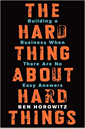 While many people talk about how great it is to start a business, very few are honest about how difficult it is to run one. In fact, calling it difficult would actually be an understatement.
Building a company inevitably leads to tough time. It’s just hard and the hard thing about it is that there is no formula to deal with those hard things.
[show_to accesslevel=’almanack-all’]
In his book The Hard Thing About Hard Things,, Ben Horowitz, an experienced tech entrepreneur and cofounder of venture capital firm Andreessen Horowitz, offers practical wisdom for managing the toughest problems business schools don’t cover. Horowitz was the co-founder and CEO of the enterprise software company Opsware, which Hewlett-Packard acquired for $1.6 billion in cash in 2007.
Better Investor, Better Businessman
Why would an investor want to know about experiences of an entrepreneur? Warren Buffett gives the clue. He said –
I am better investor because I am a businessman and I am a better businessman because I’m an investor.
It’s a deeply profound statement. If you remember our interview with Rajeev Thakkar in the January 2016 VIA issue, he spoke a lot about the need for an investor to understand the business mindset. According to him understanding how a business is run is supremely important. He said –
It tells you what the real world is. Otherwise we are sitting in our air-conditioned offices in silos, and only looking at spreadsheets. If all you’ve looked at is spreadsheets in your life, you can’t be a good equity investor.
Ben learned a very important lesson about markets pretty early in his career as a CEO of a public listed company. Talking about market efficiency, he writes in his book –
…if I’d learned anything it was that conventional wisdom had nothing to do with the truth and the efficient market hypothesis is deceptive. How else could one explain Opsware [Ben’s company] trading at half of the cash we had in the bank when we had a $20 million a year contract and fifty of the smartest engineers in the world? No, markets weren’t efficient at finding the truth; they were just very efficient at converging on a conclusion – often the wrong conclusion.
So even though this book has been written with entrepreneurs in mind, I guess it’s an invaluable source of insights for any investor on how a business is run. Learning about challenges one faces while running an organization gives an investor an edge in evaluating businesses.
Business is Hard
While sharing his journey of running a multi-million-dollar tech company, Ben dispenses useful advice about analyzing problems that confront and confound the business leaders every day. These problems require skills for managing, selling, buying, investing and supervising and the challenge with these problems is that there are no recipes for them. Ben writes –
The hard thing isn’t setting a big, hairy, audacious goal. The hard thing is laying people off when you miss the big goal. The hard thing isn’t hiring great people. The hard thing is when those “great people” develop a sense of entitlement and start demanding unreasonable things. The hard thing isn’t setting up an organizational chart. The hard thing is getting people to communicate within the organization that you just designed. The hard thing isn’t dreaming big. The hard thing is waking up in the middle of the night in a cold sweat when the dream turns into a nightmare.
Although there’s no recipe for really complicated and dynamic situations, it’s important to remember that you don’t have to pee on the electric fence to find out that it’s a dangerous activity. Learning about experiences of others may not give you the recipe but it does provide you important clues about so called electric fences. So you at least know what to avoid and how to avoid.
Facts Vs Perception
Talking about utility of developing diverse perspective, Ben recounts his experiences at school –
I was the only kid on the football team who was also on the highest academic track in math, so my teammates and I didn’t see each other in many classes. As a result, I ended up moving in multiple social circles and hanging out with kids with very different outlooks on the world. It amazed me how a diverse perspective utterly changed the meaning of every significant event in the world…Looking at the world through such different prisms helped me separate facts from perception. This ability would serve me incredibly well later when I became an entrepreneur and CEO. In particularly dire circumstances when the “facts” seemed to dictate a certain outcome, I learned to look for alternative narratives and explanations coming from radically different perspectives to inform my outlook.
Ben had a first-hand experience of large organizations falling for institutional imperative and the herd mentality. He shares an interesting experience when he was about to sell his company.
…when EMC implied that it wanted to buy us, I thought nothing of it. We were trading at about $6.50 per share and I wasn’t planning to sell at anything close to that price. But this time the news of the offer leaked to the press and the stock shot up to $9.50 per share, changing the economic equation, especially since the stock was going up for all the wrong reasons.
Ironically, the higher the stock price went up, the more companies wanted to buy us. Over the course of the next month, eleven companies expressed interest.
You see, it’s not just the small investor who gets anchored on the price. A climbing stock price is a very effective bait for enticing big companies. Perhaps that’s one of the reasons why most CEOs give so much importance to their company’s stock price.
Calculus Vs Statistics
There are two ways to look at the world. One is the deterministic way, calculus like, where you can calculate specific things precisely and deterministically. The other way is like statistical approach where you look at things probabilistically.
An investor benefits from adopting the latter approach because he is making several bets. He’s diversified and would succeed if his portfolio of bets is profitable overall irrespective of how many of those bets turn sour. However, a CEO has all his eggs in the single basket, his company. Ben argues –
Startup CEOs should not play the odds. When you are building a company, you must believe there is an answer and you cannot pay attention to your odds of finding it. You just have to find it. It matters not whether your chances are nine in ten or one in a thousand; your task is the same…People always ask me, “What’s the secret to being a successful CEO?” Sadly, there is no secret, but if there is one skill that stands out, it’s the ability to focus and make the best move when there are no good moves.
This reminds me of an analogy that Mohnish Pabrai gave in his book, Mosaic – Perspectives on Investing. He wrote –
One might think of investment managers as astronomers and CEOs as astronauts. The two roles are radically different with distinct personality traits. A subset of CEOs is entrepreneurs. And the classical definition of an entrepreneur is an individual who pursues opportunity without regard to the resources currently controlled. That sounds like a very different person that one might expect an analytical investment manager to be.
The Positivity Delusion
One of the most important management lessons for a founder/CEO is totally unintuitive – A CEO should tell it like it is. Ben writes in his book –
I thought I should project a positive, sunny demeanor and rally the unburdened troops to victory…In my mind, I was keeping everyone in high spirits by accentuating the positive and ignoring the negative…My single biggest personal improvement as CEO occurred on the day when I stopped being too positive…If you run a company, you will experience overwhelming psychological pressure to be overly positive. Stand up to the pressure, face your fear, and tell it like it is.
By telling things as they are and maintaining transparency, CEO builds trust in the organization. Telling things as they are is a critical part of building this trust. Moreover, being overly positive and upbeat about things can discourage the spread of the bad news.
A healthy company culture encourages people to share bad news. A company that discusses its problems freely and openly can quickly solve them…Build a culture that rewards—not punishes—people for getting problems into the open where they can be solved.
Peacetime Vs Wartime CEOs
When looking at the performance of a CEO, it’s important to recognize the kind of period he was at the helm. Was it a peacetime period or wartime?
Peacetime in business means those times when a company has a large advantage over the competition in its core market, and its market is growing. In times of peace, the company can focus on expanding the market and reinforcing the company’s strengths.
In wartime, a company is fending off an imminent existential threat. Such a threat can come from a wide range of sources, including competition, dramatic macroeconomic change, market change, supply chain change, and so forth.
My greatest management discovery through the transition was that peacetime and wartime require radically different management styles. Interestingly, most management books describe peacetime CEO techniques and very few describe wartime. For example, a basic principle in most management books is that you should never embarrass an employee in a public setting. On the other hand, in a room filled with people, Andy Grove once said to an employee who entered the meeting late, “All I have in this world is time, and you are wasting my time.” Why such different approaches to management?
In peacetime, leaders must maximize and broaden the current opportunity. As a result, peacetime leaders employ techniques to encourage broad-based creativity and contribution across a diverse set of possible objectives. In wartime, by contrast, the company typically has a single bullet in the chamber and must, at all costs, hit the target. The company’s survival in wartime depends upon strict adherence and alignment to the mission.
Peacetime and wartime management strategies are very different and so is CEO. If you’re comparing performances of two CEOs, don’t forget to ask if they were peacetime or wartime CEOs.
Conclusion
Reading Ben’s book will give you an insider’s perspective on how a CEO deals with problems like initiating layoffs, hiring the right people, training, and minimizing politics. When you read the book you’d feel as if were there with Ben while he was making those tough decisions and tackling the hard things. If you have wondered what it’s like to lead and scale a start-up, you should read this book for sure.
Let me wrap up here with my standard disclaimer. Reading this book review is by no means a replacement for the book.
This is meant to rekindle the fire of curiosity inside you. I am sure the bookworm in you will find this book worth reading.
The importance of reading books can never be overemphasized. The purpose of reading isn’t just for becoming more knowledgeable but to become a better human being.
Remember, there is no secret to reading more. It’s all about the game of setting the right priorities. You just have to change your perception so that reading becomes an extension of who you are and what you do.
Happy reading!

[/show_to]
[hide_from accesslevel=’almanack-all’]
- Spotlight: Big ideas from Value Investing and why applying them in your investment decision making will be a great deal
- InvestorInsights: Interviews with experienced value investors, learners, and deep thinkers
- StockTalk: Thorough analysis of business models of companies (without any recommendations)
- Behaviouronomics: Deep analysis of human behaviour and how it impacts investment decision making
- BookWorm: Reviews of the best books on Value Investing and related subjects
- Free Course – Financial Statement Analysis for Smart People (otherwise priced at Rs 5,900)
- Archives: Instant access to our huge archive from the past three years