Scientists say that water constitutes 70% of human body. Of course a quantum physicist would argue that 99.99% of our bodies is nothing but empty space. But I guess whatever is left out from that empty space, 70% of that is water.
From a great skin to fat loss, the benefits of drinking adequate water are universally known. I am not going to harp on the benefits of drinking sufficient water every day. There is enough information on the Internet and hundreds of books have already been written, read and forgotten on this subject.
In this post I am going to share my finding based on a 3-months long personal experiment to increase my daily water intake.
According to one scientific study you should drink 0.033 of a litre of water per day for every kilogram of bodyweight. So if you weigh 65 kg, that is 65 * 0.033 = 2.145 litre of water per day. But that’s bare minimum.
<!–more–>[show_to accesslevel=’almanack-all’]
For every glass of coffee or tea you consume, you need to have an extra glass of water, as caffeine will dehydrate you. Similarly, if one takes alcohol, the water requirement goes up because alcohol also dehydrates. If you do physical exercise or do more than normal physical activity, then your water requirements would be more.
According to the formula I should have been ingesting at least 2 liters of water every day. But in spite of being aware of this fact my daily water intake continued to be horribly low.
What I am going to share here is a set of few tricks, hacks if you will, that I discovered as a result of my personal experiments to increase my water intake.
Calling it an experiment may seem like an exaggeration but it plays an interesting trick on our mind. It sounds like a lot of fun when we start looking at our activities like an experiment. It brings out the curious child in us. If you label something as an experiment, we start enjoying what you’re doing.
The famous management theorist Peter Drucker observed – “What gets measured gets managed.” So the first step in designing my experiment was to measure my water intake accurately.
Four glasses, 1.5 bottle, 5 times a day are all inaccurate ways of measuring. They are just estimates and estimates don’t really inspire much. So that was the first problem to solve. How do I measure the water intake accurately without really carrying a measuring cup everywhere?
Experiment – Version 1.0
I started with a small cup (200ml) and kept it next to my water bottle. Instead of sipping water directly from the bottle, I would pour the water in the cup and then drink it. I then logged the amount in my mobile (in simple notes application).
It was obvious that this process was cumbersome (the extra steps of pouring in cup and logging it in the notes in mobile) and lead to even lesser water consumption because my mind, subconsciously, started to avoid the hassle associated with each sip.
This version of experiment needed serious improvements. However, now I had a fair idea that my daily intake was less than 1 litre and it was a sufficient motivation to continue with the experiment.
Experiment – Version 2.0
First step in improving the experiment design was to remove the extra step (pouring in a cup). So I measured the size of my gulp/sip (15-35ml) and would just count the number of gulps I was taking during each time. Although this trick simplified the process but introduced an element of inaccuracy because of the variable sip/gulp size.
Over a span of 10-12 intakes during the day, I could potentially add up an error of 350-400 ml. So the next two hurdles to remove were inaccuracy and easier logging process.
Experiment – Version 3.0
I found an app (iDrinkwater in iOS) which simplified the logging process quite a bit (not completely though). The app allows me to set reminders too with pretty interesting alarm tones like sound of swooshing water. The reminder tone itself makes you want to drink more.
However, the act of taking many readings (10-12) in a single day was still harrowing for me.
I initially thought of buying a sports bottle which comes with measurement marks, but they were too expensive and the marks were not sufficiently small. For accuracy I needed the marks to be at 20 ml difference. So I marked my drinking bottle using a permanent marker. The smallest measurement size on my bottle is 20 ml. The small plastic measuring cups which come with the cough syrup bottles came handy in calibrating my bottle.
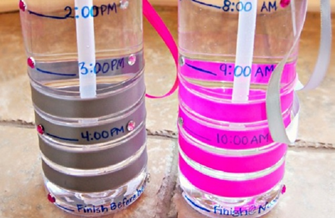
Another interesting hack that I found on the internet is to mark your bottles with time-goals. I haven’t tried it but I think it would be quite effective.
The second change that I brought in was to remove the extra step of pouring in the cup. The idea is to make it easy for you to sip the water. If you know that you have to first open the bottle cap, drink and then close it, you’ll probably skip it. So the bottles that I use has a flip top (Tupperware, available on Amazon) which can be opened with flick of your thumb.
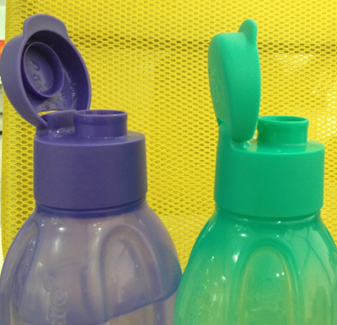
It’s a hurdle if you have to remove and close the bottle cap by screwing and unscrewing the top. With these bottles I don’t have to think twice before taking a sip.
Experiment – Version 4.0
Now that I was drinking and logging the intake easily, I had to slowly increase the consumption.
I read somewhere that the purpose of setting a goal is to push yourself. Since daily goals are difficult to chase, I set a goal of consuming 1 litre/day averaged over a week.
The app is useful here since you can set water consumption goals in it. At the end of the week I would increase my target a little bit. I used a post-it slip to keep a track of daily consumption number in front of me (out of sight out of mind).
The experiment lasted for about 3 months and at the end of it my average daily water intake was more than 2.5 litre.
I have figured that I need to finish a 500 ml bottle of water in the morning before leaving for office. I carry two 850 ml bottles to office which I finish before I reach back home in the evening. This makes sure that I consume 2.2 litres by 7.30 pm. After that it’s just having few more gulps before sleep and I am done with my daily water target.
Now I need neither the marked water bottle nor the app. The idea behind using those tools was to build the habit.
Here are couple of important things which made this experiment successful.
1. Notice that I didn’t increase my water intake abruptly. Doing that would have surprised my body and could create discomforts. Your body needs some time to adjust to a new drinking patterns. It was a gradual change which uses the principle of slow contrast effect and increases the chances of bringing a lasting change.
2. I was tracking the progress which kept the motivation high. The biggest reason people fail to bring in change is that they can’t see immediate progress or results. Logging your activity may create an illusion of progress and would keep your mind interested.
3. I always make sure that a water bottle is well within reach. I never left my home without a marked water bottle. Sometimes we don’t drink water, even if we are thirsty, just because it’s not readily available at that moment.
Can You Overdose on Water?
A 28-year-old California woman died after competing in a radio station’s on-air water-drinking contest. After downing some six liters of water in three hours, Jennifer Strange vomited, went home with a splitting headache, and died from so-called water intoxication. The condition is called hyponatremia, or dilution of the blood caused by drinking too much water.
Every hour, a healthy kidney at rest can excrete 800 to 1,000 milliliters, of water and therefore a person can drink water at a rate of 800 to 1,000 milliliters per hour without much risk.
One can die with overdose of anything, including oxygen. So don’t worry about overdosing on water. The chances of accidentally overdosing on water are pretty slim.
Conclusion
If I had to single out just one thing to improve water intake, it would be to keep a bottle of water with you at all times.
Get used to drinking water, which is refreshing, delicious and healthy.
Water is the secret elixir of a healthy and energetic life.
[/show_to]
[hide_from accesslevel=’almanack-all’]
- Spotlight: Big ideas from Value Investing and why applying them in your investment decision making will be a great deal
- InvestorInsights: Interviews with experienced value investors, learners, and deep thinkers
- StockTalk: Thorough analysis of business models of companies (without any recommendations)
- Behaviouronomics: Deep analysis of human behaviour and how it impacts investment decision making
- BookWorm: Reviews of the best books on Value Investing and related subjects
- Free Course – Financial Statement Analysis for Smart People (otherwise priced at Rs 5,900)
- Archives: Instant access to our huge archive from the past three years