• Skip to primary navigation
  • Skip to main content

The One Percent Almanack

Wit and Wisdom on Investing, Business, and Life

  • Home
  • Members
  • Log In
  • Show Search
Hide Search

Behaviouronomics

Behaviouronomics: Fundamental Attribution Error

April 10, 2016

Most people believe that other people’s behavior is the reflection of their personality. But the truth is that it is more the result of the situation than their disposition.

First impression is the last impression. This is what I have been told repeatedly by so called “communication skill experts.” But the more I have read about psychology, stronger is my belief that it’s a naive generalisation. First impression being the last impression – is mostly incorrect.

Had I gone with my first impressions about some of the strangers I met in my life, I wouldn’t have found my best friends. If you look back in your life and trace the history of your relationships with your best buddies, many of you would tend to agree with me on this.

Whenever we meet a person for the first time we have a natural tendency to attribute his behaviour to his personality. If that stranger’s behaviour is cold and unresponsive, you immediately conclude that the person is either shy or introvert or perhaps arrogant. Whereas someone who seems warm and lively makes you believe that the person is an extrovert.

Sometimes you are right, but often you are falling for what is known as the fundamental attribution error, a phrase coined by Lee Ross, a social psychologist at Stanford University. It is the tendency for people to place an undue emphasis on internal characteristics (personality) to explain someone else’s behavior in a given situation rather than considering the situation’s external factors.
[Read more…] about Behaviouronomics: Fundamental Attribution Error

Behaviouronomics: Decision Fatigue

March 10, 2016

We make hundreds of decision every day, most of which are trivial but end up taxing our mental resources, the so called willpower. And it’s dangerous to make critical decisions when the limited stock of willpower is running low.

Mark Zuckerberg, founder of Facebook, recently became father to a baby girl. So after two months of paternity leave, when he returned to work he asked his followers, showing off his wardrobe, for a suggestion about what he should be wearing to office. This is how his wardrobe looks.

Pretty drab collection, isn’t it? Zuckerberg has been wearing the same outfit, a grey t-shirt, for many years. For that matter even Steve Jobs mostly wore a black turtleneck. So why do these billionaires, who could afford to buy almost anything in this planet, choose to stick to a simple attire?

The answer is – It’s their hack to simplify life.

According to Zuckerberg, making clothing decisions each day was a “frivolous” waste of time. He says “I really want to clear my life to make it so that I have to make as few decisions as possible about anything except how best to serve this community.”

It’s estimated that in an average day, you will make somewhere around 35,000 decisions. Many of them are unconscious like walking, blinking and don’t require any mental effort. But the sheer volume of even those decisions that require at least some mental effort like what to wear, where to eat, how to get to work, who to call when you get there, is staggering.
[Read more…] about Behaviouronomics: Decision Fatigue

Behaviouronomics: Zeigarnik Effect

February 15, 2016

Outstanding tasks gnaw at us until we complete them or get rid of them. But there’s another way to relieve the stress of unfinished without finishing it.

What is not started today is never finished tomorrow.~ Johann Wolfgang von Goethe

The most interesting and exciting thing about behavioural economics and psychology is that it’s not very difficult to experimentally test the validity of theories. You don’t need expensive lab instruments. The world is your lab and its inhabitants i.e., people, including yourself, are your test subjects (read guinea pigs).

So here is a simple experiment that you can try on your next visit to any restaurant. It’s not uncommon to find waiters who don’t really write down your order. They seem to have this wonderful ability to recall the order for each table. Even if there are half a dozen orders with every order consisting of many different dishes (including special request like – I want less sugar, don’t add mushrooms in my Pizza etc.) these waiters rarely goof up. Well that’s their part of the job and with years of practice they have exercised their mental muscles so much that they develop a super-sharp memory. But do they really have a great memory?

Try this – After you are done with your meals and have paid the bills (and a good tip), wait for ten minutes after you have left your table and then go back to the waiter who was waiting on you. Ask him to repeat your order. You’d expect him to rattle off your order without any difficulty. But don’t be surprised if he gives you the look – “I am sorry, who are you?” It would seem, not just your order but your whole existence has evaporated from waiter’s memory. What happened to his super memory?
[Read more…] about Behaviouronomics: Zeigarnik Effect

Behaviouronomics: Planning Fallacy

January 8, 2016

Plans are useful in the sense that they are proof that planning has taken place. The planning process forces people to think through the right issues. But then, everybody has a plan until they get punched on the face.

When I planned my first road trip from Bangalore to Goa, I calculated that the distance, about 560 km, should take little more than 9 hours. Factoring in stopovers and few unexpected events like a flat tyre or traffic, I assumed that 12-15 hours should be sufficient for the road trip. It turned out that I did managed to Goa in 15 hours.

Now based on this, if I had to forecast the time it would take to cover a distance of say 5,000 km, a road trip to cover major cities in India, I might be tempted to extrapolate the Bangalore-Goa trip time. I’ll probably calculate that 560 km took one day so 5,000 km should take 10 days plus 2-3 more days.

Am I being reasonable in my estimation?

What I am forgetting here is that the second road trip is not only longer but more complex and subject to many more unforeseen and unexpected events. My estimation is fraught with over-optimism bias. And I am not alone in making this kind of mistake.

There are many ways a plan can fail and most of those things are too improbable to be anticipated. The likelihood that something will go wrong especially in a big project is high. Overly optimistic forecasts of the outcome of projects are found everywhere.

In fact, how often are you able to complete everything on your to-do list at the end of the day? This shows how absurdly ambitious we’re in planning.

This bias, a phenomenon in which predictions about how much time will be needed to complete a future task display an optimism bias (underestimate the time needed), is called Planning Fallacy.
[Read more…] about Behaviouronomics: Planning Fallacy

Behaviouronomics: Lucretius Problem

December 5, 2015

History repeats itself but we forget that repeating doesn’t necessarily mean repetition of the same patterns. At the end of the day, what we learn from history is that we don’t learn from history.

It was a Friday on March 11, 2011 when a massive earthquake with an intensity of 9 on Richter scale hit off the coast of Japan at 2:26 pm local time. The epicentre of the quake was 70 kilometre east of the Oshika Peninsula of Tōhoku.

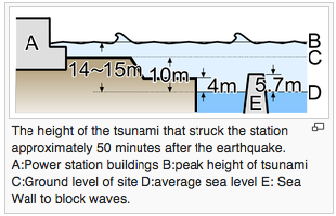
The earthquake triggered powerful tsunami waves that reached heights of up to 40 metres. It took 50 minutes for the largest wave in the tsunami to arrive at the shores of Fukushima. What followed was something totally unimaginable and unexpected for those who take pride in taming the mother nature.

The Fukushima Daiichi nuclear power plant had six separate boiling water reactors, protected by a 10-meter-high seawall to prevent sea waves from entering the plant.

When the tsunami struck the Fukushima coastline, the gigantic waves easily overtopped the plant’s seawall. It took seconds to flood the basements of the turbine buildings and disabling the emergency diesel generators. Soon the backup generator building was also flooded. This resulted in an explosion and leakage of radioactive material to the sea water and created a huge nuclear hazard.

Why would the engineers and designers of Fukushima nuclear power plant build a wall only 10-meter high? What made them believe that the waves can’t breach the 10-meter height? The reason was that the engineers had never seen sea waves as high as 10 meters in that area for the recorded history.
[Read more…] about Behaviouronomics: Lucretius Problem

  • « Go to Previous Page
  • Go to page 1
  • Interim pages omitted …
  • Go to page 10
  • Go to page 11
  • Go to page 12
  • Go to page 13
  • Go to page 14
  • Go to Next Page »

Handcrafted with in India