• Skip to primary navigation
  • Skip to main content

The One Percent Almanack

Wit and Wisdom on Investing, Business, and Life

  • Home
  • Members
  • Log In
  • Show Search
Hide Search

Behaviouronomics

Behaviouronomics: Chauffeur Knowledge

November 5, 2015

Having a chauffeur driven car is a convenience but when it comes to learning, don’t delegate the task of steering your car to a chauffeur. We discuss the pitfalls of borrowed wisdom and how to detect second hand knowledge.

In 2007 Charlie Munger gave a talk at the University of Southern California. In his talk Charlie tells the story of famous scientist Max Planck…

I frequently tell the apocryphal story about how Max Planck, after he won the Nobel Prize, went around Germany giving a same standard lecture on the new quantum mechanics. Over time, his chauffeur memorized the lecture and said, “Would you mind, Professor Planck, because it’s so boring to stay in our routine, if I gave the lecture in Munich and you just sat in front wearing my chauffeur’s hat?” Planck said, “Why not?” And the chauffeur got up and gave this long lecture on quantum mechanics. After which a physics professor stood up and asked a perfectly ghastly question. The speaker said, “Well, I’m surprised that in an advanced city like Munich I get such an elementary question. I’m going to ask my chauffeur to reply.

Well, the reason I tell that story is not to celebrate the quick wittedness of the protagonist. In this world I think we have two kinds of knowledge: One is Planck knowledge, that of the people who really know. They’ve paid the dues, they have the aptitude. Then we’ve got chauffeur knowledge. They have learned to prattle the talk. They may have a big head of hair. They often have fine timbre in their voices. They make a big impression. But in the end what they’ve got is chauffeur knowledge masquerading as real knowledge. I think I’ve just described practically every politician in the United States. You’re going to have the problem in your life of getting as much responsibility as you can into the people with the Planck knowledge and away from the people who have the chauffeur knowledge.

In the real world, it is critical to distinguish when you are “Max Planck,” and when you are the “Chauffeur.”
[Read more…] about Behaviouronomics: Chauffeur Knowledge
Behaviouronomics: Hyperbolic Discounting

October 5, 2015

Hyperbolic discounting is a remnant of our animal past. Rats never give up a piece of cheese today to get two pieces tomorrow. Humans aren’t very different too.

Few months back when I quit my job to join Vishal at Safal Niveshak, I had to return my laptop to my earlier employer, and buy a new one for myself. This got me started on the herculean task of selecting from thousands of choices available on numerous e-commerce websites. After weeks of excruciating process of comparing, shortlisting, and researching, I finally zeroed in on my final choice. Then started the wait for online discounts.

Very soon, the so called online-sale-season (i.e., weekend) arrived which offered a ‘whopping’ Rs 75 discount on my selection. So much for the patience, but for a self-proclaimed prudent consumer it still was a good deal!

Just when I was about to place the order, I saw the option of same day delivery for an additional Rs 100. Guess what yours truly did? He didn’t hesitate for a moment to take the offer.

Ironically, I waited for a week for a small discount but when the time came for buying I couldn’t wait another day and forked out extra money just to get my toy immediately. What happened to my admirable qualities of patience and prudence?

A little research on Google revealed that the introduction of ‘get-it-now’ caused me to behave irrationally. Scientists, as usual, have a name for this tendency – Hyperbolic Discounting.

On one hand, when I am forced to wait for six days, I don’t mind waiting for seven days. But when I am told that I can get something today instead of tomorrow, my temptation refuses to wait for another day.
[Read more…] about Behaviouronomics: Hyperbolic Discounting

Behaviouronomics: Illusion of Control

September 5, 2015

False understanding of the world around you can lead you to an illusion where you think you have more control on the things which are truly random.

Happiness and freedom begin with a clear understanding of one principle. Some things are within your control and somethings are not.” ~ Epictetus

Every day, shortly before nine o’clock, a man with a red hat stands in a square and begins to wave his cap around wildly. After five minutes he disappears.

One day, a policeman comes up to him and asks: “Sir! May I ask what you are doing?”

“I’m keeping the giraffes away,” replies the man.

The puzzled police man looks around and tells him, “But there aren’t any giraffes here.”

“Well, I must be doing a good job, then.”

You can safely assume that the man with the red hat wasn’t in the pink of his mental health but is it just a case of misplaced understanding of causation vs correlation? Actually there is more to it. The man is convinced that absence of evidence (giraffes) proves his prowess in controlling the giraffes. The man suffers from what is known as…

Illusion of Control (IOC)

IOC is basically the tendency to believe that we can influence something over which we have absolutely no sway. Where does this behavioural quirk come from? In millions of years of evolution, Mother Nature has hard wired this cognitive bias in human brain to increase the chances of survival in a hunter gatherer environment. It’s nature’s way to deal with uncertainty.

As a result of inability to deal with unknown, cognitive stress is created, and to avoid this stress the human mind tries to get rid of uncertainty, even if it means being wrong. IOC is a nice trick to get rid of this uncertainty.

Having a sense of control over the future has long been considered a fundamental motive and a highly adaptive trait for humans. It is well established that an absence of perceived control leads to depression, pessimism, and withdrawal from challenging situations. In contrast, possessing a general sense of control leads to self-esteem and optimism. Without any sense of control it would be difficult to carry out basic tasks. For that matter, it’s good to have an illusion (confidence) that you would be able to drive back from office to home.
[Read more…] about Behaviouronomics: Illusion of Control

Behaviouronomics: Inattentional Blindness

July 5, 2015

Sometimes our two eyes aren’t enough to see the obvious. This behavioural bias literally makes us blind to what’s right in front of our eyes.

“Where is it?” I asked my wife, while my eyes scanned the kitchen cupboard again. I was looking for the sugar jar. The plan was to surprise her with my exceptional tea making skills which I acquired after watching few YouTube videos.

“It should be there. Right in front!” informed my wife from her room.

“It’s not here. I can’t see it.” I again scanned all the shelves in the cupboard.

“Look again. I kept it there in the morning.” My wife sounded very sure about it.

“No! It’s not here. I am sure.” I confirmed while closing the cupboard. What happened next shouldn’t be surprising for you because most of you have experienced it before.

She came, opened the cupboard, grabbed the sugar jar which was obviously sitting right in front and handed over to me. I stood there flabbergasted. How could I miss it? What’s wrong with my eyes? Have I gone blind? It felt as if the jar manifested itself out of thin air. It was like…magic.

Haven’t you experienced something similar in your life? I see a smile on your face. 🙂

Now that embarrassing episode in the kitchen may look like a minor incident but it holds an important clue to a fascinating behavioural bias inherent in every human brain. It’s called inattentional blindness, which means not being able to see things that are actually there.

If you’re thinking, “Well, I am not one of those. You can’t fool me and I always find the sugar box in my kitchen.” Okay, let’s test that. 🙂

Pick a card, any card. Keep it in your mind; Better, write it down if you have a poor short term memory.


I’ll come back to this card trick little later in this post.

Are You Paying Attention?

Let me throw a challenge at you. Watch this video to test your attention.

Don’t read further. If you haven’t watched the video you’ll miss the fun because I am going to spill the beans in the next few lines. Come on, watch the video and then come back. I promise, I’ll be waiting for you, right here.
[Read more…] about Behaviouronomics: Inattentional Blindness

Behaviouronomics: Social Proof Tendency

June 5, 2015

Imagine yourself walking on the side of the road, pre-occupied with your next world changing idea and daydreaming about the possibility of money and fame it might bring to you. Suddenly a panicked group of strangers run past you as if they are being chased by something. What do you do?

Do you stop and then casually turn around to visually scan the area? Do you analyse the threat and then make a decision whether to follow the running crowd or just ignore them?

Well if you are a normal human being, chances are high that you would start running with the crowd and postpone the task of analysing the threat level.

Of course, the likelihood of a lion chasing you on a busy city street is miniscule. And at the same the chances are reasonable that the running crowd will suddenly turn around and start laughing at you and shouting “Bakraa!” (Hindi term for someone who got fooled)

You might end up looking like a fool but the “fight or flight” instinct endowed by nature prefers you to be alive and considered fool instead of being torn apart by a ferocious lion in the middle of the street. And for that matter, lions don’t give any specific concessions to rational humans.

Social Proof

As per Wikipedia, social proof is –

A psychological phenomenon where people assume the actions of others in an attempt to reflect correct behavior for a given situation. This effect is prominent in ambiguous social situations where people are unable to determine the appropriate mode of behavior, and is driven by the assumption that surrounding people possess more knowledge about the situation.

In short, monkey see, monkey do. That’s how you can explain the social proof tendency to your kids. Social proof, also known as herding, is a terribly useful mental model from psychology. So let’s dig deeper.

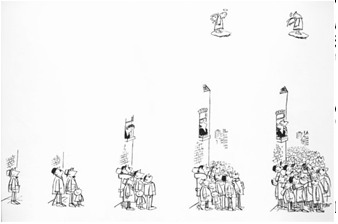
Humans are social animals. We want what others want and we tend to avoid what others avoid. When we’re uncertain, in an unfamiliar environment, we try to resolve the ambiguity by following others

But why is it so? Why do we follow the herd? The answer is evolution – the theory of natural selection.

In the hunter gatherer environment, if you saw a group of panic struck homo sapiens running past you, the obvious conclusion was that they were being chased by a ferocious lion. It gave you a tremendous evolutionary advantage if you started following the herd behaviour under such circumstances. So that’s how the social proof tendency has been wired in human behaviour.
[Read more…] about Behaviouronomics: Social Proof Tendency

  • « Go to Previous Page
  • Go to page 1
  • Interim pages omitted …
  • Go to page 11
  • Go to page 12
  • Go to page 13
  • Go to page 14
  • Go to Next Page »

Handcrafted with in India