
Among all the contemporary business leaders, very few come close to Jeff Bezos’ talent for communicating business strategies in a simplified manner. Like Warren Buffett, Bezos writes an open letter to Amazon’s shareholders every year. He’s been doing it for over two decades.
These letters have become an extraordinary source of insight into how Bezos (the world’s richest man) and his company (Amazon) think about customers, innovation, building products, and future.
Amazon started as an online bookselling platform and interestingly didn’t turn a profit for the first six years. Today it’s the second publicly traded company (after Apple) to ever hit a market capitalization of $1 trillion.
Like me, if you’re an admirer of Bezos, then you’re in the good company of people like Warren Buffett and Charlie Munger who are also big fans of the Amazon CEO. Buffett and Munger admit that they failed to see Bezos’ genius early on. Buffett called him the most remarkable business person of our age. Munger, in his nonchalant voice, said, “Jeff Bezos is a different species.”
[show_to accesslevel=’almanack-all’]
So a few days back when Bezos most recent letter (2018) arrived, I pounced on it. The memo is 2500 words of distilled business wisdom. If you haven’t read it yet, it would be a crime to postpone it.
I was pleasantly surprised to find Bezos discussing a topic that is very close to my heart — being a tinkerer. In the section titled “Intuition, curiosity, and the power of wandering” he writes —
From very early on in Amazon’s life, we knew we wanted to create a culture of builders – people who are curious, explorers. They like to invent. Even when they’re experts, they are “fresh” with a beginner’s mind. They see the way we do things as just the way we do things now. A builder’s mentality helps us approach big, hard-to-solve opportunities with a humble conviction that success can come through iteration: invent, launch, reinvent, relaunch, start over, rinse, repeat, again and again. They know the path to success is anything but straight.
In 1997, Amazon did $147 million in sales and Jeff Bezos opened his letter to shareholders with: “This is Day 1 for the Internet.” At the end of 2018, Amazon closed the books with a revenue figure of $ 233 billion and Bezos his annual letter with – “It remains Day 1.”
“What’s this obsession with Day 1?” someone asked Bezos. He replied, “Day 2 is stasis. Followed by irrelevance. Followed by excruciating, painful decline. Followed by death. And that is why it is always Day 1. To be sure, this kind of decline would happen in extreme slow motion. An established company might harvest Day 2 for decades, but the final result would still come.”
Starting every day as Day 1 is akin to having a beginner’s mind. It’s a powerful metaphor — having a beginner’s mind. In the book Zen Mind, Beginner’s Mind, Shunryu Suzuki observes —
In the beginner’s mind there are many possibilities, in the expert’s mind there are few.
In Zen Buddhism, the word Shoshin means “beginner’s mind” — a mind which is open, eager and is devoid of any preconceptions when studying a subject, even when studying at an advanced level, just as a beginner would.
At this point I would like to bring in Josh Waitzkin — an eight-time US national chess champion, thirteen-time Tai Chi Chuan push hands US national champion, and two-time Tai Chi Chuan push hands world champion. In his book, The Art of Learning: An Inner Journey to Optimal Performance, Waitzkin shares his experiences, insights, and approaches on how one can learn and excel in their life’s passion.
Waitzkin says —
It is easy to have a beginner’s mind when we are a beginner—the real challenge comes when we have become successful, people stroke our egos, we have a reputation to defend. Time and again people get locked up in the learning process by the need to look like they have all the answers. The martial arts world is riddled with this problem. People train with great intensity for many years. Then they open up a school. Their students call them “Master” and put them up on a pedestal. Suddenly this teacher stops training because he does not want to expose his weakness to his students. He puts on a robe, puffs out his chest, and walks around the school telling people what to do. Years pass, and this man is living in direct opposition to what made him great in the first place. The societal tragedy of this phenomenon is that our highly trained minds could make such valuable contributions if they didn’t get locked up by ego. Think about how many academics spend all their time defending their little patch of intellectual territory instead of welcoming in and creating new ideas. The scientific world has been frozen for decades time and again by those who frantically try to defend the old manner of thinking because they have based their careers on it. The movement from Newtonian to Quantum Physics is a good example of this. A more current one is the decades of resistance to transitioning from a localized vision of the brain towards the thrilling new work on neural plasticity.
When a child learns to walk she has a beginner’s mind. Her attempts are guided by an unstoppable curiosity and playful sense of adventure. The unfamiliarity with a new skill (walking) doesn’t deter her. In fact, it intrigues her to get immersed in the experience of figuring out the minute details. Without getting bogged down the child repeats the drill —stumbling, falling, and getting up — over and over again. That’s the secret to learning anything deeply — being fully awake to the experience at hand and being receptive to even the tiniest insights.
Bezos explains it this way —
Sometimes (often actually) in business, you do know where you’re going, and when you do, you can be efficient. Put in place a plan and execute. In contrast, wandering in business is not efficient … but it’s also not random. It’s guided – by hunch, gut, intuition, curiosity, and powered by a deep conviction that the prize for customers is big enough that it’s worth being a little messy and tangential to find our way there. Wandering is an essential counter-balance to efficiency. You need to employ both. The outsized discoveries – the “non-linear” ones – are highly likely to require wandering.
Have you seen a foraging ant? Sometimes it’s shuttling hard between its nest and the food source along with thousands of other ants in the same line. Other times, you’d see a lone ant wandering off looking for a new source of food. An ant is a creature that has mastered the art of striking the perfect balance between exploration and exploitation.
Path to success (and to learning) is anything but straight.
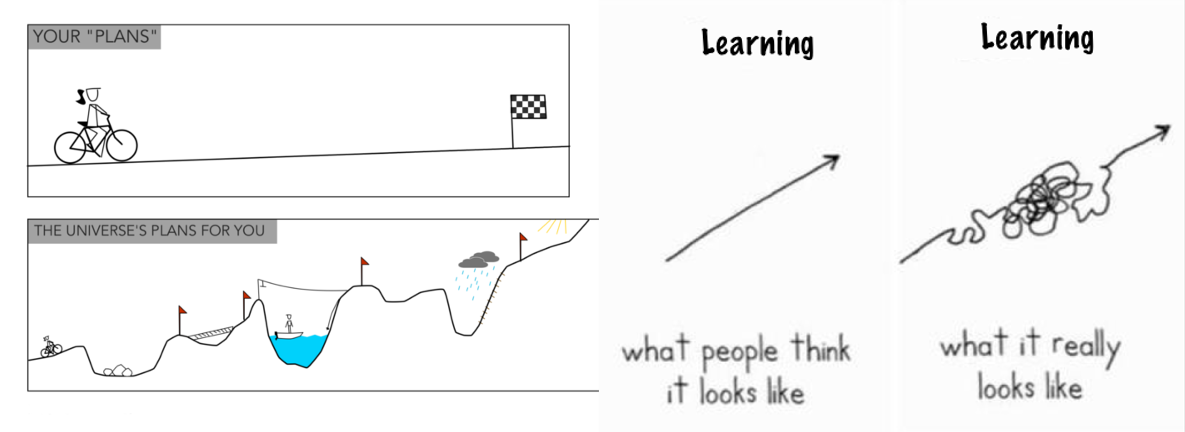
When you accept the idea of wandering, you’re indirectly embracing the path ridden with failures. Bezos again —
Development of the Fire phone and Echo was started around the same time. While the Fire phone was a failure, we were able to take our learnings (as well as the developers) and accelerate our efforts building Echo and Alexa. The vision for Echo and Alexa was inspired by the Star Trek computer. The idea also had origins in two other arenas where we’d been building and wandering for years: machine learning and the cloud. From Amazon’s early days, machine learning was an essential part of our product recommendations, and AWS gave us a front row seat to the capabilities of the cloud. After many years of development, Echo debuted in 2014, powered by Alexa, who lives in the AWS cloud.
No customer was asking for Echo. This was definitely us wandering. Market research doesn’t help. If you had gone to a customer in 2013 and said “Would you like a black, always-on cylinder in your kitchen about the size of a Pringles can that you can talk to and ask questions, that also turns on your lights and plays music?” I guarantee you they’d have looked at you strangely and said “No, thank you.”
Since that first-generation Echo, customers have purchased more than 100 million Alexa-enabled devices.
Once we’ve figured out something we enter the comfort zone — a place of comfort and predictability. Exploiting the comfort zone may be efficient for extracting the maximum value but the more we stay there the riskier it becomes. It’s the kind of risk which is invisible and inevitable.
So think like Bezos. Wander like an ant. And keep a beginner’s mind.
[/show_to]
[hide_from accesslevel=’almanack-all’]
- Spotlight: Big ideas from Value Investing and why applying them in your investment decision making will be a great deal
- InvestorInsights: Interviews with experienced value investors, learners, and deep thinkers
- StockTalk: Thorough analysis of business models of companies (without any recommendations)
- Behaviouronomics: Deep analysis of human behaviour and how it impacts investment decision making
- BookWorm: Reviews of the best books on Value Investing and related subjects
- Free Course – Financial Statement Analysis for Smart People (otherwise priced at Rs 5,900)
- Archives: Instant access to our huge archive from the past three years