
Warren Buffett in his 2012 annual letter to investors, recommended William Thorndike’s book The Outsiders. Buffett called it an outstanding book about CEOs who excelled at capital allocation. The eight terrific CEOs that featured in the book have generated exceptional results across a wide variety of industries and market conditions. We had written about Outsiders in April 2016 as part of VIA bookworm series.
Saurabh Mukherjea’s book is the answer to The Outsiders. Mukherjea writes —
The book [The Outsiders] changed the way I perceived and analysed companies which have been successful over long periods of time (we are talking decades here). What Thorndike helped me grasp was that the truly great companies take the surplus cash flows created by their sustainable competitive advantages and then either return those to shareholders or reinvest those in their core franchise, or — and this is the litmus test of greatness — reinvest those successfully in new activities or markets. It is in those latter set of investments outside the core franchise that a great company assures its future regardless of how economic circumstances and customers’ tastes pan out. Without that insight from The Outsiders, there would be no The Unusual Billionaires.
[show_to accesslevel=’almanack-all’] Fortunately, we have interviewed Saurabh Mukherjea for VIA readers. In his interview, he admitted that his investing and research process is strongly influenced by Thorndike’s book.
The Unusual Billionaires profiles seven companies that have delivered outstanding results for a decade and have been built by visionary business leaders. Those seven companies are —
Asian Paints, Astral Poly, Berger Paints, Marico, Page Industries, HDFC Bank, and Axis Bank.
To arrive at this list following filtering criteria were used —
- Public listed companies with a minimum market cap of 100 crores. The data for unlisted or smaller companies isn’t always reliable.
- The measure of the performance should be for a long period — minimum of ten years. A decade in India usually covers both the up and down cycles in the economy and it also evens out any volatility in performance because of the cyclical nature of any business.
- The twin filters of growth and profitability, i.e., companies that deliver revenue growth of at least 10 percent and ROCE of 15 percent every year for ten years. In the case of banks, ROE and loan growth were used as a proxy for ROCE and revenue growth, respectively.
Using the above three filters, Mukherjea created sixteen portfolios for every 10-year period from 1991-2005. And then he selected those companies which appeared the most number of times in each of these portfolios.
The seven companies outlined in the book pass all the criteria stated above. Each name in the list gets a dedicated chapter where the author delves deeper into the multi decadal evolution of these great companies and how they have created sustainable competitive advantages.
For this post, I’ll pick some interesting tidbits from one of these businesses — Page Industries.
It’s a name familiar (even well known) to those who have been in the market for past 4-5 years. Page Industries IPO came out in March 2007 and since then it has delivered a return of 34% CAGR to its shareholders, in spite of the fact that the stock has corrected by almost 40% recently from its all time high last year.
An acquaintance in my apartment complex was able to retire early from his job because of the money he made through his investment in Page. For the uninitiated, Page owns the manufacturing and marketing license for the Jockey brand of innerwear in India.
Page promoters — Genomal family — have a long history with Jockey international. Genomals owned Jockey license in the Philippines since 1959. So in 1991, when India opened up its economy, Jockey International refused the tie-up offers from many large Indian companies. It instead approached the Genomals to expand beyond the Philippines. That attests to the fact that compounding of goodwill and trust is the best source of creating sustainable competitive advantage. No wonder, in 2010, Jockey USA extended its licensing agreement with Page for a twenty-year period, instead of the standard practice of five years.
Another testimony to this idea of long term business relationships being a source of a strong moat is Speedo — an international swimwear brand — giving its license to Page. Similar to Jockey, this agreement was signed due to the existing relationship between Speedo International and the Genomals, with the latter having expanded Speedo’s presence in the Philippines since 1988.
A few years back, while attending a value investing conference, I remember listening to a speaker (a well-known fund manager) who invested in Page very early and made a lot of money. He mentioned that during his research, he would go to the shopping malls and check the manufacturing date on the boxes of innerwear products. He consistently found that Jockey products were never older than a few months, which meant that the Jockey was selling its SKUs very fast.
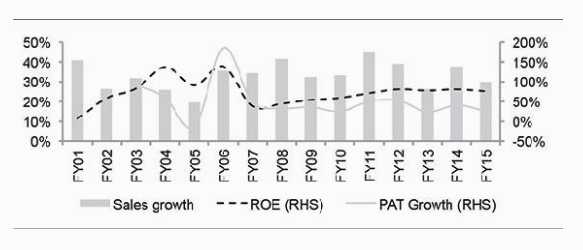
The above chart is from the book and you can see that Page has been a hallmark of consistency when it comes to a steady ROE, sales growth, and earnings growth.
Pages’s business model generates large amounts of cash, given its FMCG-like nature of business — sales are paid for in advance, while raw material supplies are paid over a period of time. Another unique thing about its strategy is they make their own elastic compared to the industry practice of outsourcing from small cottage industries. Page’s approach towards advertising has also been unique. In a neat play on Indians world view, Page has made consistent use of Caucasian models (instead of Indian models) in its advertisements and thus firmly entrenched its brand recall as an international brand.
During his visit to Page factories, Mukherjea noticed a high number of women workers. He writes —
This was something new to me since in all my visits to shop floors in India, I found that the labour force is dominated by men. As I learnt later, women account for as high as 88 percent of Page’s labour force. The primary benefit of this is reduced probability of labour unrest as compared to a male-dominated force. Page’s management has a strict policy against supervisors shouting at workers in its manufacturing plants. The company also provides medicines free of cost to their workers, a unique feature compared to many other textile manufacturing set-ups.
Pius Thomas, the GM of finance, says, “At page, we are very careful about our capital allocation and will not invest in projects which are not directly related to the core business. Even core projects will not be taken up unless they promise an ROCE of at least 20 percent.” Capital allocation is a skill which is often missing in the repertoire of most CEOs because they are mostly operational experts. However, as Warren Buffett has often pointed out that capital allocation is the most important for any CEO. In the case of Page, the management talks the language of capital allocators.
Towards the end of the book Mukherjea has provided a checklist that distils the key lessons from the journeys of the seven companies. He writes —
…the checklist is designed to help those readers who are genuinely committed to understanding and researching companies. My checklist is limited to three major heads: industry attractiveness, management quality and competitive advantages. While each of these broad categories, in turn, has numerous subheads within them, I have restricted the checklist to simple questions.
Industry Attractiveness
- Is the company’s business heavily dependent on government regulation?
- How many competitors are present in the industry and how strong is the competitive intensity?
- What is the overall size of the industry and its growth potential?
- Is the company in an industry where the proportion of value addition is high?
- What is the capital intensity and capital efficiency of the industry?
- Is the industry’s business dependent on India’s overall economic cycle?
- Does the business generate excess returns higher than the industry average?
I look for industries which are relatively free of regulation, low on competitive intensity and growing at double-digit rates (examples include heavy trucks, cars, speciality chemicals). Such industries usually tend to have a small number of relatively large companies and in such situations, the top two players in that industry are usually able to generate ROCEs in excess of the cost of capital.
Management Quality
- Does the management have a track record of good governance and clean accounting?
- Do the owners of the company have connections to political parties?
- Does the company have a strong track record of efficient capital allocation?
- Do the promoters have a track record of remaining focused on their core operations?
I look for management teams which maintain a clean set of accounts and allow genuinely independent directors (who can look after the interest of minority shareholders) to sit on the board. I look for promoters who are humble, hard-working, self-aware of their limitations and are focused on the well-being of their business. I am keen to avoid promoters who build business relationships with politicians.
Competitive Advantage
- What is the company’s track record on innovation?
- What is the company’s investment in brands and reputation?
- How strong is the company’s architecture?
- Does the company own any strategic assets?
- Does the company have ROCEs that are higher than the industry average?
I look for companies which can sustainably drive ROCEs in excess of 15 per cent and in excess of the industry average by deriving sustainable competitive advantages from: (a) a culture of innovation; (b) strong brands; (c) architecture, i.e. unique relationships between people within the firm and/or between the firm and its suppliers or customers; and (d) strategic assets such as intellectual property, physical property or licences.
It’s difficult to find such an elaborate and deep coverage of quality businesses in one place. The book covers a very detailed account of each of the seven companies — right from their history to how they grew the business over the decades, what challenges they overcame and how their management continued to focus on creating long term value for the shareholders.
[/show_to] [hide_from accesslevel=’almanack-all’]
- Spotlight: Big ideas from Value Investing and why applying them in your investment decision making will be a great deal
- InvestorInsights: Interviews with experienced value investors, learners, and deep thinkers
- StockTalk: Thorough analysis of business models of companies (without any recommendations)
- Behaviouronomics: Deep analysis of human behaviour and how it impacts investment decision making
- BookWorm: Reviews of the best books on Value Investing and related subjects
- Free Course – Financial Statement Analysis for Smart People (otherwise priced at Rs 5,900)
- Archives: Instant access to our huge archive from the past three years