
I am a big fan of Calvin and Hobbes comic strip. According to me, it’s the greatest comic ever created. Sadly, Bill Watterson, the creator of Calvin and Hobbes, developed an interest in other creative pursuits and stopped making Calvin and Hobbes after 1995.
For the uninitiated, Calvin is a 6-year-old boy who is a little too smart for his age. But judging by his performance at school, one would think of him as a slow learner. However, Calvin’s genius is revealed when Watternson lets you peek into the little boy’s life outside the classroom. The kid may not know basic mathematical operations like addition or multiplication but he can outsmart any adult when it comes to imagination. And let me remind you what Albert Einstein said, “Imagination is more important than knowledge.”
[show_to accesslevel=’almanack-all’]
The most exciting part of Calvin’s life is his buddy — Hobbes — a tiger. To the outside world, Hobbes is just a stuffed toy but in Calvin’s mind Hobbes is not only a real tiger but a philosopher friend.
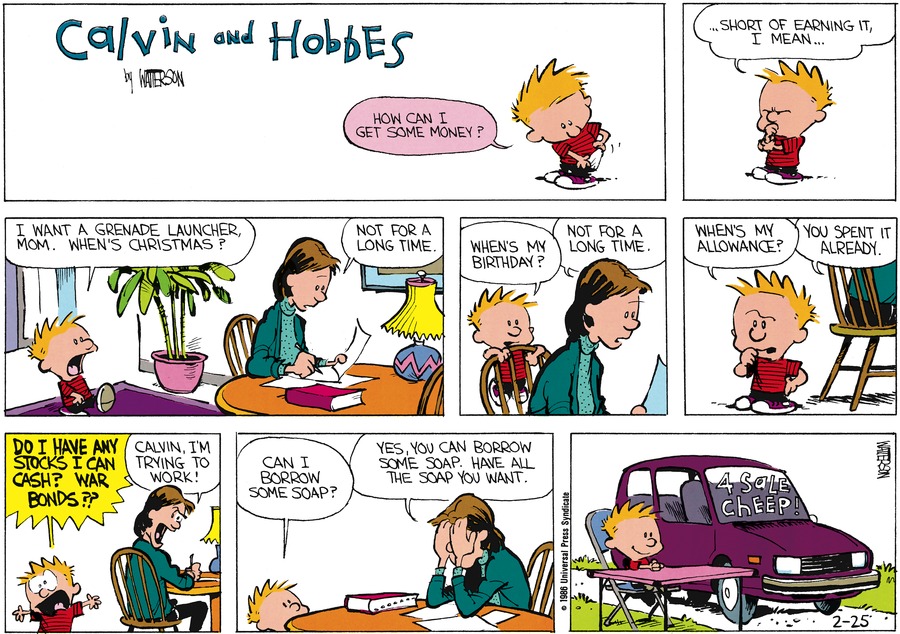
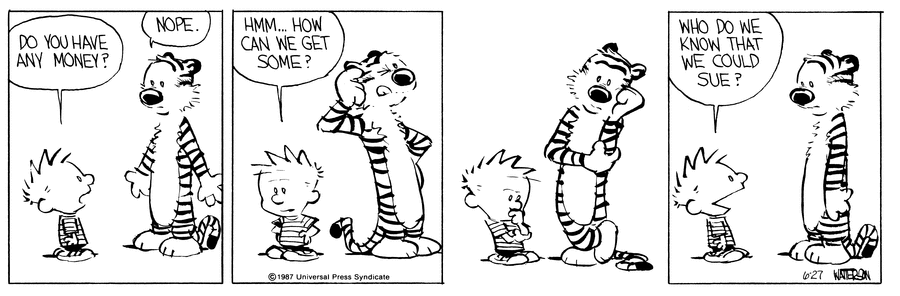
I think Calvin’s intelligence has blossomed because of the interesting conversations he’s had with Hobbes.
How can you have an interesting conversation with a stuffed toy? Well, it’s Calvin’s mind imagining both sides of the dialogue. This smart strategy — the practice of having an enriching conversation with yourself — isn’t just a comic book trick. It’s a very effective problem-solving method.
Charlie Munger says —
There are two great ways of discovering the solution to the most difficult problems. The first is to explain it to someone who simply nods in response. It’s what Munger calls the Orangutan Method. If you enter an orangutan’s cage, give him a banana and talk about the problem, when you leave the orangutan will still be eating the banana. But you’ll be a little bit closer to a solution.
Of course, this is not a replacement for having a conversation with other smart people but you don’t have access to smart people all the time. The person you spend the most time with is yourself. In fact, you are always talking to yourself in your head. However, this constant mental chatter is often repetitive, involuntary, and scattered. But the moment you take extra effort to verbalize your thoughts, your own ears get involved. Moreover, talking out loud breaks the cacophony inside our mind and gives it a direction.
This is very similar to the idea of journaling. Journaling is simply an activity of writing in plain language about what’s going on around you and what are your thoughts about them. It can include things like your future goals, plans, dreams, reminders to yourself, comments on ideas/people, or any unrelated thing that crosses your mind. Writing down your thoughts is a great thinking tool. It crystallizes the half-baked ideas in your head and helps you zero down on things that are most relevant to the matter at hand. Today Journaling features in my personal list of top 10 big ideas for life.
However, writing and speaking are two different cognitive activities. They engage different parts of your brain. There may be some overlap but I know the neurons that control writing and the ones that control speech are definitely different. How do I know? Haven’t you seen cases where someone lost his voice but can still write? In fact, most of us as kids first learn to speak and then later get acquainted with pen/pencil.
Which means, speaking out loud and then allowing your brain to listen to your words back creates a very different kind of feedback than what journaling does. In fact, very few writers know this — the best way to put yourself in the shoes of your audience is to read out loud what you have written. Anything that you write, if it doesn’t sound okay while reading it out loud to yourself, it won’t sound well in the reader’s mind too.
That’s why Feynman’s technique is so powerful for learning anything deeply. It engages both the faculties — writing and speaking — simultaneously. It’s learning on steroids. Watch this video if you haven’t heard about Feynman’s technique.
Warren Buffett vouches that Charlie Munger is one of the smartest persons alive today. I am sure Munger has several smart friends but given the cult-like following he has, a lot of his time is spent talking to people who are not as sharp. Those not-so-bright souls are the ones who get to learn a lot from Munger but I guess Munger also learns a lot in this process, thanks to the Orangutan theory. This audience who is no match to Charlie’s intellect is like a bunch of orangutans nodding to whatever Charlie is saying.
Everybody is like an orangutan in some areas. Even Einstein would have been as dumb as an orangutan when it came to matters which were not important to him.
Teaching is considered the best way to learn. Even if you’re teaching to a set of uninterested audience, just by speaking out your thoughts, your own understanding improves. Even if your listener doesn’t learn anything, you definitely come out smarter from the one-way conversation.
Of course, you could sit in front of the mirror and try to explain it to your own reflection but in this case your eyes are telling your brain that you are being fooled and that might defeat the purpose. Perhaps, that’s why Charlie said you need someone else in front of you.
Once you learn the power of this trick, it would be a paradigm-shifting experience for you.
Gary Lupyan, a researcher and psychology professor at the University of Wisconsin-Madison, wanted to find out if hearing a word can enhance your perception about that object. His team did an experiment where they asked subjects to search for different objects in different situations. For example, subjects were asked to search for a picture of a specific item, like a banana, among 20 images of random items.
They divided their subjects into two groups and asked one group to say the name of the object out loud to themselves. The idea was to find out if the brain became more receptive to discovering that object by saying the object’s name.
Lupyan discovered that when subjects said the word “banana” before searching for a picture of one, they found the picture faster and more accurately. They concluded that saying the word out loud made the subjects more aware of its physical traits, which then made the banana stand out among other objects.
Similarly, when you talk out loud about a problem, your brain tries to reach out to your subconscious knowledge bank and pull out insights that were not available to your conscious thoughts earlier.
So what are you waiting for? Go get your hobbes and start talking to him about problems that are bothering you.
Trying to find a flaw in your investment hypothesis? Ask Hobbes. Tell him everything you know about the business, its financials, its competitive strength and why you think it’s valuations are attractive. Then wait for the answers.
If it works wonderfully well for Calvin, why won’t it work for you?
- Spotlight: Big ideas from Value Investing and why applying them in your investment decision making will be a great deal
- InvestorInsights: Interviews with experienced value investors, learners, and deep thinkers
- StockTalk: Thorough analysis of business models of companies (without any recommendations)
- Behaviouronomics: Deep analysis of human behaviour and how it impacts investment decision making
- BookWorm: Reviews of the best books on Value Investing and related subjects
- Free Course – Financial Statement Analysis for Smart People (otherwise priced at Rs 5,900)
- Archives: Instant access to our huge archive from the past three years