
Aldous Huxley an English philosopher once said-
Experience is not what happens to a man; it is what a man does with what happens to him.
In isolation, experience and knowledge are useless. It’s the symbiotic relationship between these two that makes them valuable. Knowledge which doesn’t inspire action has a shelf life of a banana, i.e., it doesn’t last long. When actions don’t refine back the knowledge that initiated them, it’s like throwing darts in the dark.
[show_to accesslevel=’almanack-all’]
A tight feedback loop between knowledge and experience is essential for making progress. And an inseparable part of this process is the scrutiny of this feedback loop.
Rare are those who are genuinely thoughtful about what they do. These are the people who have an insatiable appetite for learning. And their willingness to apply their knowledge is what separates them from the crowd.
Among these practitioners, there’s a small set of people who don’t just keep their discoveries to themselves. They go out and share it with the world. They write about it. Talk about it. They are courageous enough to take a personal risk of public scrutiny. They stick out their neck with their strong opinions about the world. Because they aren’t bothered about being proven wrong. In fact, they even look forward to it. They want to be proven wrong. Because they know that’s how progress happens. By being proven wrong. Every time they’re proven wrong they move towards being less wrong. That’s their aim.
Among these teacher-practitioners, there’s even smaller set of those who are effective communicators. They teach in a way that makes people listen to them. They are brilliant storytellers. They package their ideas into a mesmerizing narrative.
Consider yourself extremely lucky if you have access to such people in your life. But if you don’t then the best way to associate with them is to read what write/say.
As Charlie Munger says, the most useful ideas are discovered through interdisciplinary learning. Imagine if you could find multidisciplinary thinkers from every field and learn from them. Won’t that be multidisciplinary education on steroids?
Recently, Prof Sanjay Bakshi (a storyteller-teacher-practitioner himself) recommended this on Twitter –
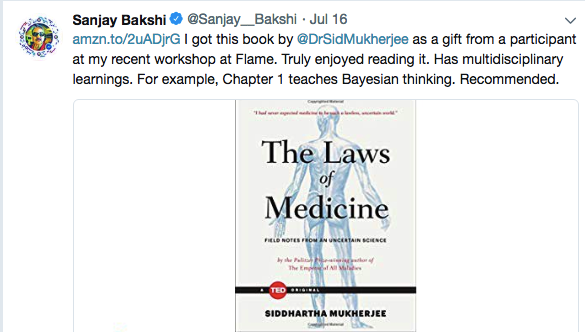
Dr. Siddhartha Mukherjee is a cancer surgeon. But that doesn’t make him unique because there are thousands of cancer surgeons in the world. What makes him special is that he’s a storyteller-teacher-practitioner. His first book – The Emperor of All Maladies – won a Pulitzer prize.
So when I saw Prof. Bakshi’s tweet, I immediately bought a copy of The Laws of Medicine and read it in one sitting. It’s a short 70-page read but don’t let its size fool you. The book packs a wallop.
As Prof. Bakshi mentioned, Dr. Mukherjee is a multidisciplinary thinker. That’s why his ideas on medicine have universal appeal. Moreover, when you gloss over the medical jargons which Dr. Mukherjee does artfully in his writings, the insights from medical case studies become easily accessible and engaging to outsiders.
Mukherjee closed the first chapter with a quote from his senior surgeon – “It’s easy to make perfect decisions with perfect information. Medicine asks you to make perfect decisions with imperfect information.”
I think you can safely replace the word medicine with investing in the above quote. Today, the world of a small investor is brimming with information. But very few investors know what to do with this information especially when the data is imperfect, incomplete or uncertain.
The challenges of the medical field form the backdrop of this book, but I also expected it to be an essay about information, imperfection, and uncertainty. I hoped the book to be equally relevant for people like me who have no medical background. I wasn’t disappointed.
As I read further, the author soon acknowledged what I had suspected. He writes –
I had never expected medicine to be such a lawless, uncertain world. I wondered if the compulsive naming of parts, diseases, and chemical reactions—frenulum, otitis, glycolysis—was a mechanism invented by doctors to defend themselves against a largely unknowable sphere of knowledge. The profusion of facts obscured a deeper and more significant problem: the reconciliation between knowledge (certain, fixed, perfect, concrete) and clinical wisdom (uncertain, fluid, imperfect, abstract).
This book began as a means for me to discover tools that might guide me through a reconciliation between these two spheres of knowledge. The “laws of medicine,” as I describe them in this book, are really laws of uncertainty, imprecision, and incompleteness. They apply equally to all disciplines of knowledge where these forces come into play. They are laws of imperfection.
Whether investing or medicine, the world we live in is messy, chaotic, and full of surprises.
Was it appropriate to treat a forty-year-old woman with acute leukemia with an aggressive bone-marrow transplant if her health was declining rapidly, asks Mukherjee, “At first glance, textbooks and published clinical trials gave you an answer. In this instance, standard wisdom held that patients with declining health and performance should not be given a transplant. But what if that answer didn’t apply to this woman, with this history, in this particular crisis? What if the leukemia itself was causing the rapid decline? If she asked about her prognosis, I could certainly quote a survival rate pulled from a trial – but what if she was an outlier?”
Those are the kind of puzzles that reality loves to throws at our face every day. How to deal with it?
As the complexity of the problems has increased in human life, we have invented tools that are even more complex. Unfortunately, these complex solutions tend to stir up a false sense of confidence. They make us prone to what Charlie Munger likes to call the-man-with-a hammer syndrome.
Purging was a common medical intervention in the nineteenth century not because it was particularly effective, but because it was one of the few things that doctors could actually achieve through medicines; if you had a hammer, as the saying goes, then everything looks like a nail.
Today most doctors scoff at any practice even remotely resembling purging. But is it possible that even modern medical science has its own version of purging which is rampant today?
Gerd Gigerenzer, in his book Risk Savvy, has described how most doctors lack the ability to interpret the results of many important medical diagnostic procedures like mammography and PSA tests. Numbers have shown that prescribing these tests to everyone does more harm than good.
Mukherjee weaves this idea into a deeply engrossing medical case study. Just this one story and the insight from it makes the book worth reading. Everything else in the book is a bonus.
Every diagnostic challenge in medicine can be imagined as a probability game. This is how you play the game: you assign a probability that a patient’s symptoms can be explained by some pathological dysfunction – heart failure, say, or rheumatoid arthritis – and then you summon evidence to increase or decrease the probability. Every scrap of evidence – patient’s medical history, a doctor’s instincts, findings from a physical examination, past experiences, rumors, hunches, behaviors, gossip – raises or lowers the probability. Once the probability tips over a certain point, you order a confirmatory test – and then you read the test in the context of the prior probability.
Many diagnostic tests which are carelessly prescribed by most doctors are actually confirmatory tests. Taking those tests without understanding their usefulness can have serious consequences. A test can only be interpreted sanely, argues Mukherjee, “in the context of prior probabilities.”
Every test – whether in medicine or any field – has a false-positive and false-negative rate. For example, in HIV test a false positive is when the result is positive even when the patient doesn’t have HIV infection. In a false negative, the test result is negative, but actually, the patient is infected with HIV.
What happens when you run a diagnostic test with high accuracy, say 99.9 percent, on a large set of people?
Suppose the HIV test has a false-positive rate of 1 in 1000, i.e., one out of every thousand patients tests positive, even though the patient carries no infection. And suppose, further, we deploy this test in a population of patients where the prevalence of HIV infection is also 1 in 1000. To a close approximation, for every infected patient who tests positive, there will also be one uninfected person who will also test positive. For every test that comes back positive, in short, there is only a 50 percent chance that the patient is actually positive. Such a test, we’d all agree, is not particularly useful: it only works half the time.
Do you see what happened? A highly accurate test for a rare disease (low prevalence/prior probability), when deployed on a large number of people, turns into a shockingly inaccurate procedure.
Suppose our pre-selection strategy is so accurate that we can stratify patients as “high risk” before the test. Now, the up-front prevalence of infection climbs to 19 in 100, and the situation changes dramatically. For every twenty positive tests, only one is false positive, and nineteen are true positives – an accuracy rate of 95 percent. It seems like a trick pulled out of a magician’s hat: by merely changing the structure of the tested population, the same test is transformed from perfectly useless to perfectly useful. You need a strong piece of prior knowledge.
The idea applies not only to medicine, writes Mukherjee, “but to any other discipline that is predicated on predictions: economics or banking, gambling or astrology. The core logic holds true whether you’re trying to forecast tomorrow’s weather or seeking to predict rises and falls in the stock market. It is a universal feature of all tests.”
This is the best explanation of Bayes’ theorem that I’ve ever seen. It is one of the three big ideas that the author has discussed in the book.
Dr. Mukherjee reminds me of Dr. Atul Gawande, another storyteller-teacher-practitioner.
Ninety-nine percent of everything humans knew about the world in the 19th century has already been proven wrong. What makes you think that everything we know today will not be eventually proven wrong?
People like Mukherjee and Gawande aren’t afraid to accept and even announce that what we know today is probably wrong. And they put in an immense cognitive effort to refine their ideas and invite the world to ponder over them.
We need more people like them.[/show_to] [hide_from accesslevel=’almanack-all’]
- Spotlight: Big ideas from Value Investing and why applying them in your investment decision making will be a great deal
- InvestorInsights: Interviews with experienced value investors, learners, and deep thinkers
- StockTalk: Thorough analysis of business models of companies (without any recommendations)
- Behaviouronomics: Deep analysis of human behaviour and how it impacts investment decision making
- BookWorm: Reviews of the best books on Value Investing and related subjects
- Free Course – Financial Statement Analysis for Smart People (otherwise priced at Rs 5,900)
- Archives: Instant access to our huge archive from the past three years