
In 1983, Daniel Kahneman — the famous behavioural scientist — and his colleague Amos Tversky, published this example in Psychology Review. The example is about a fictitious character called Linda.
Linda is 31 years old, single, outspoken and very bright. She majored in philosophy. As a student, she was deeply concerned with issues of discrimination and social justice, and also participated in anti-nuclear demonstrations. Based on this information about Linda, you have to estimate which of the following statements about Linda are more likely to be true.
[show_to accesslevel=’almanack-all’]
Linda is active in the feminist movement. (F)
Linda is a bank teller. (T)
Linda is a bank teller and is active in the feminist movement. (T&F)
Kahneman and Tversky asked a group of students to make a prediction and they discovered that 85% of the participants predicted that Linda is more likely to be a bank teller and active feminist (T&F) than she’s likely to be just a bank teller (T).
But that’s impossible unless all bank tellers are also active in the feminist movement, writes Gabriel Weinberg in his book Super Thinking, “The fallacy arises because the probability of two events in conjunction is always less than or equal to the probability of either one of the events occurring alone, a concept illustrated in the Venn diagram”
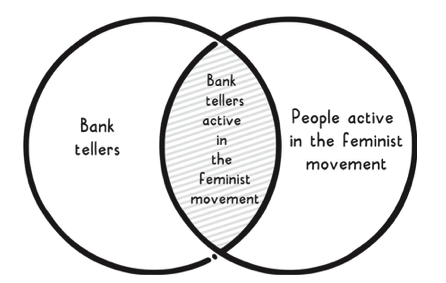
Part of the reason for the conjunction fallacy is that most people don’t have an intuitive understanding of probability. And it’s true even for those who are supposedly more math savvy. So, it surprised Kahneman when he asked the same question from a more sophisticated audience. In his book, Thinking Fast and Slow, Kahneman writes —
We were convinced that statistically sophisticated respondents would do better, so we administered the same questionnaire to doctoral students in the decision-science program of the Stanford Graduate School of Business, all of whom had taken several advanced courses in probability, statistics, and decision theory. We were surprised again: 85% of these respondents also ranked “feminist bank teller” as more likely than “bank teller.”
A fallacy is when our intuition tells us something which goes against logical reasoning.
When I first read about Linda’s example, I found it hard to fight my intuition. There was no confusion about Kahneman’s logic but somehow it still didn’t feel right. I started thinking about Conjunction Fallacy in the context of investing and reframed the Linda problem like this —
Imagine a NBFC company that has been in the news for corporate governance issues. Moreover, for the past few quarters the management has stopped doing investor conference calls. Now, what’s more likely to happen in the next one year?
- The stock price goes down by 30%
- A fraud is detected and the stock price corrects by 30%.
Had I not known about Linda’s example, I would have gone with the second option. But if you think about it, the stock price can go down even if no fraud is detected. Maybe the whole market crashes because of some larger macro event. Maybe the NBFC industry is going through a crisis.
The conjunction fallacy stems from the human brain’s tendency to find causality behind events. This need for causality nudges us towards those explanations which seem more plausible because of the availability of more details.
Kahneman writes —
…probability judgments were higher for the richer and more detailed scenario, contrary to logic. This is a trap for forecasters and their clients: adding detail to scenarios makes them more persuasive, but less likely to come true. To appreciate the role of plausibility, consider the following questions: Which alternative is more probable?
Mark has hair.
Mark has blond hair.and Which alternative is more probable?
Jane is a teacher.
Jane is a teacher and walks to work.The two questions have the same logical structure as the Linda problem, but they cause no fallacy, because the more detailed outcome is only more detailed—it is not more plausible, or more coherent, or a better story. The evaluation of plausibility and coherence does not suggest an answer to the probability question. In the absence of a competing intuition, logic prevails.
The Conjunction Fallacy is a battle between plausibility and probability. Plausibility is subjective. Different people, based on their past experiences and what information they have, can assign a varied level of plausibility to the outcome of certain events. But the probability is objective. It’s about base rates.
In case of the stock market example, the information that was provided to you, i.e., the corporate governance issues and management’s reluctance to communicate with the investors, increase the plausibility of the fraud which in turn will surely affect the stock price negatively. This whole sequence of cause and effect sounds more appealing than the simple statement — the stock fall by 30%.
This is the reason for overconfidence among investors when they spend too much time digging out obscure data about a company without questioning its relevance. When presented with new data, our brain being a sucker for confirmation bias, usually retains the information that agrees to its pre-formed notions and discards any conflicting evidence. As a result, more data simply makes our hypothesis more plausible (to us) and not more probable.
The Conjunction Fallacy explains why people believe fake news, argues mathematician John Allen Paulos. Fake news is nothing but stories where more facts (mostly unverified) are enumerated to make it sound more believable even though it’s actually less probable.
Paulos writes —
Thanks to the vast amount of information (or misinformation) on the internet, we are all able to build houses of just one color. Nowadays, we can all easily be misguided by confirmation bias, our natural tendency to search for information that confirms our beliefs and to ignore that which threatens our beliefs. The consequence, if we don’t check our unexamined predilections, is a world that is made entirely of single-colored houses, some red, some blue. And too many single-colored neighborhoods can lead to skewed beliefs.
Let me illustrate with a less extreme example. Consider the fictitious Sen. Smith, a happily married family man extremely devoted to his son and daughter who lives modestly in his small hometown. Which is more likely: (a) Smith accepted an illegal campaign contribution from a supporter or (b) Smith accepted an illegal campaign contribution from a supporter and used it to pay for his daughter’s expensive medical treatments in a distant city? The second story sounds more likely, because it sounds like there’s a more coherent story being fleshed out, but despite that, the first alternative is more likely. The reason: For any statements A, B, and C, the probability A is true is always greater than the probability that A, B, and C are all true since whenever A, B, and C are true, so is A, but not vice versa. There is sometimes a trade-off between plausibility and probability.
Rolf Dobelli, in his book The Art of Thinking Clearly, cites another great example to illustrate this fallacy. He writes —
I experienced this after the 9/11 attacks on the World Trade Center. I wanted to take out travel insurance and came across a firm that offered special “terrorism cover.” Although other policies protected against all possible incidents (including terrorism), I automatically fell for the offer. The high point of the whole farce was that I was willing to pay even more for this enticing yet redundant add-on.
If I tell you that John found a cat, you will roll your eyes, “Duh! So what?”
But if I tell you that John found Mary’s cat, then it becomes more interesting and you would ask, “Tell me the whole story.”
Humans love stories. More the details in a piece of information, more are the chances of finding connections and correlations. And the mind likes to latch on to those correlations even if they lead to wrong conclusions. Someone wisely observed — a human mind is a meaning-making machine. And this hunger for meaning drives us towards poor decisions informed by false plausibilities.
[/show_to]
[hide_from accesslevel=’almanack-all’]
- Spotlight: Big ideas from Value Investing and why applying them in your investment decision making will be a great deal
- InvestorInsights: Interviews with experienced value investors, learners, and deep thinkers
- StockTalk: Thorough analysis of business models of companies (without any recommendations)
- Behaviouronomics: Deep analysis of human behaviour and how it impacts investment decision making
- BookWorm: Reviews of the best books on Value Investing and related subjects
- Free Course – Financial Statement Analysis for Smart People (otherwise priced at Rs 5,900)
- Archives: Instant access to our huge archive from the past three years