
Let me ask you a simple question. What’s the shape of the earth?
You might say, “Round.” To sound little more accurate, some of you might say, “Earth is like a solid sphere.” Those who are mathematically inclined would probably point out that the earth is a spheroid that bulges at the equator and is somewhat squashed at the poles.
What if I told you that there’s a large group of people who (still) believe that the earth is a flat circular disc with a large dome covering it from all sides and the sun and the moon are man-made lights hung on a huge pole standing at the center of the circular disc?
Yes, in the 21st century there exists a real flat earth society. And these people aren’t crazy. They’re a thriving community and perhaps growing. Google it.
Of course, the flat earth model doesn’t explain everything but it’s interesting to observe a flat-earther’s response when you ask him to explain why certain observations don’t fit his theory. Instead of re-evaluating the validity of his beliefs, he’d take the refuge of a conspiracy theory. And like all conspiracy theories, everything can be reasoned by flat-earthers using circular logic.
[show_to accesslevel=’almanack-all’]
Now before we ridicule the flat earthers, let me ask you my follow up question, “How do you know that earth is round/sphere?”
And before you answer that, let me add that following are not acceptable answers —
“Everyone knows/says this.”
“That’s what we were taught in the school.”
“It’s on Wikipedia.”
I am sure no one among us has carried out personal experiments to confirm that earth is round. At least I never cared to fact-check or verify personally. It’s natural for us to think that our beliefs come about as a result of in-depth analysis and critical thinking. Unfortunately, it isn’t true. Most of our beliefs are formed without any examination or verification.
In Annie Duke‘s book Thinking in Bets, she describes how belief formation actually works:
- We hear something;
- We believe it to be true;
- Only sometimes later, if we have the time or inclination, we think about it and vet it, determining whether it is, in fact, true or false.
The longer we’ve believed something to be true, the harder it is to change it. Especially, if our past experiences seem to align (even vaguely) with those beliefs. The dopamine rush that the brain gets by having its views confirmed creates a strong addiction.
Throwing more facts at flat-earther doesn’t seem to help. In fact, the more you show them the evidence, the more firmly they cling to their existing beliefs. In psychology, this is known as the Backfire Effect. It’s the extreme side of confirmation bias.
Confirmation bias is the mental state where our beliefs are heavily influenced by what we want to believe. As a result, we tend to cherry-pick the information which confirms our world view. In simple words, we’re motivated by wishful thinking rather than rationality based on objective data.
Put simply, we interpret things not based on the content of the evidence but based on the content of our minds.
Just like every other human bias, the roots of confirmation bias can be traced back to evolutionary biology. Millions of years of evolution has wired the human brain to shun the inconsistencies in the environment – either by avoiding or by resolving. Harbouring two conflicting pieces of information in our mind creates a severe mental discomfort known as cognitive dissonance. The three-pound grey matter inside our skull has been designed by mother nature in such a manner that it’s optimized to conserve energy by getting rid of (by hook or by crook) cognitive dissonance, even if it means being delusional. The result of this tendency is what psychologists have termed as confirmation bias.
Backfire effect is confirmation bias on steroids. This happens when irrespective of how convincing the facts that support the contrary viewpoint are, one not just refuses to change his or her mind but becomes all the more convinced about prior beliefs. Essentially, the backfire effect means that showing people evidence which proves that they are wrong is often ineffective, and can actually end up backfiring, by causing them to support their original stance more strongly than they previously did.
Famous investment blogger Morgan Housel writes —
…most of what guides us are beliefs that reflect what we’ve happened to experience in the narrow view of our own lives. Even when investors study history, they put more weight on stories that align with their own experiences, because those stories are easier to understand and confirm their beliefs. It’s painful to contemplate, but a lot of what all of us believe about investing is either right but temporary, or wrong but convincing. If you’re unwilling to update your views when the world changes, or be open-minded enough to realize that some of your views were anecdotal to begin with, boy, you will be eaten alive in this field.
Having said all this, let me acknowledge that it’s easy to point out the irrationality in others and hard to accept our own follies. Don’t believe me? Here are a few simple questions that you should ask yourself often.
- How have you responded on occasions when you were proven wrong?
- Are there any trends happening now that contradict how I’ve been taught the world is supposed to work?
- In the past, can you recall instances when you changed your mind when the previous views were contradicted?
Do an honest introspection and the results would surprise you about your own fallibility. And there’s no disgrace in it. To be human is to be irrational. However, the trouble begins when we refused to accept it. Being delusional about our abilities is the recipe for disastrous decisions.
Tell people what they want to hear and you can be wrong indefinitely without penalty, writes Housel, “Confirmation is in much higher demand than information.”
Most of the avenues where we acquire information today (internet, TV news) are designed to strengthen our existing beliefs. Google and Facebook profile their users based on their online activity and then construct their feed that is more likely to be clicked by that user. Which means they’re fueling the confirmation bias.
David McRaney, in his book You Are Not So Smart, writes —
What should be evident from the studies on the backfire effect is you can never win an argument online. When you start to pull out facts and figures, hyperlinks and quotes, you are actually making the opponent feel as though they are even more sure of their position than before you started the debate. As they match your fervor, the same thing happens in your skull. The backfire effect pushes both of you deeper into your original beliefs.
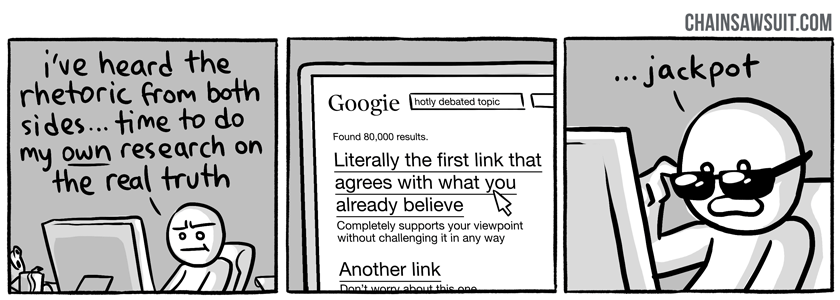
So how do we save ourselves from the backfire effect?
Charlie Munger gives some clues. Munger says on Charles Darwin: “He trained himself to consider any evidence tending to disconfirm any hypothesis of his, especially if he thought his hypothesis was a particularly good one.”
It’s said about Darwin that whenever he encountered any evidence which seemed to go against his hypothesis, he immediately made a note of it. He understood the mind tends to ignore disconfirming evidence, so he made sure that he wasn’t fooling himself by ignoring important evidences.
The best way to fight confirmation bias is to train ourselves to seek disconfirming evidence actively.
Cullen Roche in his blog Pragmatic Capitalism writes –
I prefer to read the things that least agree with me. I know what I don’t know which is basically most things. So I try to focus on reading that which will reduce the potential for confirmation bias. Yes, we all have our favorite authors, journalists and sources, but we enjoy them largely because they make us feel good about what we already know. I suggest getting out of your comfort zone and reading that which really challenges you to reconsider all the things you think you know. When you’ve accumulated a reading list that irritates you, challenges you and excites you, you know you’ve got a well-rounded set of sources.
In fact, the most robust world view is the one which is arrived at by falsifying lots of theories. Nassim Taleb, in his book Antifragile, has termed this approach as Via Negativa. It’s inspired by Karl Popper’s idea of falsification which said that science is all about falsification and not confirmation. For anything hypothesis to be scientific, it has to describe the conditions under which it would be proven false. If a hypothesis doesn’t have such clauses, then it’s merely a conspiracy theory.
Which means any rational investigation must proceed with a focus on finding disconfirming evidence rather than just finding more information which confirms the conjecture.
I’ll leave you with these enlightening words from Morgan Housel on the connection between confirmation bias and investing —
[hide_from accesslevel=’almanack-all’]if you change your mind about that thing, a wave of people who gave you attention because they wanted to believe in the thing will flee and discount your wisdom, since they can no longer use you to confirm their views. There are things that never change, but underneath them are trends, industries, companies, countries, and strategies that come and go. The ability to let go of past beliefs when they’re no longer valid, or you realize you were wrong to begin with, is indispensable in this field. The only thing more dangerous than a view that changes on a dime is a view that hasn’t changed in decades. [/show_to]
- Spotlight: Big ideas from Value Investing and why applying them in your investment decision making will be a great deal
- InvestorInsights: Interviews with experienced value investors, learners, and deep thinkers
- StockTalk: Thorough analysis of business models of companies (without any recommendations)
- Behaviouronomics: Deep analysis of human behaviour and how it impacts investment decision making
- BookWorm: Reviews of the best books on Value Investing and related subjects
- Free Course – Financial Statement Analysis for Smart People (otherwise priced at Rs 5,900)
- Archives: Instant access to our huge archive from the past three years