
Monty Hall problem has baffled the maths enthusiasts for decades. Mr. Monty Hall was associated with the popular game show called Let’s Make a Deal on American TV. Over his 30 years long career, Hall hosted nearly 5000 episodes of Let’s Make a Deal.
At the end of every episode, the contestants were offered to play a game called “Big Deal.” Here’s how it was structured.
A contestant was invited to stand with Monty Hall facing three big doors: Door no. 1, Door no. 2, and Door no. 3. Behind one of these three doors is a grand prize like a brand new car. The other two doors have something useless like a goat. Of course, Hall knew beforehand which door had the prize.
[show_to accesslevel=’almanack-all’]
The contestant picks a door, hoping to win the grand prize. Now, instead of revealing the results, Hall plays a trick. Out of the two doors which were not selected by the contestant, Monty opens one of them and shows the goat. Then he turns to the contestant and asks them if they would like to switch to the other closed door? Or would they prefer to stick with their original choice?
What would you do? Think about it before proceeding further.
When I saw this for the first time, my response was that it should not matter if the contestant switches or not. And that was the response of thousands of others when this puzzle was first made popular by Marilyn vos Savant, a magazine columnist who was also recognized by Guinness as the woman with the highest IQ (measured at 228). When she suggested that it pays to switch doors, her mailbag was full of letters telling her she was wrong. In fact, several prominent mathematicians and college professors ridiculed her for blundering on such a silly question.
One could reason that Hall opening the door doesn’t really change anything. Finally, there are two doors available—open one and you win; open the other and you lose. So it seems self-evident that whether you change your choice or not, your chances of winning are 50/50. What could be simpler?
Since, it’s a probability puzzle like the popular coin toss riddles, one can arrive at a solution by reasoning in a logical way, but the most reliable way to verify the right answer would be to run an experiment, i.e., solve the problem empirically.
Here’s how we could do it.
Ask someone to play the role of Monty. Play the game 100 times. In the first set of 50 plays, you always choose the option of switching. In the second set of 50 plays, you always stick with your original choice. Now compare the results. You’d be surprised to find that “switch” strategy beats the “staying” strategy hands down.
The solution to the formal Monty Hall problem is counterintuitive and incontrovertible. I have spent hours trying to wrap my head around the logical explanation of this mind-bender and the most convincing one I found was in Jake Taylor’s letter to his investors.
He reasons —
The trick to solving the Monty Hall problem is to think of yourself as not alone. (This is also called using “natural frequencies” in the decision-making literature.) Imagine there are three contestants standing in front of the three doors. The contestant in front of door 1 wins by switching to door 2. The contestant who initially chose door 3 will also win switching to door 2. Only the contestant who chose door 2 and switches loses. The math is that in 2-of-3 cases, it pays to switch.
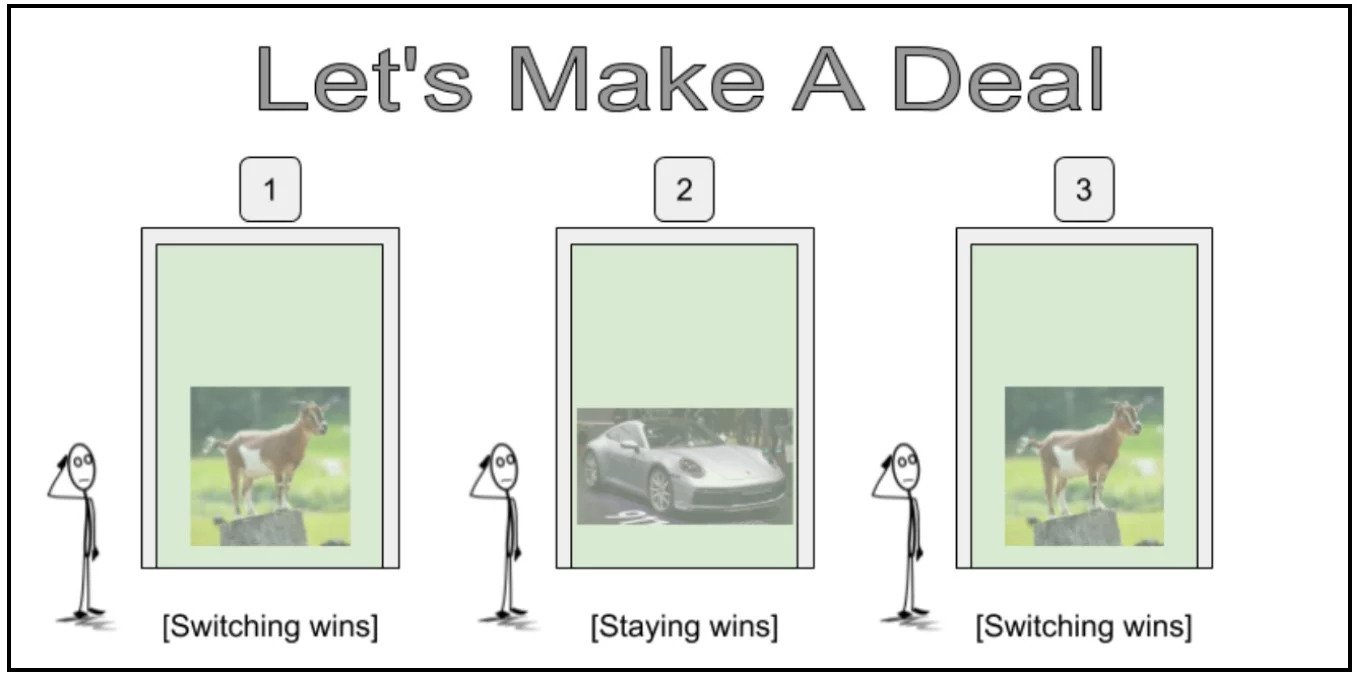
There are several other approaches to think through this riddle, which you can google. If you don’t understand it immediately, don’t worry. Remember, it has stumped thousands of smart people. You’d need to spend a reasonable amount of time to really appreciate why Savant was right. There is something about the Monty Hall problem that makes it wonderfully resistant to our intuitions.
So what’s the lesson for investors?
First, when the new information presents itself, we need to look at it objectively and see how it changes the odds for us. Allow me to rerun this quote from John Maynard Keynes — “When the facts change, I change my mind. What do you do, sir?”
The fact that Monty knew which door has the prize and he used that knowledge to select a door which had a goat, is an important and relevant piece of information that needs to be incorporated in your decision making.
What if it wasn’t Monty but someone from the audience (who didn’t know which door had goat/car) was asked to open a door randomly and it reveals a goat, will that case be different? Yes. Because now the third door is being opened randomly, so in this case, switching strategy won’t have any advantage over staying strategy.
Real-world situations don’t always come packaged neatly like Monty Hall problem. In the real world, it’s almost impossible to know the whole range of potential outcomes and implied probabilities.
Here’s another twist to Monty Hall problem which gives a clue on the messiness of reality.
A lot of times during the game show, Monty Hall would declare the results immediately after the contestant made his first choice without giving an option to switch. And on other occasions, when as usual contestant was mulling over if he should switch, Monty would pull out a large wad of bills and offer $3,000 not to switch. The dialogue would go something like this —
“I’ll switch to door 2,” insists the contestant.
“Three thousand dollars,” Hall says. “Cash money. It could be a car, but it could be a goat. Four thousand.”
“I’ll try the door,” the contestant says, rejecting the cash offer.
“Forty-five hundred. Forty-seven. My last offer: five thousand dollars.”
“Let’s open the door.” The contestant is hell-bent on switching.
“You just ended up with a goat,” Monty says. “Now do you see what happened there? The higher I got, the more you thought that the car was behind the door 2. I wanted to con you into switching there, because I knew the car was behind 1. That’s the kind of thing I can do when I’m in control of the game.”
A few months back, I invested in a special situation opportunity. The company had announced that it was selling its entire business. Promoters assured that the cash from the sale would be used to reward the shareholders. Mr. Market, for some reason, didn’t like the news and sent the company’s stock down by 60 percent. I calculated that it was a classic case of Mr. Market confusing between risk and uncertainty. I invested with the assumption that the company will either pay dividends or offer share buyback. Nothing happened for the next six months. Then promoters announced that they were delisting the company. I had never thought about the delisting scenario. It was not part of my initial hypothesis.
What did I do?
Like the uninformed contestant, I stuck to my “staying” strategy i.e., I remained invested. It took me a few more months to acknowledge the fact that this new information (delisting) had changed the equation. So, finally I exited the stock without waiting for any further development. It turned out to be a profitable bet but not as much as I had estimated.
A few lessons I want to highlight in the context of Monty Hall problem.
- Investing is a game of probability. And our brains are just not wired to do probability problems very well. It’s not intuitive for an investor to accept the fact that in spite of sound judgment and rigorous investment process, many bets will not be profitable. You need to diversify enough not to get thrown out of the investing game because you put all your money on a single stock.
- The odds of an investment becoming profitable change, as new information becomes available. Students of value investing are generally taught to ignore the short term price fluctuations of a security but people often mistake that for “buy and forget.” Remember, it’s rare but still possible for a company to experience a sudden and permanent loss of its earning power. That can’t be ignored.
- Not every new piece of information is relevant. You need to know how to differentiate between signal and noise.
- It’s hard to change our mind even if the facts warrant “switch” because of sunk costs and ignorance.
Monty Hall problem is a reminder of how important it is to understand the nuances of probabilistic decision making under uncertainty.
[/show_to]
[hide_from accesslevel=’almanack-all’]
- Spotlight: Big ideas from Value Investing and why applying them in your investment decision making will be a great deal
- InvestorInsights: Interviews with experienced value investors, learners, and deep thinkers
- StockTalk: Thorough analysis of business models of companies (without any recommendations)
- Behaviouronomics: Deep analysis of human behaviour and how it impacts investment decision making
- BookWorm: Reviews of the best books on Value Investing and related subjects
- Free Course – Financial Statement Analysis for Smart People (otherwise priced at Rs 5,900)
- Archives: Instant access to our huge archive from the past three years