
Unreasonable expectations cause most people to make terrible mistakes when it comes to stock market investing. We share varied thoughts on what makes for reasonable expectations
What do we want out of life? To be healthy, happy with our families, in our work, etc? What interferes with this? Isn’t it often emotions like fear, anger, worry, disappointment, stress, and sadness caused by problems, mistakes, losses, and unreasonable expectations?
Well, that last one – unreasonable expectations – is what causes most people to make terrible mistakes when it comes to stock market investing.
Consider the period of January 2006 when Google announced its financial results for the final quarter of 2005. While the company reported a sales growth of a whopping 97%, its net profit had surged by 82% over the same quarter of previous year.
Now, you would consider this to be a magnificent quarter, right? Well, investors in Google didn’t! As a reaction to these phenomenal figures, Google’s stock tumbled 16% in a matter of second. Trading in the stock had to be interrupted. When it resumed, the stock plunged another 15%. Absolute panic!
Let’s now head to April 2003, when Infosys had announced its fourth quarter and full year results for FY03. I still remember that day, because I was just a week into my new job as a stock market analyst, and was in charge of handling the software sector, and thus Infosys came under my coverage.
The company had just announced its result for the quarter and full-year ended March 2003. For the full-year, it had recorded 39% and 19% growth in sales and net profit respectively. Now you would imagine that these were pretty good growth numbers, right? I did too. But to my horror, the stock crashed by 37% over the next two days.
Imagine losing one-third of your capital in a span of two days. How would you feel? While I was not an investor in Infosys then, but being new to the stock markets, and in charge of research on Infosys, I was utterly confused, and at the same time, scared seeing such a sharp fall in the stock price.
“What’s wrong with the markets?” I asked my senior colleague. “Infosys has reported such a good result, so why has its stock been punished so badly?”
[show_to accesslevel=’almanack-all’]
“Look at the expectations,” he told me. “Well, the company has guided for a 24% growth in sales and 12% growth in profits for the year ending March 2004,” I argued. “I think that’s not a poor guidance anyways!”
“Yeah, but that’s poor as compared to the analysts’ and markets’ expectations from the company!” he replied. “The markets are nervous about the company’s earnings expectations for the coming year, and that’s why they have hammered the stock down. It’s as simple as that!”
“So who’s the culprit here? The company? Or the analysts?” I asked. “I’m not sure about that,” he told me, “But this is how stock market works.”
This is How the Stock Market Works!
It is easy to react to expectations that are way over-met – low expectations are much more fun – the secret is not fast ambition, it is low expectations.
This is what Charlie Munger said at the shareholder meeting of Daily Journal Corporation (DJCO) in 2014. While he was talking about the relationship between a husband and wife, having low or reasonable expectations is a great way to start your relationship with an investment as well.
This is a tough lesson for a stock market analyst to learn, because he gets paid for ‘expecting’ – whether it’s the next month, or quarter, or a year. But then, I fail to understand why individual investors fall into the trap of having unreasonable expectations, even when they have been through the pain of their unreasonableness several times in the past.
Why is it so difficult for an individual investor to understand that the stock market is not an accommodating machine and will not give him consistently high returns just because he expects to earn them?
You see, history suggests that blindly accepting more risk to get the unreasonable returns you expect is a big mistake. The stock does not know that you own it, and neither does it care.
Return goals must be reasonable,” Howards Marks writes in his book The Most Important Thing. “What returns can we aspire to?” he asks, and then replies, “Most of the time – although not necessarily at any particular point in time (and not necessarily today) – it’s reasonable to aspire to returns in single digits or perhaps low double digits. High teens are something very special, and anything more should be viewed as a province of experienced pros (and only the best of those). The same is true of particularly consistent results. Expecting too much in these regards is likely to lead to disappointment or loss.
Now when Mr. Marks talks about single-digit returns, he is possibly talking about the US or other western markets where even inflation is in the low-single digits, and so is the cost of capital, which is near-zero. So, expecting such returns in an inflationary economy like India, and where the cost of capital is in itself in the low teens isn’t feasible. And if you wish to earn just that, you must not invest in stocks at all.
But even in the Indian context, expecting anything more than high teens should be viewed as a province of experienced pros – and only the best of those. And even with the pros, you must remember the concept of ‘alternative history’ that we studied in the first issue of the Value Investing Almanack, which suggests that what matters more than the outcome is the process used to achieve it.
You will find a lot of pros playing with fire (like leverage) to achieve magnificent returns, but then for every one of such breed who survives, there are countless who lie in the (financial) graveyard after taking unreasonable risks expecting unreasonable returns to continue.
Here is a typical investor mentality (which is also how most professional investors think) as the stock market rises higher and higher, like we are seeing now, or what happened during 2005 to 2007 –
• Stage 1 – I need 12 percent, slightly higher than a bank fixed deposit.
• Stage 2 – Okay, I’d be glad to earn 15 percent.
• Stage 3 – 18 percent would even be better. I can then beat the market.
• Stage 4 – 20 percent would be great. I can beat most other smart investors.
• Stage 5 – 25 percent is terrific, and possible. This is what I have earned in the last 2 years.
• Stage 6 – 30 percent sounds out of this world, but you see, I have a knack of picking multibaggers!
You can see the shift in expected returns, which are guided by how the recent past has been. So, recency bias plays a great role in setting unreasonable expectations from the future. All investors can see and read around them is of others making high and quick returns. Envy starts driving the expectations. ‘Multibagger’ becomes a fancy word.
Now, since everyone is talking about their multibagger returns which seem easily ‘available’ to one and all, availability bias also kicks in an investor’s mind. Then comes the overconfidence bias. “If others can earn super-normal returns, so can I,” the investor starts to think.
In such heady times, try asking such people to avoid unnecessary risks – like borrowing to invest and/or speculate – and aim for, say, 20% long-term annual return, and be ready to face a backlash!
Howard Marks writes in his book…
I don’t think normal risk-bearing and normal functioning of the capital markets should be expected to produce [unreasonable] returns. Higher returns are “unnatural,” and their achievement requires some combination of the following:
• an extremely depressed environment in which to buy (hopefully to be followed by a good environment in which to sell),
• extraordinary investment skill,
• extensive risk bearing,
• heavy leverage, or
• good luckThus, investors should pursue such returns only if they believe some of these elements are present and are willing to stake money on that belief. However, each of these is problematic in some way.
Great buying opportunities don’t come along every day. Exceptional skill is rare by definition. Risk bearing works against you when things go amiss. So does leverage, which operates in both directions, magnifying losses as well as gains. And certainly luck can’t be counted on.
Skill is the least ephemeral of these elements, but it’s rare (and even skill can’t be counted on to produce high returns in a low-return environment).
Graham on Reasonable Expectations
The Intelligent Investor is of course a practical guide to sound investment, but it is also a work of philosophy.
Buried throughout the book are invaluable caveats that are easy to overlook yet deserve to get full billing because they can spare an amateur a lot of headaches down the road. In the book’s introduction, there are two such provisos quite nearby one another, the first being –
…be prepared to experience significant and perhaps protracted falls as well as rises in the value of [your] holdings
…and the second being –
…while enthusiasm may be necessary for great accomplishments elsewhere, on Wall Street it almost invariably leads to disaster
Subtle, but profound, these two warnings are Graham’s opening salvo on the subject of investor psychology, or more accurately, the investor’s own psychology. It will be a common thread running throughout the book – your biggest risk in investing is yourself and your psychological reaction to events impacting your portfolio.
Translating the first message, Graham is trying to gird the investor for the inevitabilities of the market, where volatility is constant in both directions. The key, as you will see, is to master volatility by recognizing that the upward variety is not necessarily proof of a good decision and the downward variety is not punishment but an opportunity to buy at bargain prices.
The second message is even more important – successful investing requires an even-keeled temperament and reasonable expectations about long-term success.
The game is about expecting little and learning to be pleasantly surprised, rather than expecting a lot and constantly being disappointed.
The last warning is to be consistent and disciplined, to never abandon your principles in dire times because that is in fact when they become most valuable –
Through all their vicissitudes and casualties, as earth-shaking as they were unforeseen, it remained true that sound investment principles produced generally sound results.
This is again a psychological appeal. When everyone else is losing their shirts, and their minds, forgetting what they’re doing and why, it will pay the long-term investor great dividends to be mindful of who he is and by what principles he invests as his conservatism is always in due time rewarded.
Anyways, in his book, Graham defined investing as –
…one which, upon thorough analysis promises safety of principal and an adequate return. Operations not meeting these requirements are speculative.
Then, he defined adequate return as –
…any rate or amount of return, however low, which the investor is willing to accept, provided he acts with reasonable intelligence.
Contrast this with what most people believe. Their test of an investment technique is usually whether it works. So if they can beat the market over any period (like many I know have done in the last 12 months), no matter how dangerous or dumb their tactics, people would boast that they were right.
To see why temporarily high returns, which add to even greater and more unreasonable future return expectations, don’t prove anything, imagine that two places are 150 KM apart. If I observe the 60 KM speed limit on most Indian highways, I can drive that distance in 2.5 hours. If I drive at 150 KM, I can get there in an hour.
But, if I drive this way – at 150 KMPH – and survive, am I right? Should you be tempted to try it, too, because you heard me bragging that it worked?
Flashy gimmicks for earning unreasonable returns are much the same: In the short term, so long as your luck holds out, they work. Over time, however, they will get you killed.
If You Don’t Know Where You’re Going
You’ve got to be careful if you don’t know where you’re going, ’cause you might not get there. ~ Yogi Berra
At the heart of Graham’s teachings lies his advice that the intelligent investor must never forecast the future exclusively by extrapolating the past. Unfortunately, that’s exactly the mistake that stock market experts and investors have made innumerable times in the past. Some go even further. Since stocks had “always” beaten bonds over any period of at least 30 years, stocks must be less risky than bonds or even cash in the bank. And if you can eliminate all the risk of owning stocks simply by hanging on to them long enough, then why quibble over how much you pay for them in the first place?
In India, it’s easy to find a forecaster who argues that stocks have returned an annual average of around 18% over the past 30 years and thus that’s what investors can easily expect in the future. But what if I tell you that the average annual return for the BSE-Sensex has been just around 8% over the past 23 years (since the peak of Harshad Mehta bull run), and 9% over the past 21 years?
Of course, these are just two calculations and you may accuse me of being selective in my choice to prove a point. But that’s what I am up to – prove a point, that when you do not pay heed to the price you are paying for stocks because you have unreasonable expectations from the future, you are bound to get disappointed. Just pick out any fund manager or analyst and ask him – “Is the stock market riskier today than two years ago simply because prices are higher?” The answer would be – no. But the answer is ‘yes’. It always has been. It always will be.
Like an enraged Greek god, the stock market has crushed everyone who has come to believe that the high returns of the late 1990s or the early and then mid 2000s were some kind of divine right.
As you can see from the table on the right side of this page, BSE Sensex’s 3-year CAGR return over the past 20 years, when the starting P/E was above 20x (9 times in last 20 years), has averaged just around 2%. And we are almost at the 20x level now.
Of course, despite its several downturns and crashes, the Sensex and the broader stock market has moved up over the long run, it pays to remember what Lord Keynes said – “The market can stay irrational longer than you can stay solvent.”
Higher They Go, Harder They Fall
Jason Zweig writes in his commentary of Chapter 3 of The Intelligent Investor…
As the enduring antidote to bull-market baloney, Graham urges the intelligent investor to ask some simple, skeptical questions. Why should the future returns of stocks always be the same as their past returns? When every investor comes to believe that stocks are guaranteed to make money in the long run, won’t the market end up being wildly overpriced? And once that happens, how can future returns possibly be high?
Graham’s answers, as always, are rooted in logic and common sense. The value of any investment is, and always must be, a function of the price you pay for it.
Since the profits that companies can earn are finite, the price that investors should be willing to pay for stocks must also be finite.
Think of it this way: Michael Jordan may well have been the greatest basketball player of all time, and he pulled fans into Chicago Stadium like a giant electromagnet. The Chicago Bulls got a bargain by paying Jordan up to $34 million a year to bounce a big leather ball around a wooden floor. But that does not mean the Bulls would have been justified paying him $340 million, or $3.4 billion, or $34 billion, per season.
Focusing on the market’s recent returns when they have been rosy, warns Graham, will lead to “a quite illogical and dangerous conclusion that equally marvellous results could be expected for common stocks in the future.”

The Math of Reasonable Expectations
The stock market’s performance depends on three factors –
1. Real growth (the rise of companies’ earnings and dividends)
2. Inflationary growth (the general rise of prices throughout the economy)
3. Speculative growth/decline (any increase or decrease in the investing public’s appetite for stocks)
In the long run, the yearly growth in corporate earnings per share in India – including inflationary growth – has averaged around 14-15%. Then, the dividend yield on stocks has been around 2%. So, in the long run, a defensive investor can reasonably expect stocks to average around 16-17% annual return – assuming you buy quality businesses at reasonable prices. And then, above-average investment skill and a lot of good luck can help you earn around 20%. Now, remember that while the incremental return of 3% seems meagre considering the better investment skill you may bring on table, over a 20-year period, it can create a 66% outperformance (as compared to a 17% CAGR return), and over a 25-year period, an 88% difference.
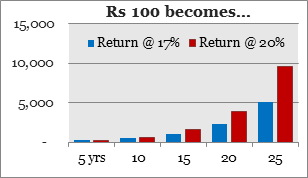
Anyways, here’s another take on what you must reasonably expect to earn from the stock market in the long run (this comes from Prof. Sanjay Bakshi’s reply to a comment on this post) –
In a world where interest rates are 10% if you can find long-term opportunities that will give you 18% you should be more than satisfied. That’s how I look at it. If someone else finds a 25% opportunity and I don’t invest in it, it doesn’t bother me. Being envious is a bad idea in investing and in life. That’s a big lesson for every student of Charlie Munger.
Your hurdle rate should naturally be anchored to passive, relatively effortless fixed income returns. In a world where AAA bond yields jump to 16%, then an expected return of 18% in equities will be a bit silly, no? Therefore, you have to have an adjustable aspirational level and then go around looking for opportunities that will meet your aspirations.
If you can’t find them, then you must lower your expectations. If you want happiness in investing and in life, having an adjustable aspirational level is important.
Voltaire said, “The perfect is the enemy of the good.” This saying is especially applicable to investing, where insisting on participating only when conditions are perfect – like buying at the bottom in the expectation of great return – that can cause you to miss out on a lot. Perfection in investing is generally unobtainable, and the best one can hope for is to make a lot of good investments – that are expected to make reasonable long-term returns – and exclude the bad ones.
Have Reasonable Expectations
If we don’t hope for much, reality often beats our expectations. If we always expect the best or have unreal expectations, we are often disappointed. We feel worse and make bad judgments. Expect adversity. We encounter adversity in whatever we choose to do in life. Charles Munger gives his iron prescription for life –
Whenever you think that some situation or some person is ruining your life, it is actually you who are ruining your life … Feeling like a victim is a perfectly disastrous way to go through life. If you just take the attitude that however bad it is in any way, it’s always your fault and you just fix it as best you can – the so-called “iron prescription” – I think that really works.
When bad things happen, ask: What else does this mean? See life’s obstacles as temporary setbacks, not disasters. Mark Twain says: “[Our] race, in its poverty, has unquestionably one really effective weapon – laughter … Against the assault of laughter nothing can stand.”
And here’s Jason Zweig in The Intelligent Investor…
The only thing you can be confident of while forecasting future stock returns is that you will probably turn out to be wrong. The only indisputable truth that the past teaches us is that the future will always surprise us —always!
And the corollary to that law of financial history is that the markets will most brutally surprise the very people who are most certain that their views about the future are right. Staying humble about your forecasting powers, as Graham did, will keep you from risking too much on a view of the future that may well turn out to be wrong.
So, by all means, you should lower your expectations — but take care not to depress your spirit. For the intelligent investor, hope always springs eternal, because it should. In the financial markets, the worse the future looks, the better it usually turns out to be. A cynic once told G. K. Chesterton, the British novelist and essayist, “Blessed is he who expecteth nothing, for he shall not be disappointed.” Chesterton’s rejoinder? “Blessed is he who expecteth nothing, for he shall enjoy everything.
To sum up, recognize your limits and be reasonable with your expectations. How well do you know what you don’t know? Don’t let your ego determine what you should do.
Munger says,
It is remarkable how much long-term advantage people like us have gotten by trying to be consistently not stupid, instead of trying to be very intelligent. There must be some wisdom in the old saying: ‘It’s the strong swimmers who drown.
Addendum
I asked a few practicing value investors this question –
Howard Marks has talked about the importance of “reasonable expectations” in his book ‘The Most Important Thing’. Graham laid importance on “adequate return” in his definition of investing.
What are your thoughts on the importance for investors to have reasonable expectations from their stock market investments? Also, in the Indian context, what is the maximum expected rate of long-term return from the stock market that you would term as “reasonable” given the current interest rate scenario?
What follows below are their responses.
Ankur Jain – Charlie Munger says that the key to a successful life is to keep one’s expectations low. And I think this works beautifully in investing as well. Keeping reasonable expectations removes undue anxiety which might otherwise corrupt the investing process. High expectations of returns can create pressure and force the investors to take unnecessary risks. Even the best sports persons, best businessmen and best investors crumble under pressure. So, it’s extremely important to have reasonable expectations from one’s financial investments.
My own sense of a reasonable expectation is linked to my opportunity cost of capital. If I didn’t find good equity investments, I will put my money in fixed deposits [I don’t know anything else] which are right now yielding around 8-9% per annum. And if my investments can generate a return of 16-17% p.a. which is twice the fixed deposit rate, I would be happy. I got added confidence about this figure when I read an interview of Mr Ajay Piramal mentioning his criteria about selecting investments. He mentioned that his team looks for an internal benchmark of at least 17% IRR over the life of the investment.
Shyam Sekhar – I would look at returns in the region of 18% compounded as reasonable. The historic returns have been significantly higher for many investors tending closer to even as high as 30%. This is a phenomenon driven by runaway inflation. But, as our economy matures, we will see returns trending down. Regulation is still weak giving a lot of license to market practises that boost returns. We see investors buy big parcels of stocks and publicising it to attract following. A more tightly regulated market will lead to lower returns.
I would think anything above 18% over a 50 year investment career is suspect.
Investors must have reasonable return expectations if they want to own stable, high quality stocks. These companies compound consistently over very long periods of time. Having reasonable return expectations will manifest in an investor’s portfolio. The stock selection, rate of churn, portfolio stability and return predictability will be higher. But, returns will be capped and we will not see stocks turn ten baggers in short bursts of time only to flame out sooner than we expect them to. Having reasonable expectations would certainly help an investor be more disciplined and quality driven.
Currently, long term return in India is trending much higher for disciplined investors. It is more in the range of 24-30%. Higher interest rates have helped this trend sustain for long periods of time. If we manage to contain inflation, we will see returns drop, This is because I expect real returns to be more or less stable. Real returns between India and the developed markets will converge in the coming decades. If inflation drops and stays low, we will see returns trend lower. When we talk of returns, we must learn to talk only in terms of real returns.
Neeraj Marathe – Various benchmarks are used to determine what’s and adequate returns and reasonable expectations. Obviously, it has to be higher than the risk-free rate of return and inflation.
Personally, I would say that twice the risk-free rate of return would be the bare-minimum one should target. I personally target doubling my portfolio in 3 years, which is a 24% CAGR. But, in general, earning 2x the fixed deposit rate of return is a reasonable target.
Dev Ashish – If I want to invest in equities, I need to be compensated for taking on the additional risk involved in such investments – or a premium above the risk-free rate (around 8.7% currently). My reasonable expectation for investing in stocks is thus the sum of the risk-free rate and the risk premium, which equates to around 15% as of now (in case the risk-free rate goes down, my reasonable expectations from stocks will also go down proportionately).
Anything more and I will be guilty of chasing higher returns, which requires me to take more risks. So the more risk I take, higher would be my returns expectations; but unfortunately at higher risk levels, it is the lower returns that become more possible. So I am better off toning down my expectations to remain in sync with what is my risk appetite.
[/show_to] [hide_from accesslevel=’almanack-all’]- Spotlight: Big ideas from Value Investing and why applying them in your investment decision making will be a great deal
- InvestorInsights: Interviews with experienced value investors, learners, and deep thinkers
- StockTalk: Thorough analysis of business models of companies (without any recommendations)
- Behaviouronomics: Deep analysis of human behaviour and how it impacts investment decision making
- BookWorm: Reviews of the best books on Value Investing and related subjects
- Free Course – Financial Statement Analysis for Smart People (otherwise priced at Rs 5,900)
- Archives: Instant access to our huge archive from the past three years