
For a human mind, the best way to learn a complex idea is to find it living inside something else it already understands. Metaphors create that bridge. It’s when we find metaphors, to explain something which doesn’t exist in our current vocabulary, we break the mental barrier and create the possibility of discovering something new.
In 1891, a German high school mathematics teacher, Wilhelm Von Osten claimed that his horse named ‘Hans’ had unusual intelligence. According to Osten, with the help of some basic training, Hans had developed a remarkable ability to solve fairly difficult mathematical problems. Osten firmly believed that humans had been underestimating the reasoning skills of animals, especially horses. Soon Von Osten began touring all over Germany to show off “Clever Hans” mathematical proficiency.
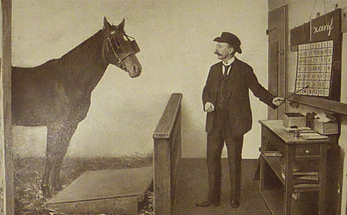
Alan Bellows in his article,Clever Hans the Math Horse,describes this incident –
[show_to accesslevel=’almanack-all’]
As word of the spectacle spread, Hans’ free exhibitions began drawing larger and larger crowds of curious onlookers. They were seldom disappointed. “If the first day of the month is a Wednesday,” Von Osten would ask Hans, who had learned to respond to verbal questions, “what is the date of the following Monday?”
Six hoof-taps would follow. “What is the square root of sixteen?” Four taps. Von Osten also explained to the astonished crowds that Hans could spell out words with taps, where one tap is an “A”, two taps a “B”, and so on. Hans would then demonstrate this talent by spelling out the names of people he knew, and responding to simple questions. He could also tap out the time of day. Though he made mistakes occasionally, his accuracy was found to be roughly 89%. By some estimates, Hans’ grasp of mathematics was equivalent to a fourteen-year-old’s.
The story sounds too weird to be true. Of course, there was some misunderstanding else by this time we would have heard about at least few dozen horses winning Nobel prize for Mathematics. I won’t keep you in dark for too long else you’d anyway click on Alan’s article and figure out yourself. I’ll come back to this story and I’ll reveal the secret but before that I want you to play along with for a while.
Let’s imagine that when Hans was busy delivering jaw-dropping performances, you were also there in Germany and looking to recruit a mathematician. Someone casually mentioned Hans’ talent to you. Would you stop your search and start wondering if Hans could be the answer to your prayers? Of course not. Reminds me of Warren Buffett’s quote –
A horse that can count to 10 is a remarkable horse but not a remarkable mathematician.
Germany’s board of education finally stepped in and started an independent investigation into Hans’ abilities. Very soon they discovered that the horse indeed didn’t possess any mathematical at all. However, the horse was pretty good at reading Van Osten’s body language. Once the “correct” tap was made, the subtle underlying tension suddenly disappeared from the Osten’s face, which Hans apparently took as the cue to stop tapping. The horse wasn’t mathematically inclined but he sure was smart enough to take people on a ride (pun intended) for quite a while.
The trivial lesson here is that if one is looking for mathematicians, it’s foolish to get distracted by a group of smart horses. The horse will sprint. It may sometimes even gallop. And oh, the irresistible ability to count to 10. Who wouldn’t get enticed? But no matter how smart the horse is, it will never get you past 10. You may want to stop by and enjoy the talented horse’s show but that shouldn’t be a reason to lose focus. Stay on your hunt for a mathematician.
This obvious lesson when extended to the world of investing reveals useful insights. If you think a bit, it will occur to you that it’s quite easy for investors to get enamoured by smart horses and forget about what they were looking for in the first place.
The hunt for a mathematician is invariably going to get intercepted by a bunch of smart horses, intelligent dogs, and talking dolphins. Similarly, in search for a great business, an investor typically must sift through a lot of mediocre and good enough businesses. The mathematician is a metaphor for great businesses which are focused on the long term and have the potential to generate tremendous wealth over decades. Mr. Market, especially during heady bull markets, tends to offer a plenty of juicy looking ideas. But they are the biggest distraction for they try to lure with their ‘counting up to 10’ capabilities i.e., short term performance. The investing horses post profits for few quarters. They even dole out generous dividends for a couple of years. Buffett, in his 1985 letter to shareholders, wrote –
A horse that can count to ten is a remarkable horse — not a remarkable mathematician. Likewise, a textile company that allocates capital brilliantly within its industry is a remarkable textile company — but not a remarkable business.
The horse and a mathematician are very effective metaphors to think about good enough businesses and great businesses.
In fact, Buffett’s history with horses goes all the way back to his childhood days when he was first introduced to the world of horse race betting. Intrigued as a boy by the voluminous data involving variables such as weights, speed ratings, pace, past performance, and breeding, Buffett developed a keen interest in horse racing. But he and his friend Bob Russell found that they were too young to bet in the horse race track, but they quickly figured out how to make money.
Alice Schroeder, in her book The Snowball, describes this incident –
They [Buffett and Russell] call that ‘stooping.’ At the start of the racing season you get all these people who’d never seen a race except in the movies. And they’d think that if your horse came in second or third, you didn’t get paid, because all the emphasis is on the winner, so they’d throw away place and show tickets. The other time you would hit it big was when there was a disputed race. That little light would go on that said ‘contested’ or ‘protest.’ By the time, some people had thrown away their tickets. Meanwhile, we were just gobbling them up. We wouldn’t even look at them when we were working. At night we’d go through them. It was awful; people would spit on the floor. But we had great fun. If I found any winning ticket, my aunt Alice, who didn’t care anything at all about races, would cash them in for us, because they wouldn’t cash them for kids.
In fact, over the past few decades, Buffett has utilized the horse as a metaphor in many different contexts. In his 1989 letter, he wrote –
It’s far better to buy a wonderful company at a fair price than a fair company at a wonderful price. Charlie understood this early; I was a slow learner. But now, when buying companies or common stocks, we look for first-class businesses accompanied by first-class managements. That leads right into a related lesson: Good jockeys will do well on good horses, but not on broken-down nags. Both Berkshire’s textile business and Hochschild, Kohn had able and honest people running them. The same managers employed in a business with good economic characteristics would have achieved fine records. But they were never going to make any progress while running in quicksand. I’ve said many times that when a management with a reputation for brilliance tackles a business with a reputation for bad economics, it is the reputation of the business that remains intact.
Here the message is that all things being equal, one should bet on the horse rather than the jockey. Now, this is a diametrically opposite advice if you compare it with the mathematician example. There Buffett described the horse as something that needs to be avoided. In jockey analogy, he’s essentially saying that an investor should focus on the horse first. But that’s the beauty of using the right metaphors. The same metaphor, even with a conflicting looking usage, can convey the relevant message with equal impact without creating any confusion.
Charlie Munger, in his 1994 lecture titled A Lesson on Elementary, Worldly Wisdom as It Relates to Investment Management and Business at the University of Southern California, said –
Then there’s another model from microeconomics that I find very interesting. When technology moves as fast as it does in a civilization like ours, you get a phenomenon that I call competitive destruction. You know, you have the finest buggy whip factory, and, all of a sudden, in comes this little horseless carriage. And before too many years go by, your buggy whip business is dead. You either get into a different business or you’re dead – you’re destroyed. It happens again and again and again.
Charlie is using the words horse and buggy whip to describe the businesses that fail to adapt to the changing environment. You may not remember the words ‘competitive destruction’ or ‘technology disruption’ but it’s hard to get rid of the picture of a carriage attached to a dead horse which was run over by an automobile. Buffett used a similar expression to describe the idea of disruption. In another letter, he wrote –
…we are free of historical biases created by lifelong association with a given industry and are not subject to pressures from colleagues having a vested interest in maintaining the status quo. That’s important: If horses had controlled investment decisions, there would have been no auto industry.
For a human mind, the best way to learn a complex idea is to find it living inside something else it already understands. Famous author Napoleon Hill said, “Anything that a human mind can conceive and believe, it can achieve.” But to conceive it, the mind must first imagine it. And how does mind imagine new things?
By drawing analogy. “This,” is like, “that.”
It’s when we find metaphors, to explain something which doesn’t exist in our current vocabulary, we break the mental barrier and create the possibility of discovering something new.
One of my all-time favourite movies is Forrest Gump. The movie starts with this line –
My momma always said, “Life was like a box of chocolates. You never know what you’re gonna get.”
Life – a box of chocolates. Another brilliant metaphor, isn’t it?
So how do you find metaphors? By joining ideas together. Roger Von Oech, in his immensely useful tool – Creative Whack Pack – has a card which reminds –
A powerful way to join ideas together is to make a metaphor. You can do this simply by recognizing similarities between unrelated phenomena. Indeed, this is how our thinking grows: we understand the unfamiliar by comparing it to what we know…Metaphors can also give us a fresh insight into a problem. For example, here are three metaphors for life. (1) Life is like a jigsaw puzzle but you don’t have the picture on the front of the box to use as a guide. Sometimes, you’re not even sure if you have all the pieces. (2) Life is like a bagel. It’s delicious when it’s fresh and warm, but often it’s just hard. The hole in the middle is its great mystery, and yet it wouldn’t be a bagel without it. (3) Life is like a poker game. You deal or are dealt to. You bet, check, bluff, and raise. You learn from those you play with. Sometimes you win with a pair or lose with a full house. But whatever happens, it’s best to keep shuffling along.
In fact, if you can’t explain your thoughts to lay people i.e., in simple language, chances are that you aren’t clear about those insights either. So the practice of using metaphors is an exercise to bring more clarity inside your own head.
You know what’s better than a metaphor? Humour. And it’s a double whammy when you get both. Buffett, being a master in both the areas i.e., rib-tickling one-liners and metaphors, wrote on another instance –
…why potential buyers even look at projections prepared by sellers baffles me. Charlie and I never give them a glance, but instead keep in mind the story of the man with an ailing horse. Visiting the vet, he said: “Can you help me? Sometimes my horse walks just fine and sometimes he limps.” The vet’s reply was pointed: “No problem — when he’s walking fine, sell him.
At Berkshire, we have all the difficulties in perceiving the future that other acquisition-minded companies do. Like they also, we face the inherent problem that the seller of a business practically always knows far more about it than the buyer and picks the time of sale— a time when the business is likely to be walking “just fine.
Most people will forget that disappointing statistics of M&A deals and poor base rates of IPOs but they cannot forget the image of a limping horse. The idea I am harping on here is the utility of metaphors and why they work. They work because they build a bridge between two different parts of our brain. Which brings me to another creativity hack for generating investing insights.
Arbitrarily chose words, put them together and then see if you can find any meaningful connections between them. That’s a nice trick for arm-twisting the unrelated neurons inside your skull to talk to each other.
A related practice that I once learned from Prof. Bakshi is to search the super-texts for specific words and then see what comes out.
Sometimes you can find remarkable insights (including insights about, but not limited to, remarkable horses) just by searching random words in Warren Buffett’s letters. Like I did by searching for the word ‘horse’ in his letters. In e-book readers, like Kindle, it’s easy to do text searches.
When the markets are all looking expensive, there is anyway not much to do for a value investor, apart from leafing through old annual reports. What could be a better use of this downtime than to re-read the investment classics using a new method?
[/show_to] [hide_from accesslevel=’almanack-all’]- Spotlight: Big ideas from Value Investing and why applying them in your investment decision making will be a great deal
- InvestorInsights: Interviews with experienced value investors, learners, and deep thinkers
- StockTalk: Thorough analysis of business models of companies (without any recommendations)
- Behaviouronomics: Deep analysis of human behaviour and how it impacts investment decision making
- BookWorm: Reviews of the best books on Value Investing and related subjects
- Free Course – Financial Statement Analysis for Smart People (otherwise priced at Rs 5,900)
- Archives: Instant access to our huge archive from the past three years