
If you have chosen to invest money in stock market, accept the fact that there will be times of uncertainty with no clear visibility into near future. Since you can’t predict what tomorrow will bring, you must be prepared for whatever it does. If you can’t stomach that, perhaps you shouldn’t be in the stock market at all.
There’s no question about the fact that it’s harder to see the future than the present. But the quest for certainty and longing to know the future is an old human endeavour. For centuries, people have been misled by looking for certainties where none existed.
Uncertainty creates acute mental discomfort and there are evolutionary reasons behind it. Before agricultural revolution, homo sapiens lived as hunter-gatherers. In the absence of steady food supply and the constant threat of wild animals, evolution hardwired human brain to resolve uncertainties about its environment. Agricultural revolution resolved the uncertainties about food and danger but opened up new avenues like diseases, famine, and natural calamities. The way the human race has dealt with these problems was to seek answers from authority figures.
Until 500 years back, before the scientific revolution started unfolding the layers that were hiding the secrets of nature, this thirst for certainty was quenched by religion and collective myths. Religion and its CEOs (priests, pope, godmen etc.), who claimed to have a direct connection with God, offered all answers to all the important problems. So, this tendency to equate knowledge with certainty is an old habit. As technology advanced, it gave birth to methods and tools where it became possible to remove a certain class of randomness from human life, like having more control over deadly diseases and adequate supply of food. Today, modern technologies, from mathematical stock prediction methods to medical imaging machines, have made us more confident about many unpredictable things.
[show_to accesslevel=’almanack-all’]
We may have mastered the uncertainty of basic things like where will the next meal come from, or will I be able to survive the next seasonal flu or epidemic, but as scientific progress has pushed us forward, it has also brought extreme complexity in
If a medieval king in 700 A.D. went to sleep and woke up in 1000 A.D., he wouldn’t have found much difference in the world around him. But if a farmer went to sleep in 1700 A.D. and woke up 300 years later in the year 2000, he probably would find himself on a totally different planet.
The half-life of businesses is going down rapidly. Today, a billion-dollar business can completely disappear in less than a decade. The instant availability of information has introduced extreme efficiency in the systems around us. But an easy and constant flow of information has amplified the noise too. The noise doesn’t come alone. It brings with it healthy doses of uncertainty. Despite knowing that uncertainty is a norm today, the basic human urge to seek certainty can’t be suppressed completely. In the stock market, this primal need for visibility into future results in extreme anxiety. Investing requires us to deal with the future. If the future were knowable by all, investing would be neither challenging nor profitable.
But knowing that businesses are fragile, the fluctuations in stock market prices is hard to ignore. This widespread anxiety about uncertainty ensures that astrologers, crystal ball gazers, and stock market forecasters thrive during uncertain times. Their confidence in their abilities to forecast the future acts like a magic pill. Their prescription is always about doing something. Buy, Sell, or at least stay glued to TV channels. In fact, if you think about it, the real cause of worry isn’t uncertainty. It’s the risk.
It’s the Risk, Stupid!
Risk doesn’t always equal uncertainty. It’s a very crucial distinction, the difference between risk and uncertainty, that confuses most investors. Uncertainty is having a possible range of future outcomes because of a present event. Risk is when one of those outcomes possesses a serious threat to your financial net worth. One of the clearest and most accurate definition of risk is what I heard from Howard Marks. He said, “Risk means uncertainty about which outcome will occur and about the possibility of loss when the unfavourable ones do.”
Of course, there’s much more uncertainty in stocks as compared to bank fixed deposits. And that uncertainty is what makes the stock market look riskier. But the thing that needs to be understood is that you get paid better in stocks not because you assume more risk, but because you are willing to stomach the inherent uncertainty.
Many people don’t realise that even past, like future, is uncertain (at least in terms of its utility to predict the future) because whatever happened was just one of the many possibilities. Howard Marks writes –
Most of the people acknowledge the uncertainty that surrounds the future, but they feel that at least the past is known and fixed. After all, the past is history, absolute and unchanging…things that happened are only a small subset of the things that could have happened. Thus, the fact that a stratagem or action worked – under the circumstances that unfolded – doesn’t necessarily prove the decision behind it was wise.
How to Deal with Uncertainty?
The first trick is to accept that uncertainty is an inseparable part of this universe. It starts at the quantum level. Quantum physics says that even the behaviour of subatomic particles, like an electron, is uncertain.
Quantum theory states that you can’t measure both the speed and location of an electron at the same time. If you measure one, the other becomes uncertain. And this is not because of the limitation of the measuring instruments or lack of technology. It’s an objective truth. And despite this lowest level uncertainty, the universe on higher levels seem to behave quite predictably in many areas e.g. the laws of gravity. There is no uncertainty about planetary movements and their locations. So, if you have chosen to invest money in stock market, accept the fact that there will be times of uncertainty with no clear visibility into near future. Since you can’t predict what tomorrow will bring, you must be prepared for whatever it does. If you can’t stomach that, perhaps you shouldn’t be in the stock market at all.

A wise man once said, “God grant me the serenity to accept the things I cannot change, the courage to change the things I can and the wisdom to know the difference.” Well, that quote contains an important clue about stock market uncertainty. Once you have accepted that uncertainty is inevitable, the second trick to deal with it is to understand where uncertainty can or can’t be controlled. Once you have developed the mental toughness to weather the uncertainty, the next step is to realise that uncertainty brings a lot of opportunities.
Whenever there’s a news about a significant political event or economic policy, markets react to it. In such situations, most investors, including big institutional investors, pull out their investments arguing, “We’re going to wait until the dust settles and the clouds of uncertainty clear out.” Of course, what they mean is that they’re frightened and don’t understand the businesses they own.
Do you see the paradox in this strategy? By the time the dust has settled and the clouds have cleared out, there won’t be any bargains left. So, uncertainty brings two kinds of opportunity. Firstly, it gives you a chance to practice patience and build your equanimity muscle i.e., keeping calm and being unruffled by the raging storm of panic and irrationality around. Jason Zweig, in his recent article titled “Do You Really Have the Stamina to Be Wealthy?”wrote –
Between September 1929 and June 1932, the stock market lost more than 83% even after annual dividends as high as 6%. Losses nearly as severe came in 1973-74 and in 2000-02. And sooner or later, they will again. Cultivate your patience now; one of these days, you will need it.
Second, it throws up attractive bargains in the stock market, provided you have done your homework beforehand and have a watch list of great businesses ready. If any of those businesses have become cheaper than your estimate of fair value, back up your truck.
In his 2010 letter to shareholders, Warren Buffett wrote –
Commentators today often talk of “great uncertainty.” But think back, for example, to December 6, 1941, October 18, 1987 and September 10, 2001. No matter how serene today may be, tomorrow is always uncertain. Don’t let that reality spook you. Throughout my lifetime, politicians and pundits have constantly moaned about terrifying problems facing America. Yet our citizens now live an astonishing six times better than when I was born. The prophets of doom have overlooked the all-important factor that is certain: Human potential is far from exhausted, and the American system for unleashing that potential — a system that has worked wonders for over two centuries despite frequent interruptions for recessions and even a Civil War — remains alive and effective.
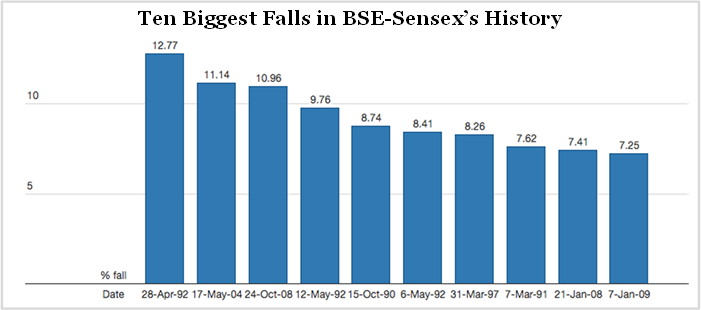
What about the Indian stock market? Have a look at the above chart which shows the ten biggest falls in Sensex’s history. The worst one (12.7 percent) was at the time of Harshad Mehta scam in 1992. The time immediately after these corrections was considered most uncertain. Quite a few businesses did get wiped out, but if you have even a basic understanding of analysing businesses, it would have been obvious that most of those businesses were sitting ducks waiting to be slaughtered. On the other hand, quality businesses run by able and honest managements weathered the storm and created huge wealth for people who chose to stay put.
Whether it’s Brexit, Trump or demonetization, uncertainty will always find an excuse to present itself in some form. And during these times, Mr. Market will throw away the baby with the bathwater. Bigger the uncertainty, more the number of babies.
Warren Buffett’s statement is applicable in India also. Irrespective of what happens in the short-term, over the long-term, our country is going to grow economically. Which means businesses will grow and the stock market will show an upward trend. Just like lower level uncertainty in quantum physics doesn’t affect the higher-level law, the short-term uncertainty and volatility aren’t going to make a dent in the long-term prospects of our country and its resilient businesses
[/show_to] [hide_from accesslevel=’almanack-all’]- Spotlight: Big ideas from Value Investing and why applying them in your investment decision making will be a great deal
- InvestorInsights: Interviews with experienced value investors, learners, and deep thinkers
- StockTalk: Thorough analysis of business models of companies (without any recommendations)
- Behaviouronomics: Deep analysis of human behaviour and how it impacts investment decision making
- BookWorm: Reviews of the best books on Value Investing and related subjects
- Free Course – Financial Statement Analysis for Smart People (otherwise priced at Rs 5,900)
- Archives: Instant access to our huge archive from the past three years