
The act of looking stupid is one of the most difficult tasks of being an investor in stock market. And this is especially when you see ‘smart’ people all around you, people who seem to be making no mistakes and doing nothing wrong.
It was exactly nine years ago (how time flies!), when the Indian capital market was gearing up for its biggest IPO ever. Reliance Power, which was set to raise Rs 11,000 crore, received bids worth Rs 750,000 crore as the offer was oversubscribed by 73 times. Everyone and his brother-in-law who subscribed to the IPO looked smarter, even as my family members whom I had asked to avoid the issue by far, seemed disturbed on my recommendation.
So I looked stupid even as there were stories floating all around how people borrowed money and sold their properties to apply to this IPO that was sure to succeed. In fact, we were the only research house in India that had asked its clients to avoid the IPO and we had received a lot of brickbats for the same.
I, being the power analyst and the guy who wrote the IPO analysis report on the company, did a DCF valuation of the stock discounting free cash flows for the next 25 years (the general norm for DCF is 10 years)! My ideas was to lengthen the DCF calculation period by as much as possible and then see how the stock really stacked up.
The result of my DCF valuation then was, hold your breath, Rs 60 per share. In other words, my intrinsic value estimate for Reliance Power’s stock, after assuming the rosiest of picture for the business, came to Rs 60. The stock was offered in the IPO at around Rs 450.
If you had read my report then, you could have gauged the level of ‘stupidity’ I had shown by valuing the stock almost 85% lower than the IPO offer price.
“An overconfident, stupid jerk!” one of my analyst friends introduced me to his friend while telling him my mis-adventures in valuing the Reliance Power stock then.
Well the rest, as they say, is history. Even after adjusting for the bonus issue Reliance Power offered its shareholders immediately after the IPO, the stock is down almost 85% from its peak of 2008.
[show_to accesslevel=’almanack-all’]

Well, I managed to score some brownie points among my family members who had avoided this disaster, but that’s not the point here. The point is that the stock market gives you a lot of chances to feel on top of the world, and a lot of situations when you look and feel like a stupid.
This second act, that of looking stupid, is one of the most difficult tasks of being an investor in stocks. And this is especially when you see ‘smart’ people all around you, people who seem to be making no mistakes and doing nothing wrong.
In the world of social media that gives a lot of investors to showcase to the world how their portfolios have done in the last one year or five years, I see an oversupply of smartness. In fact, a lot of such people seem extraordinarily smart. And when you have a lot of smart people around you, it becomes so difficult to look stupid.
Looking Stupid is a Lonely Act
I recently read a story of the great astronomer Arthur Eddington, who had just figured out that the stars get their power from burning hydrogen in a nuclear reaction producing helium.
He recounted how, on the night after his discovery, he was sitting on his bench with his girlfriend. She said, “Look how pretty the stars shine!” To which he replied, “Yes, and right now, I’m the only man in the world who knows how they shine.”
Eddington was describing a kind of wonderful loneliness who have when you make a discovery. However, when it comes to investing in stocks, the loneliness after discovering a great but boring business when no one else is looking at it (as they are all lapping up other ‘interesting and hot’ ideas) often doesn’t feel wonderful.
It may have been easier for Warren Buffett to avoid the dotcom bubble because he did not understand what was happening in that space then, and being called a stupid for such ignorance. But for most of us investors, most of the mistakes in our investment decision making happen because, like Newton and his South Sea adventure, we don’t want to look stupid.

The very fact that Newton did not feel good looking stupid after cashing out his early profits in South Sea Company even as his friends got richer, tells us a lot about us lesser mortals.
So it feels terrible when we look stupid avoiding hot stocks when our friends are all getting richer, and also when we look stupid investing in sound but boring and slow-moving stocks when our friends are again getting richer investing (mostly speculating) in the ‘flavors of the season’.
This is especially true here in India, where we have been brought up in a society where looking stupid, making mistakes, or being wrong is seen as a stigma, and being smart and being right is always looked upon.
“Don’t dare to look stupid!” I would often tell myself before committing on to something new while in the early part of my career as an analyst. After all, how could you dare to look stupid when your salary and reputation depended on looking smart, always?
That stigma gradually vanished after I was on my own, and started reading the likes of Buffett, Munger, and Howard Marks with greater attention. Especially when I read this memo from the Marks, where he wrote about the idea of ‘daring to be different’ (being different is like being stupid in investing), I was hooked.
“Dare to be wrong,” Marks wrote, very much like Charlie Munger told him, “It (investing) is not supposed to be easy. Anyone who finds it easy is stupid.” Marks was here talking about the idea of daring to be wrong and make mistakes at times, but I think what he wrote also made sense with the idea of daring to look stupid. For instance, Marks wrote –
Any attempt to compile superior investment results has to entail acceptance of the possibility of being wrong.
…since conventional behavior is sure to produce average performance, people who want to be above average can’t expect to get there by engaging in conventional behavior.
Their behavior has to be different. And in the course of trying to be different and better, they have to bear the risk of being different and worse. That truth is simply unarguable. There is no way to strive for the former that doesn’t require bearing the risk of the latter.
Of course, at times when you look stupid and everyone else looks smart, you will in fact be stupid.
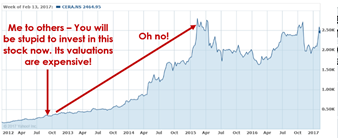
Like this experience I had with Cera Sanitaryware when, sometime in 2012, I asked readers to be circumspect about the business largely because I though the valuations were expensive at that time…I was in fact proved a stupid as the stock and the business’ intrinsic value kept moving higher and higher. The stock became a 7+ bagger in the next 2.5 years.
Or take this example of my experience with Page Industries where I made a 5 bagger in less than 2 years.
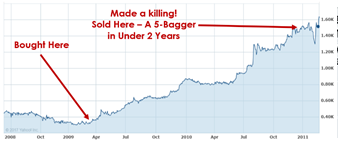
I then then sold the stock to “lock in my gains before I could lose them.” A couple of my investor friends asked me not to sell the stock so soon but I thought they were stupid and I was smart. Well, what happened after I sold my stock tells you who was smart then and who was stupid…

Anyways, lot of self-bashing here…so let me end it. 😉
Coming back to the point about looking stupid, it is examples like these (Cera, Page, etc.) that lead one to often avoid the act of looking stupid. It is often examples like these that lead one to think that the crowd is always right. It is examples like these that lead one to mistrust one’s own judgment, even when Ben Graham and Warren Buffett have vociferously advised investors this –
You are neither right nor wrong because the crowd disagrees with you. You are right because your data and reasoning are right.
I have seen so many people over the years who have sat on the stock market’s sidelines – mostly due to fear of looking stupid losing money – that they have paid huge opportunity costs of not being invested. Then, ironically, most of these people would enter the market when it was the time to run out of the fire exit, and the possibility of being (not ‘looking’) stupid was at his highest.
One more thing about stupidity here is that even being stupid at times in investing is fine. It’s not a game where you can expect to make no mistakes at all.
In fact, in Janet Lowe’s book Damn Right: Behind the Scenes with Berkshire Hathaway Billionaire Charlie Munger,addresses the issue of losing investments by saying…
I’ve been through a number of down periods. If you live a long time, you’re going to be out of investment fashion some of the time.
In his 2003 letter to shareholders, Buffett echoed Munger’s view, writing…
In buying businesses, I’ve made some terrible mistakes, both of commission and omission.
Munger and Buffett’s comments often remind me that mistakes should be taken in stride and shouldn’t distract from the bigger picture of long-term success.
I have been tempted in the past to toss aside proven strategies during market’s ups and downs, but have realized that staying focused on what works over time is always a better and highly profitable approach.
Of course, I have had my share of investing mistakes as well, like…
• Investing in businesses without sustainable moats (Arvind)
• Buying stocks without understanding underlying businesses (Hotel Leela)
• Selling good businesses too early (Page Industries)
• Avoiding great businesses just because their stock prices were slightly higher than my ‘comfortable’ buying prices (Asian Paints)
• Selling great businesses that did not seem to move for 2-3 years (Swaraj Engines)
The list is long, but let me not embarrass myself too much at one go.
However, thankfully, my mistakes have not deterred me from working on my investment process, to improve in such a way that I avoid repeating my mistakes from the past. And that has helped me earn a satisfactory return on my investments over the past few years.
Investing is a Humbling Game
I was recently reading a story on the classical Greek philosopher, Socrates, who was tried and executed in 399 BC. He was tried on two charges – corrupting the youth, and impiety (perceived lack of proper respect for something considered sacred).

Socrates had done no such thing. What he had done was educate the youth, teaching them to challenge arguments from authority and question what they believed to be true.
In the process, he frustrated and embarrassed many powerful people with his constant line of questioning, known today as the Socratic method.
Another Greek philosopher Plato wrote an account of the speech Socrates made at his trial, called The Apology.
In The Apology, Plato wrote that the oracle at Delphi had pronounced Socrates the wisest man in Athens. No one was more astonished and disbelieving than Socrates himself. So he immediately set out to disprove the oracle by finding a wiser man.
Here is what Socrates found as he met a few supposedly wise men…
I went to one who had the reputation of wisdom, and observed to him – his name I need not mention; he was a politician whom I selected for examination – and the result was as follows: When I began to talk with him, I could not help thinking that he was not really wise, although he was thought wise by many, and wiser still by himself; and I went and tried to explain to him that he thought himself wise, but was not really wise; and the consequence was that he hated me, and his enmity was shared by several who were present and heard me.
So I left him, saying to myself, as I went away: Well, although I do not suppose that either of us knows anything really beautiful and good, I am better off than he is – for he knows nothing, and thinks that he knows. I neither know nor think that I know. In this latter particular, then, I seem to have slightly the advantage of him.
Then I went to another, who had still higher philosophical pretensions, and my conclusion was exactly the same. I made another enemy of him, and of many others besides him.
In the end, Socrates discovered he was indeed the wisest man in Athens. Not because of how much he knew, but because he was the only one who understood how much he did not know.
Perhaps nowhere is this lesson in humility more valuable than in the world of investing. Knowing that you don’t know is the dawning of wisdom.
Humility is, in fact, one of the greatest assets for any stock market investor.
Knowing that you don’t know a lot of things, knowing that you will make a lot of mistakes, and knowing that you may be crucified for your mistakes…and accepting these as part of the game that must still be played, is what creates a successful investor.
I am not yet a successful investor, so I can say all this only through my readings and learning from other investors who have emerged successful in the past. And Buffett leads this list.
In the stock market, randomness can greatly impact your returns and especially in the short term. But what really matters for you as an investor is the performance of your portfolio over a long period (at least five years), not whether an individual stock has fallen 50% or risen 200% over the past week or month.
Don’t Fear Looking Stupid
Every time I watch my five-year-old son performing his antics, I realize that he has zero fear of looking stupid. As a result, he freely runs around the house while singing songs about Spiderman and Iron Man. Or not care about having his dinner all over his face. He also doesn’t know that it’s sometimes embarrassing to be completely honest and vulnerable.
At some point, he’ll enter into the prison we adults freely stay in. That place of fear that keeps us from trying, or saying, or learning new things. We are so consumed, it seems, with not looking stupid that we have no space to ask ourselves a better question.
But what if we stopped caring so much about looking stupid? What if we treat looking stupid as a competitive advantage instead? How?
Long Term Investing Often Looks Stupid
I recently shared my notes on a brilliant investment letter I read from John Huber of Saber Capital. I suggest you read the letter a couple of times at least, for it contains one of the simplest yet profound ideas that can lead you to success in investing. John talks about the fact that when investment horizons are getting shorter and shorter, the only sustainable edge you may have is to think and act long term.
Now, this is easier said than done. Average investment period is getting shorter and shorter because majority of people are now focused on the short term. And when you do something that is against the majority i.e., think and act long term, you will of course look stupid from time to time.
Like people who made a 27-bagger in Apple’s stock over the past 12 years. They looked like stupid holding in to the stock through four major declines (above 40%) in the stock’s price during this period –
• -33% in 2006;
• -52% in 2008;
• -45% in 2013; and
• -29% in 2016

Here is a how the journey of, say, a 30-bagger looks like when money grows at 20% per annum…

It’s the first 5x of the 30x journey where one looks the most stupid, simply because one must wait for nine long years to achieve this 5x.
But for investors who could pass this time without bothering about what others (who aim to make money faster, like 10x in 10 years) may be thinking of them, the journey to the next 5x, and the next, becomes faster and faster.
In other words, patience almost always looks stupid or questionable, especially during periods of sharply rising stock prices and inflated valuations.
Anyways, coming back to Howard Marks’ memo, he quoted Lou Brock, one of baseball’s best players of the late 1960s, as saying – “Show me a guy who’s afraid to look bad, and I’ll show you a guy you can beat every time.”
The interesting part about the stock market is that wherever you look, you would find such guys aplenty – people who are afraid to look bad/stupid, and thus people who do things that everyone else is doing.
Anyways, here is how Marks closed his memo –
Unconventional behavior is the only road to superior investment results, but it isn’t for everyone. In addition to superior skill, successful investing requires the ability to look wrong for a while and survive some mistakes.
Thus each person has to assess whether he’s temperamentally equipped to do these things and whether his circumstances will allow it…when the chips are down and the early going makes him look wrong, as it invariably will.
Not everyone can answer these questions in the affirmative. It’s those who believe they can that should take a chance on being great.
Mark these words, and note them in your investment journal if you maintain one – Successful investing requires the ability to look stupid/wrong for a while and survive some mistakes.
But then, are you willing to bear the embarrassment of looking stupid when all others around you are looking smart?
[/show_to] [hide_from accesslevel=’almanack-all’]- Spotlight: Big ideas from Value Investing and why applying them in your investment decision making will be a great deal
- InvestorInsights: Interviews with experienced value investors, learners, and deep thinkers
- StockTalk: Thorough analysis of business models of companies (without any recommendations)
- Behaviouronomics: Deep analysis of human behaviour and how it impacts investment decision making
- BookWorm: Reviews of the best books on Value Investing and related subjects
- Free Course – Financial Statement Analysis for Smart People (otherwise priced at Rs 5,900)
- Archives: Instant access to our huge archive from the past three years