
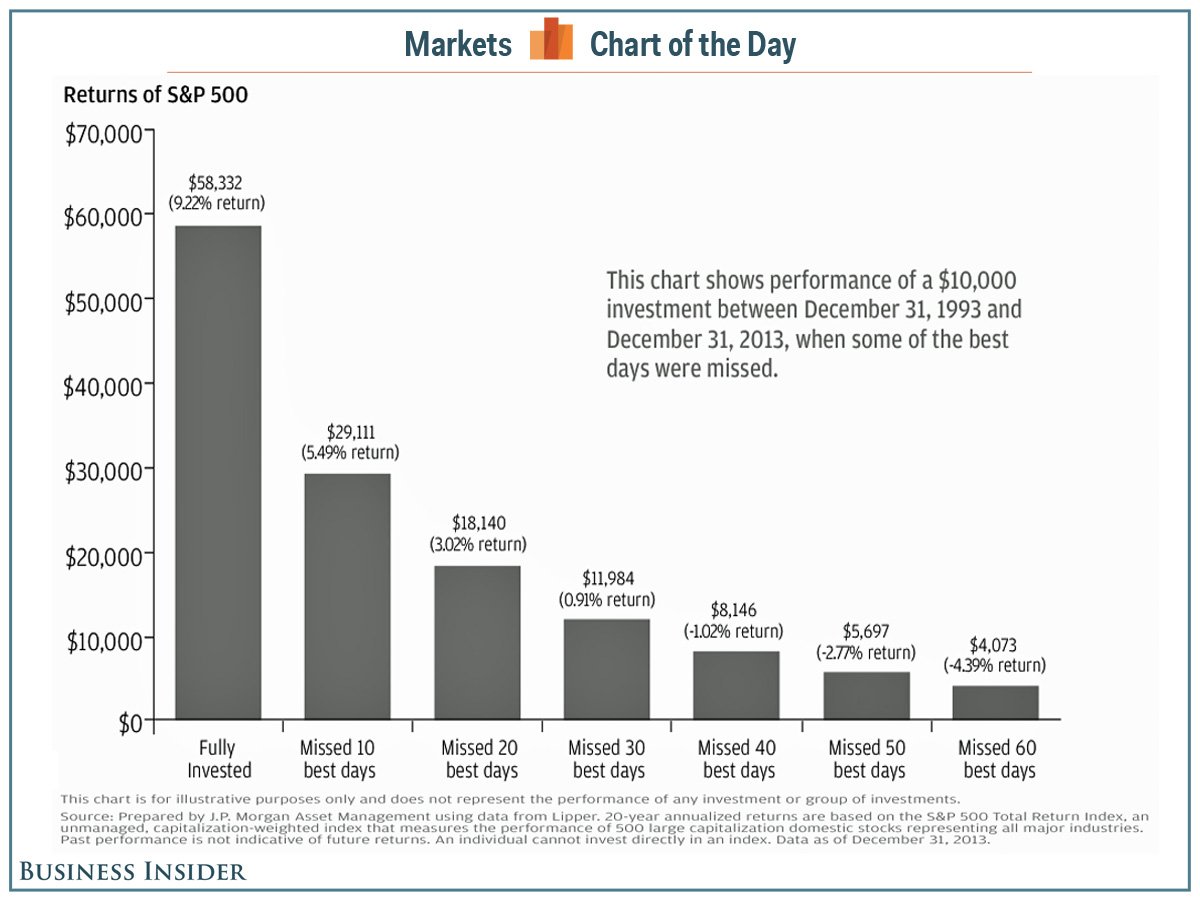
In 2014, JPMorgan Asset Management did a study and discovered that the 40 best days accounted for more than the entire S&P 500 return from 1993–2013. In other words, if someone traded only on these specific 40 days, i.e., invested his money in S&P 500 in the morning and sold in the evening then he would have the same returns as someone who stayed invested for 20 years.
[show_to accesslevel=’almanack-all’]
Click here if you can see the image above.
In the 1987 film Wall Street, Bud Fox, a rising stock broker looks at the legendary financier Gordan Gekko and says:
Life comes down to a few moments. This is one of them.
Is it possible that JPMorgan’s observation was once in a lifetime pattern which only shrewd market players like Fox could identify? Not really. If you do little research, you’d find that the pattern isn’t that rare.
Counting from January 2000 to December 2016, there are a total of 204 months. Out of these, only six specific months were responsible for the entire real gain in the S&P 500 (with dividends reinvested). But maybe the period that we’ve chosen here is cherry-picked to prove my point. So let’s expand our sample. What does the data say if you consider the period spanning close to 150 years, i.e., between 1871 to 2016?
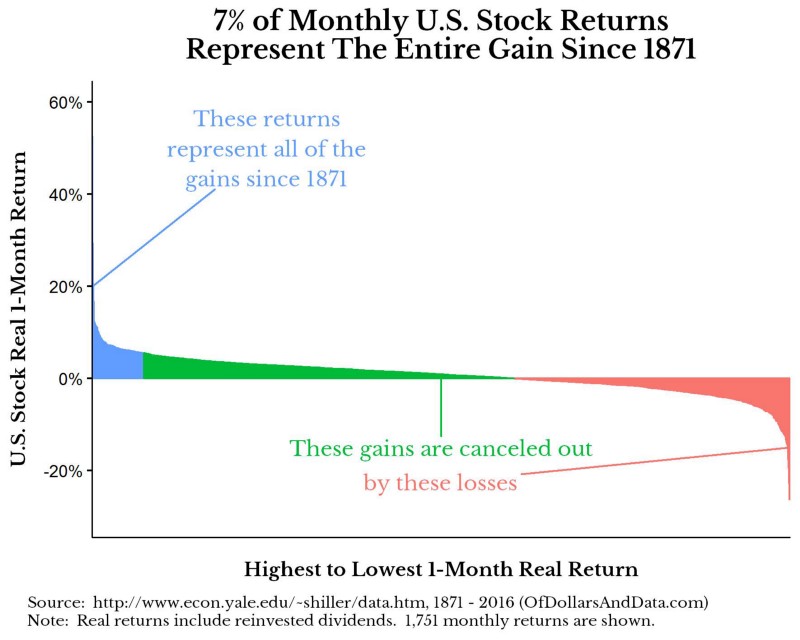
As you can see above, even in this case, 7% of all monthly returns represent the entire real gain in U.S. stocks. So the pattern is undeniable. A majority of gains are heavily concentrated to a tiny percentage of trading periods.
Seeing this, the 19th-century Italian economist Vilfredo Pareto would be smiling as if he’s saying, “I told you.”
Pareto had discovered this general pattern which later came to be known as the 80/20 rule. The rule — also known as Pareto’s Principle — says that approximately 80 percent of the effects generated by any large system are caused by 20 percent of the variables in that system. The 80/20 rule is observed in all large systems, including those in economics, management, engineering, and, as we’ve seen above, in the stock market. It’s important to note that the specific percentages in the 80/20 rule aren’t important. The proportion could be 90/10 or 70/30 or even 93/7 as it’s visible in our example of the US stock market’s 150-year history.
If this 80/20 rule is so evident, it should be possible for most investors to identify those specific periods and stack up superior returns. Isn’t it? Let’ do the math.
In our second example (January 2000 to December 2016), the winning months are six out of 204, i.e., less than 3%. What are the odds that part-time investors like us can get that right? Less than 3 percent, of course! Because in real life it’s nearly impossible to predict those winning months. Even for Bud Fox.
Miss even a single month from those six months and you’d do worse than the index returns. But that’s not the real risk. When you’re attempting to spot those winning months, you’re not just exposing yourself to the risk of missing them but also signing up for the risk of landing in those periods which are on the other side of the spectrum, i.e., the months that account for most of the negative returns.
Pareto’s principle would dictate that a small number of months would account for the majority of the decline in a given period.
What this means is that an investor, while trying to time the market, may end up choosing those trading periods which cumulatively do the maximum damage to his capital.
Let’s add few more scenarios in this salad of possibilities.
What if the investor misses the best trading months and also the worst trading months? Here’s an illustration (a chart and a table) that shows the comparison of returns where investor stays out of the market during the best ten months, the worst ten months and both for the S&P 500 index.
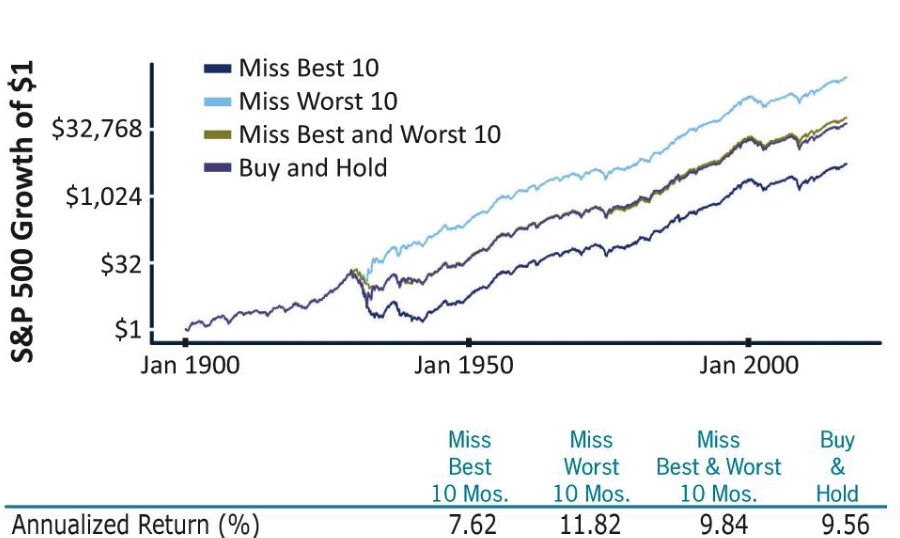
A market timer will try to capture the best months and avoid the worst months. Theoretically, such precise timing would trounce the markets hands down. But investing isn’t about the size of the gain. It’s also about how likely are those gains?
Going by probabilities, the chances are pretty high that an investor who is actively trying to time the market will miss both — the best ten months and worst ten months. Now, compare that to an investor who stays invested during the period without giving a hoot to market timing. Such a buy-and-hold strategy produces marginally inferior returns as compared to the dance-strategy but what about the stress and the transactional costs associated with the market timing dance? And don’t forget that buy-and-hold eradicates the risk of doing worse than the market, i.e., it limits the downside.
In the 2010 Annual Report of Berkshire Hathaway, Warren Buffett wrote —
…the immediate future is uncertain; America has faced the unknown since 1776. It’s just that sometimes people focus on the myriad of uncertainties that always exist while at other times they ignore them (usually because the recent past has been uneventful).
American business will do fine over time. And stocks will do well just as certainly, since their fate is tied to business performance. Periodic setbacks will occur, yes, but investors and managers are in a game that is heavily stacked in their favor. (The Dow Jones Industrials advanced from 66 to 11,497 in the 20th Century, a staggering 17,320% increase that materialized despite four costly wars, a Great Depression and many recessions. And don’t forget that shareholders received substantial dividends throughout the century as well.) Since the basic game is so favorable, Charlie and I believe it’s a terrible mistake to try to dance in and out of it based upon the turn of tarot cards, the predictions of “experts,” or the ebb and flow of business activity. The risks of being out of the game are huge compared to the risks of being in it.
The risk is not about missing the best trading periods. The risk is also not about hitting the worst trading periods because we don’t have any control over hitting or missing.
The real risk, as Buffett writes, is the risk of being out of the game. That’s a risk to focus on because it’s something which is in our control — staying in the game.
The surest way to capture the best trading periods is to avoid trying. Avoid trying to get around the worst days. Avoid trying to zero on the best days. The most sensible strategy is to stay invested in the market as much as possible.
Buffett again —
Money will always flow toward opportunity, and there is an abundance of that in America. Commentators today often talk of “great uncertainty.” But think back, for example, to December 6, 1941, October 18, 1987 and September 10, 2001. No matter how serene today may be, tomorrow is always uncertain. Don’t let that reality spook you. Throughout my lifetime, politicians and pundit shave constantly moaned about terrifying problems facing America. Yet our citizens now live an astonishing six times better than when I was born. The prophets of doom have overlooked the all-important factor that is certain: Human potential is far from exhausted, and the American system for unleashing that potential – a system that has worked wonders for over two centuries despite frequent interruptions for recessions and even a Civil War – remains alive and effective.
What Buffett has observed for America is true for India also. Like the US, we’ve had our share of large-scale social, political, and economic disturbances but the broader markets have shown resilience and they always seem to come back.
Everyone has heard of Buffett’s two rules of investing, “Rule Number 1: Don’t lose money. Rule Number 2: Don’t forget rule number 1.” But Charlie Munger is a straight shooter, so he has just one rule as far as long-term compounding is concerned. He says, “The first rule of compounding: Never interrupt it unnecessarily.”
Minimize risk. Stay in the game. Don’t interrupt compounding.
[/show_to]
[hide_from accesslevel=’almanack-all’]
- Spotlight: Big ideas from Value Investing and why applying them in your investment decision making will be a great deal
- InvestorInsights: Interviews with experienced value investors, learners, and deep thinkers
- StockTalk: Thorough analysis of business models of companies (without any recommendations)
- Behaviouronomics: Deep analysis of human behaviour and how it impacts investment decision making
- BookWorm: Reviews of the best books on Value Investing and related subjects
- Free Course – Financial Statement Analysis for Smart People (otherwise priced at Rs 5,900)
- Archives: Instant access to our huge archive from the past three years