
Imagine you are walking down the street. As you wait for the traffic light to turn red so that you can cross the busy intersection, you feel a gentle tug on your shirt from behind. You turn around to find a ten-year-old boy smiling at you.
“Hey buddy!” you greet him while trying to match his elated body language.
“My name is Krish,” he replies while maintaining his ear-to-ear smile.
“How can I help you, Krish?”
“Do you see the tall apartment over there?” he points towards a multistoried building across the street, “I stay there. Our apartment society is organizing a play for social awareness. The show is on Saturday night. And I am selling tickets for the same. It’s ₹250. Would you like to contribute?”
[show_to accesslevel=’almanack-all’]
As much as you want to support the social awareness campaigns, spending Saturday night watching children’s play doesn’t sound very exciting to you. Does it?
“Wow. That sounds great, Krish!” as those words slip out of your mouth your mind starts racing to find an appropriate excuse.
“I would’ve loved to contribute and watch the play. Unfortunately, I won’t be in the town this Saturday.” you try to sound honest while fighting a rising feeling of guilt. “Sorry about that, buddy!”
“I understand, Sir.” the boy gives a quick nod. “Well, if you can’t buy any tickets, how about buying some of these handmade greeting cards? They’re just ₹50 each.”
How could you refuse that request? You were being offered so many things just for fifty bucks. First, the amount was one-fifth of what was requested earlier. Second, there was no risk of blocking your Saturday night. And third and the most important one — atonement for refusing the little boy’s first request. After all, you owe it to the little boy. Don’t you? He did you a big favour by allowing you to get away with a much smaller amount.
Do you know what just happened? Well, let me give you a hint. See if you can find the clue in this Denis the Menace cartoon strip.
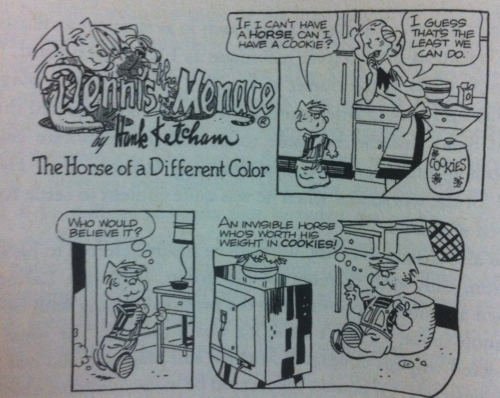
Perhaps Krish was inspired by Denis. He took Denis’ idea and converted it into a weapon of persuasion. Krish’s trick exploited not one but two powerful behavioural biases — Contrast Bias and Reciprocity.
Let’s understand them one by one and then we’ll explore what happens when both the biases are in action at the same time.
Contrast Principle
I’ll take Charlie Munger’s help in defining this behavioural anomaly. This an excerpt from his famous lecture on the psychology of human misjudgment –
Human nervous system can’t naturally measure in absolute scientific units, it must instead rely on something simpler. The eyes have a solution that limits their programming needs: the contrast in what is seen is registered. And as in sight, so does it go, largely, in the other sense. Moreover, as perception goes, so goes cognition. The result is man’s Contrast-Misreaction Tendency.
Contrast principle affects the way we see the difference, writes Robert Cialdini in his book Influence, “between two things that are presented one after another. Simply put, if the second item is fairly different from the first, we will tend to see it as more different than it actually is. So if we lift a light object first and then lift a heavy object, we will estimate the second object to be heavier than if we had lifted it without first trying the light one.”
Here’s a small experiment that you can safely try at home to experience the contrast principle first hand. Take three buckets of water. One with cold water, one with lukewarm (similar to the hot shower) and the third one with water at room temperature. Now dip your right hand in the cold bucket and left in the lukewarm bucket. Keep your hands immersed for a minute and then put both your hands in the third bucket which had water at normal temperature. Be ready for bewilderment if you haven’t tried this experiment before.
Even though both hands are in the same bucket, the right hand (that had been in the cold water) would feel as if it is now in hot water, while the left hand (that was dipped in hot water initially) would feel as if it is now in the cold water.
This tendency is routinely used by salesmen to exploit customers who are buying merchandise and services. For example, when someone is spending ₹10 lacs on a brand new car, spending another ₹25,000 for adding overpriced leather accessory doesn’t really feel too much.
Okay. Now hold on to that thought on contrast principle for a while. Let’s talk about the second behavioural bias which is perhaps the greatest loophole in our mental wiring which is routinely exploited by persuasion experts.
Jujitsu of Reciprocation
Reciprocity Bias or the rule of reciprocation, as described by Cialdini, says that human beings have a strong tendency and deep-seated urge to return any favours. Cialdini writes –
The rule says that we should try to repay, in kind, what another person has provided us. If a woman does us a favor, we should do her one in return; if a man sends us a birthday present, we should remember his birthday with a gift of our own; if a couple invites us to a party, we should be sure to invite them to one of ours. By virtue of the reciprocity rule, then, we are obligated to the future repayment of favors, gifts, invitations, and the like. So typical is it for indebtedness to accompany the receipt of such things that a term like “much obliged” has become a synonym for “thank you,” not only in the English language but in others as well.
This rule is deeply implanted in us by the process of socialization that homo sapiens has undergone over thousands of years. Each one of us has been taught to live up to the rule, says Cialdini “and each of us knows about the social sanctions and derision applied to anyone who violates it.” So there is a strong social stigma attached to the act of not returning the favour.
The force of reciprocity is extremely strong. It’s very subtle too.
One of the reasons reciprocation can be used so effectively as a device for gaining another’s compliance is its power. The rule possesses awesome strength, often producing a “yes” response to a request that, except for an existing feeling of indebtedness, would have surely been refused.
Cialdini compares the psychological force of reciprocity to a martial arts form called jujitsu. In jujitsu, the key is to use the strength and energy of the opponent against him. It exploits and manipulates the naturally present principles of gravity, leverage, momentum, and inertia. A skilled jujitsu artist can defeat an opponent without exerting much personal force. Surprisingly, to the onlookers (including the opponent), the manipulation is almost invisible.
Reciprocal Concessions
In behavioural science, one plus one is not two. It’s not even eleven. It’s more than that.
Little Krish knew that his first request would most probably be rejected. So he used that large request as a way to make you feel guilty. By accepting a no for the first request, Krish extended an invisible and unsolicited favour to you.
Using the contrast principle, he made the second request look much smaller and reasonable than the first one. And then using the power of reciprocity, he allowed you to return the favour and settle the accounts.
Cialdini calls this manipulation as reciprocal concessions. He writes —
The technique is a simple one that we can call the rejection-then-retreat technique. Suppose you want me to agree to a certain request. One way to increase your chances would be first to make a larger request of me, one that I will most likely turn down. Then, after I have refused, you would make the smaller request that you were really interested in all along. Provided that you have structured your requests skillfully, I should view your second request as a concession to me and should feel inclined to respond with a concession of my own, the only one I would have immediately open to me—compliance with your second request.
I knew a guy who was very successful in his network marketing business. Like most multi-level marketing schemes, his work involved primarily two things. First, recruiting new people to join his network. And second, selling products to those prospects who were happier to be his customers rather than his networking partners. He confessed that while showing the products to his customers, he deliberately prepared a long list from the product catalog with a hefty final bill at the end of his sales pitch. And then on customers request he would slash that list to half and most customers would be happy to make the purchase.
Rejection-then-retreat is a common negotiation strategy. Cialdini again —
Labor negotiators, for instance, often use the tactic of beginning with extreme demands that they do not actually expect to win but from which they can retreat in a series of seeming concessions designed to draw real concessions from the opposing side. It would appear, then, that the larger the initial request, the more effective the procedure, since there would be more room available for illusory concessions. This is true only up to a point, however. Research conducted at Bar-Ilan University in Israel on the rejection-then-retreat technique shows that if the first set of demands is so extreme as to be seen as unreasonable, the tactic backfires. In such cases, the party who has made the extreme first request is not seen to be bargaining in good faith. Any subsequent retreat from that wholly unrealistic initial position is not viewed as a genuine concession and thus is not reciprocated. The truly gifted negotiator, then, is one whose initial position is exaggerated enough to allow for a series of reciprocal concessions that will yield a desirable final offer from the opponent, yet is not so outlandish as to be seen as illegitimate from the start.
How does this psychological bias affect an investor in the stock market?
Well, every time a stock in your watchlist runs up and then retreats albeit to a price much higher than it was initially, it’s the little Krish disguised as Mr. Market telling you, “See, I have brought down the stock price so much from its highest point. I am doing you a favour by giving you a bargain. Don’t miss the opportunity.”
What are you going to do? Would you have bought the same stock had it gone up to its final price without an intermediate run up?
Don’t forget that the intermittent high price might just be a decoy.
Note: Krish’s story is adapted from Robert Cialdini’s personal experience with a boy scout selling him chocolate bars.
[/show_to] [hide_from accesslevel=’almanack-all’]
- Spotlight: Big ideas from Value Investing and why applying them in your investment decision making will be a great deal
- InvestorInsights: Interviews with experienced value investors, learners, and deep thinkers
- StockTalk: Thorough analysis of business models of companies (without any recommendations)
- Behaviouronomics: Deep analysis of human behaviour and how it impacts investment decision making
- BookWorm: Reviews of the best books on Value Investing and related subjects
- Free Course – Financial Statement Analysis for Smart People (otherwise priced at Rs 5,900)
- Archives: Instant access to our huge archive from the past three years