
In 1999 when Warren Buffett bought a 75% stake in MidAmerican Energy Holdings Company, David Sokol was its CEO. He retained his position till 2008. Apart from managing MidAmerican, Sokol played a crucial role in turning around Berkshire’s other investments like NetJets and Johns Manville. Over the years he established a reputation inside Berkshire Hathaway as Mr. Fixit.
In his annual letters, Buffett often referred to Sokol as a terrific manager, a brilliant dealmaker and a huge asset to Berkshire. In his 2008 letter, he wrote —
[show_to accesslevel=’almanack-all’]
Charlie and I are equally enthusiastic about our utility business, which had record earnings last year and is poised for future gains. Dave Sokol and Greg Abel, the managers of this operation, have achieved results unmatched elsewhere in the utility industry. I love it when they come up with new projects because in this capital-intensive business these ventures are often large. Such projects offer Berkshire the opportunity to put out substantial sums at decent returns.
Based on Sokol’s research, Buffett invested in Chinese automobile company BYD which turned out to be a hugely profitable investment for Berkshire. Not only that, Sokol was considered to be the leading candidate to take over the reins from Buffett at Berkshire. But all of that abruptly changed when Sokol resigned in 2011.
It was speculated that his resignation was because of insider trading allegations. After buying a significant chunk of shares in Lubrizol, he pitched the acquisition to Berkshire’s board. The acquisition went through and Lubrizol’s shares went up. Although it was never officially proved that there was any wrongdoing on Sokol’s part but his departure from Berkshire appeared to have links to the Lubrizol stock purchase.
For a second put yourself in Buffett’s shoes and imagine how you would feel when one of your most trusted business partners who has worked with you closely for decades behaves in a totally unexpected and undesired way? Like Sokol did.
When asked in one interview if he had felt betrayed by Sokol’s behaviour, Munger replied —
It’s not my nature … when you get little surprises as a result of human nature … to spend much time feeling betrayed. I always want to put my head down and adjust. I don’t allow myself to spend much time ever with any feelings of betrayal. If some flickering idea like that came to me, I’d get rid of it quickly. I don’t like any feeling of being victimized. I think that’s a counterproductive way to think as a human being. I am not a victim. I am a survivor.
That brings me to the central point of this article. Investing is a game of survival. When it comes to facing the market crashes, investing blunders, unfair dealings, or breach of trust, the one factor that’s by far the leading cause of investment success over the long term is this — grin and bear it. And keep playing the game.
The moment your focus goes towards feeling cheated or being a victim of an unfair transaction, it takes away your eyes from other doors which might be opening up towards better opportunities. The role of unfortunate outcomes — ones that make you feel like a victim of circumstances — is limited to learning from them and treating them as a data point which can improve your decisions in the future.
In 2007 Munger delivered a speech at the University of Southern California. He said —
Life will have terrible blows in it … horrible blows, unfair blows. And some people recover and others don’t. And there I think the attitude of Epictetus is the best. He said that every missed chance in life was an opportunity to behave well, every missed chance in life was an opportunity to learn something, and that your duty was not to be submerged in self-pity, but to utilize the terrible blow in constructive fashion. That is a very good idea.
On another occasion, Charlie posed this question to his audience in one of his talks.
What one frame of mind is likely to cause the most damage to an individual’s happiness, his contribution to others, and the like — what one frame of mind will be the worst?
And without waiting for a reply, he answered it himself. He said —
The answer, of course, would be some sort of paranoid self-pity. I can’t imagine a more destructive frame of mind. Every time you think some person, or some unfairness is ruining your life, it is you who are ruining your life.
When I shared this quote with one of my acquaintances who doesn’t know much about Charlie Munger, he retorted, “Of course, it’s easy for him to say that. He’s a billionaire, has a cult following and revered like a demigod of wisdom in the world of business and investing.”
I reminded him that when Charlie was 31 years old, he lost his home in his divorce settlement and was completely broke.
And shortly after his divorce, Charlie’s nine-year-old son Teddy was diagnosed with leukemia. He had no health insurance. Even doctors couldn’t do anything to save little Teddy’s life. Rick Guerin, Charlie’s friend, recalls that Munger would go into the hospital, hold his young son, and then walk the streets of Pasadena crying. Teddy died.
Charlie has had his fair share of tough life situations. More than fair, I would say. But he never allowed those tribulations to keep him down or indulge in self-pity.
Later in life, Munger faced a horrific operation that left him blind in one eye with pain so terrible that he eventually had his eye removed. Since then, every year, he has read more books with one eye than most people read in a lifetime.
Why does the human mind like to wallow in self-pity? I don’t know. Perhaps evolutionary sociology can explain it. Some people argue that feeling sorry for oneself gives a cathartic release. Maybe it does. But if you think about it rationally, it doesn’t really solve any other problems. It keeps you mired in the victim mentality. It’s like having a big heavy ball of misery chained to your leg.
Imagine you were at Munger’s place and your doctor told you this — you have developed a condition that’s causing your remaining eye to fill up with blood, and now there’s a risk of losing vision in your healthy eye too. What would you do? Being a voracious reader like Munger is, the idea of going completely blind would have been devastating, right?
So, when Munger’s doctor recently broke this news to him, Munger told his friend, “It’s time for me to learn braille.” And he started taking braille lessons. He refused to be a victim. He chose to be a survivor.
Fortunately, Charlie’s eye condition improved and he still has his vision.
Feeling like a victim is a perfectly disastrous way to go through life, says Munger, “If you just take the attitude that however bad it is in anyway, it’s always your fault and you just fix it as best you can … I think that really works.”
The self-pity and victim mentality is a result of believing in just world hypothesis. Gabriel Weinberg, in his new book Super Thinking writes —
Many people instead choose to believe that the world is completely fair, orderly, and predictable. This view is called the just world hypothesis , where people always get what they deserve, good or bad, because of their actions alone, with no accounting for luck or randomness. This view is summed up as you reap what you sow.
The world around us is largely a soup of random events loosely connected by few broad patterns. And one of those patterns is that the universe doesn’t care for any individual’s personal agenda.
So don’t be surprised when you discover that your broker was frontrunning your trades. Don’t let it come as a shock when you find out that your financial advisor had been recommending toxic financial products to you. It’s really not unfair when the management of a company lie through their teeth to shareholders. Each of these unfair transactions is an opportunity for the investor to learn the patterns that lead to unethical behaviour.
If your investment journey has thrown a few bad apples your way, if your business partner has broken your trust, if you feel that the world is not fair then be reminded that the world is not supposed to be fair.
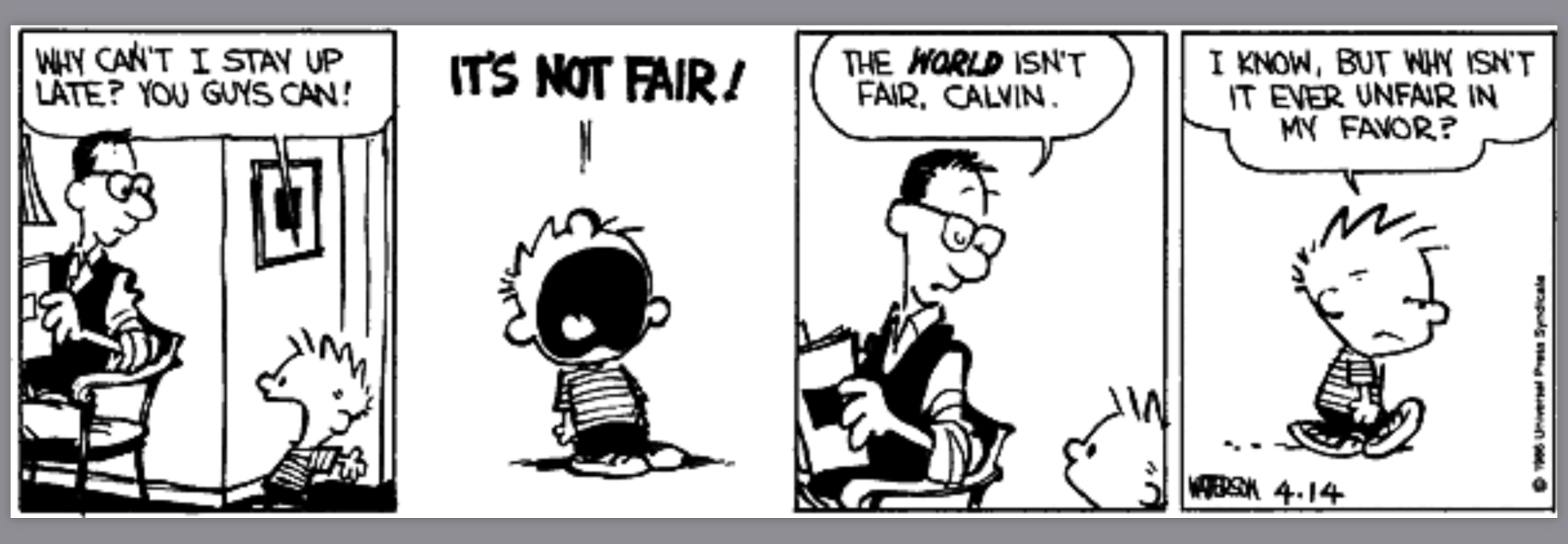
It’s not supposed to be fair in your favour or in anyone’s favour.
[/show_to] [hide_from accesslevel=’almanack-all’]
- Spotlight: Big ideas from Value Investing and why applying them in your investment decision making will be a great deal
- InvestorInsights: Interviews with experienced value investors, learners, and deep thinkers
- StockTalk: Thorough analysis of business models of companies (without any recommendations)
- Behaviouronomics: Deep analysis of human behaviour and how it impacts investment decision making
- BookWorm: Reviews of the best books on Value Investing and related subjects
- Free Course – Financial Statement Analysis for Smart People (otherwise priced at Rs 5,900)
- Archives: Instant access to our huge archive from the past three years