
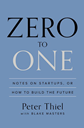
Peter Thiel is the guy who identified the multi-billion dollar businesses like Paypal, Facebook, LinkedIn and Palantir very early and invested in them. The best way to predict the future is to create it. Peter knows that for sure and in his book he reveals the secrets.
 The most interesting thing about future is that it’s unpredictable. Anybody who claims that he or she can predict the future is either lying or crazy, possibly both.
However, there’s still a way in which a handful of people have ended up not only predicting the future but benefitting from it enormously and creating disproportionate amount of wealth in the process. These are the people who believe – “The best way to predict the future is to create it.”
The problem is that these people work secretly and rarely come out in public to claim their share of fame. But once in a while, you see a dark horse coming out and willing to share his or her thought process.
Peter Thiel is one such dark horse who was relatively unknown outside the group of selective people in Silicon Valley. In case you don’t know about Peter Thiel, he was the founder of PayPal (with Elon Musk) and an early stage investor in Facebook, LinkedIn and SpaceX. He is one guy who has been there, done that. Thiel’s ideas are must read for every entrepreneur.
In this post, I’ll share some big ideas I learned from Thiel’s book Zero to One. The book is based on his lectures at Stanford University. One of his students, Blake Masters, made lecture notes and published it. The notes became instant hit on the internet and soon Masters got an opportunity to co-author ‘Zero to One’ with Peter Thiel.
In just few years, Blake Masters went from being Peter Thiel’s student to co-author. I call this strategy, exposing yourself to positive black swan or in simple words, giving luck a chance to find you. But I’ll save that discussion for some other day.
Let’s talk about the book.
Nassim Taleb says in his endorsement of this book – “If a risk taker writes a book, read it. If it is Peter Thiel, read it twice. In fact, read it thrice to be safe.”
[show_to accesslevel=’almanack-all’]
Like a Zen master, Thiel doesn’t believe in giving readymade answers. His ideas are more like an exercise in thinking.
I’ll pick up few insights, especially the ones which resonated most with my current state of mind, from the book as part of this review but you’ll be doing yourself a huge injustice if you skip reading the book after reading these notes. As Taleb says, this book is not just a must-read but a must re-read.
Thinking – Zero to One
As a value investor you may find this unsettling but if you want to bring a change as an entrepreneur, this philosophy will make a lot of sense. Thiel writes –
The next Bill Gates will not build an operating system. The next Larry Page or Sergey Brin won’t make a search engine. And the next Mark Zuckerberg won’t create a social network. If you are copying these guys, you aren’t learning from them.
Of course, it’s easier to copy a model than to make something new. Doing what we already know how to do takes the world from 1 to n, adding more of something familiar. But every time we create something new, we go from 0 to 1. The act of creation is singular, as is the moment of creation, and the result is something fresh and strange.
“Zero to One is about how to build companies that create new things…the single most powerful pattern I have noticed is that successful people find value in unexpected places, and they do this by thinking about business from first principles instead of formulas.
What Peter calls “first principles,” Charlie Munger calls elementary worldly wisdom – the fundamental ideas from the major disciplines.
Going from 1 to n, the horizontal progress, is easy to imagine because we already know what it looks like. Vertical progress, going from zero to one, is harder because it requires doing something nobody else has ever done.
According to Thiel, horizontal progress is not technology. It’s globalization – what China has been doing. Vertical progress is the real technology – that takes you from 0 to 1.
Globalization alone will not solve the world’s problem. In fact, without technology, globalization will make our planet unsustainable. For example, without technological change, if China doubles its energy production over the next two decades, it will also double its air pollution. What the world needs is more ‘zero to one’ thinkers than 1 to n implementers. This means one needs to imagine the future first. That brings us to the question…
How to Look Into The Future?
The most interesting question that Thiel talks about, which he routinely asks people in interviews, is – “What important truth do very few people agree with you on?”
He says
This is a question that sounds easy because it’s straightforward. Actually, it’s very hard to answer. It’s intellectually difficult because the knowledge that everyone is taught in school is by definition agreed upon. And it’s psychologically difficult because anyone trying to answer must say something she knows to be unpopular. Brilliant thinking is rare, but courage is in even shorter supply than genius.
Answers like, “Our educational system is broken and urgently needs to be fixed” or “There is no God” are all bad answers. When most people answer contrarian questions, they usually try to extrapolate the present.
A good answer looks something like this – “Most people believe in x, but the truth is the opposite of x.”
Answering contrarian questions and noticing what is ‘not present’ is a skill that can take you closer to seeing the future. Contrarian questions allow you to see the present in different ways and good answers give you a glimpse of the future.
The Power Law
Few weeks back, I wrote about Power Law in my Latticework series on Safal Niveshak. It’s an important mental model and very relevant in today’s modern world which is ridden with complexity and extreme outcomes. Thiel writes…
…the power law—so named because exponential equations describe severely unequal distributions—is the law of the universe. It defines our surroundings so completely that we usually don’t even see it….in venture capital, where investors try to profit from exponential growth in early-stage companies, a few companies attain exponentially greater value than all others. Most businesses never need to deal with venture capital, but everyone needs to know exactly one thing that even venture capitalists struggle to understand: we don’t live in a normal world; we live under a power law.
It’s not a secret anymore that majority of the successful venture capital funds have most of their returns coming from top 2-3 investments. These 2-3 companies outperform rest of the portfolio (combined) by a huge margin. That’s why diversification doesn’t work in venture capital business.
Investing is no different. Charlie Munger suggests that one should have just 3 to 4 great businesses in portfolio. Even Buffett accepts that most of his returns have come from a handful of businesses that he has bought over 50 years.
To explain this idea, Buffett uses the 20-hole punch-card metaphor. He advises that investors should think about making only 20 decisions throughout their investing career. This way you won’t sprinkle away your money in mindless diversification. The Power Law is the secret to exponential returns. Thiel writes…
The power law is not just important to investors; rather, it’s important to everybody because everybody is an investor…When you choose a career, you act on your belief that the kind of work you do will be valuable decades from now…an individual cannot diversify his own life by keeping dozens of equally possible careers in ready reserve.
For the startup world, this means you should not necessarily start your own company, even if you are extraordinarily talented. If anything, too many people are starting their own companies today. People who understand the power law will hesitate more than others when it comes to founding a new venture: they know how tremendously successful they could become by joining the very best company while it’s growing fast. The power law means that differences between companies will dwarf the differences in roles inside companies. You could have 100% of the equity if you fully fund your own venture, but if it fails you’ll have 100% of nothing. Owning just 0.01% of Google, by contrast, is incredibly valuable (more than $35 million as of this writing).
That’s the reason I joined Safal Niveshak instead of starting my own company. 😉 Not that I distinctly understood this idea back then but it feels good to connect the dots looking backwards.
Discovering the Secrets
Learning the conventions and rules of the game are essential for creating a good foundation in any field, but it won’t give you the edge.
Remember the contrarian question: What important truth do very few people agree with you on?
Contrarian thinking is based on the assumption that there are still secrets which aren’t known to public. Looking at the history of innovation and technological breakthrough in last few centuries, some would guess that there are many world changing companies yet to be started. Hence there are many secrets left to be uncovered. But our society has somehow come to believe that we are nearing the state of perfect knowledge – a state where everything that can be known is already known.
Take the case of efficient market theory, which proposes that there are no inefficiencies (secrets) in the market so it’s futile to even try. But value investors like Warren Buffett and Charlie Munger have been shouting the secret from the rooftops. According to them markets aren’t always efficient. Any investor, with hard work and patience, can discover those pockets of inefficiencies (secrets) from time to time.
Thiel writes …
You can’t find secrets without looking for them…there are many more secrets left to find, but they will yield only to relentless searchers…Great companies can be built on open but unsuspected secrets about how the world works…only by believing in and looking for secrets could you see beyond the convention to an opportunity hidden in plain sight.
So what do you do when you find a secret? The last thing you should do is go out and share it with everybody. Thiel suggests…
If you find a secret, you face a choice: Do you tell anyone? Or do you keep it to yourself?
Unless you have perfectly conventional beliefs, it’s rarely a good idea to tell everybody everything that you know.
So who do you tell? Whoever you need to, and no more. In practice, there’s always a golden mean between telling nobody and telling everybody—and that’s a company. The best entrepreneurs know this: every great business is built around a secret that’s hidden from the outside. A great company is a conspiracy to change the world; when you share your secret, the recipient becomes a fellow conspirator.
Conclusion
I think Thiel might be one of the top ten smartest people living on this planet today (first spot is of course held by Charlie Munger).
The easiest way to become smart is to ponder what geniuses say. Zero To One is full of counterintuitive insights that will help your thinking and ignite possibility.
Remember, the future can’t happen on its own. It needs people like Peter Thiel and people like you who believe in taking the mankind from zero to one, one step at a time.
Thiel’s book is worth reading in its entirety. If you miss this book you might miss the future too, again!
Also read:
- http://www.tailopez.com/blog/zero-to-one
- http://microcapclub.com/2015/09/book-review-zero-to-one-by-peter-thiel/
- https://www.farnamstreetblog.com/2015/10/zero-to-one/
- Spotlight: Big ideas from Value Investing and why applying them in your investment decision making will be a great deal
- InvestorInsights: Interviews with experienced value investors, learners, and deep thinkers
- StockTalk: Thorough analysis of business models of companies (without any recommendations)
- Behaviouronomics: Deep analysis of human behaviour and how it impacts investment decision making
- BookWorm: Reviews of the best books on Value Investing and related subjects
- Free Course – Financial Statement Analysis for Smart People (otherwise priced at Rs 5,900)
- Archives: Instant access to our huge archive from the past three years