
The investment management business is based on a single basic belief: Investors can beat the market. Unfortunately, when these investors are themselves the market they cannot, as a group, outperform themselves. They’re playing a loser’s game.
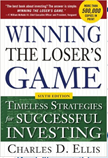
Good sense of humour and investment acumen don’t normally go hand in hand. Apart from Warren Buffett there are very few value investors who possess all the three qualities of candour, straight talk, and good humour. Charlie Ellis is one of them.
Ellis is a strong proponent of index funds. According to him, for an individual investor the best strategy to compound wealth over the long term is to shun the active money management and go with index funds. I don’t personally agree that index fund, especially for those who are willing to invest few hours every week in learning the game, is the right choice for all investors. Nevertheless, I find Ellis’ arguments very compelling.
Charles Ellis wrote a paper in 1975 which popularized the concept of loser’s game. The paper talked about how the approach taken by good and bad tennis players is also seen in investing. Ellis’ article was based on Dr. Simon Ramo’s research. The idea was later adopted into this book called Winning The Loser’s Game.
Loser’s Game
Dr. Ramo, in his book Extraordinary Tennis for the Ordinary Tennis Player, argues that in expert tennis the ultimate outcome is determined by the actions of the winner. Professional tennis players stroke the ball hard with laser-like precision through long and often exciting rallies until one player is able to drive the ball just out of reach or force the other player to make an error. These splendid players seldom make mistakes.
[show_to accesslevel=’almanack-all’]
This game, played by professionals and experts, is called a winner’s game. But when it comes to amateur players they play a totally different kind of game. The ball is all too often hit into the net or out of bounds, and double faults at service are not uncommon. Amateurs seldom beat their opponents but instead beat themselves. The victor in this game of tennis gets a higher score because the opponent is losing, even more, points. Ramo calls this kind of game as loser’s game. Put simply, in a winner’s game, the outcome is determined by the correct actions of the winner whereas in a loser’s game, the outcome is determined by mistakes made by the loser. So what’s the functional equivalent of this insight in the game of investing?
A few decades back the stock market wasn’t dominated by the institutional investors. A retail investor who transacted in the stock market was most likely pitted against another small investor. And among the two, the one who did superior analysis and had access to better information about the business usually made the better decision and more money.
But in the current markets when a small investor, like you and me, buys or sells a stock, the odds are high that the party on the other side is an institutional investor. The kind of resources, information, and analysis that these institutional investors have makes it unlikely that a small investor can beat them in their game. What’s their game? Institutional investors are in a race to bigger and bigger assets under management (AUM) which is dependent on their quarter to quarter performance. They are into the short-term performance game. And if that’s where you, as a small investor, try to outperform them, you’re playing a loser’s game. No wonder why the small investor beats himself all the time!
Ironically, when these institutional investors are transacting with each other, their winner’s game turns into a loser’s game for themselves. Since they don’t have any special edge against each other and are driven by same rules, conventions and incentives. Given the cost of active management—fees, commissions, market impact of big transactions, etc.— a large majority of investment managers have and will continue over the long term to underperform the overall market. So investing is a loser’s game, not only at the amateur level but also at the professional level. I would argue that investing in IPOs is a loser’s game too. The promoters and investment bankers who set the IPO price are better informed about the value of the business than a small investor. To draw an analogy from Tennis, you an amateur player is playing against Roger Federer or Serena Williams. It’s their game and they have a massive edge. They have designed a winner’s game and enticing you to join in. But there’s a ray of hope for individual investors. Ellis writes –
The encouraging truth is that while most investors are doomed to lose if they play the loser’s game of trying to beat the market, every investor can be a long-term winner.
All we need to do to be long-term winners is to reorient ourselves to concentrate on realistic long-term goal setting and staying the course with sensible investment policies that will achieve our own particular objectives by applying the self-discipline, patience, and fortitude required for persistent implementation.
Here’s a small sample of strategies offered by Ellis in his book.
Time Advantage
Archimedes said, “Give me a lever long enough and a place to stand, and I can move the earth.” In investing, that lever is time. Ellis writes…
Time transforms investments from least attractive to most attractive…As a result, time changes the ways in which portfolios of different kinds of investments can best be used by different investors in a different situation and with different objectives.
Most fund managers are at the whims of their clients. If there are too many redemptions fund manager might be forced to sell his stocks at the wrong time. In effect, he doesn’t really have the staying power. He can’t ride out a temporary market correction by staying invested. But as an individual investor, you’re not forced to sell your stocks because Mr. Market is panicking. But to earn this edge, you have to make sure that you invest only that portion of your saving in stock market which won’t be required for next 5-10 years. And if your investment horizon is in decades then you have virtually found the Archimedes’ lever. All you need is a place to stand i.e., a sound investment policy.
Investment Risk
According to Ellis, at the most fundamental level, an investment risk is this – Not having the money when you need it. It’s the simplest and most powerful definition of risk that I have ever seen. The argument of investment risk circles back to the idea of time advantage that we saw above. Ellis writes –
The difference between true investment risk and apparent riskiness or market risk is a function of time. Yes, stocks can be very risky if time is short. But unless you begin your investment program at a silly “too high” level in the stock market when the time is long enough, the apparent riskiness of stocks evaporates and the favourable long-term returns become increasingly evident.
For investors, investment risk can also be divided by time into “short-term risk” and “long-term risk.” The real risk in the short-term is that you will need to sell – to raise cash – when the market happens to be low. That’s why, in the long term, the risks are clearly lowest for stocks, but in the short-term, the risks are just clearly highest for stocks. One risk that most investors are not prepared for, however, is how long it can take for the stock market to recover to peak prices. It’s worth remembering that it took 16 years for the S&P 500 stock index to get back up to its 1966 peak and even longer to regain the peak of 1929. But if you don’t need to sell and don’t sell, you really shouldn’t much care about the nominal fluctuations of stock prices.
Market Prediction
Predicting the movement of markets is extremely hard. However, if your intention is to be approximately right than precisely wrong then you understand the game.
Predicting the stock market roughly is not hard, but predicting it accurately is truly impossible. Equally, predicting approximately where the stock market will normally be in the long run is not hard, but even estimating how it will move over the next few months is nearly impossible – and pointless.
Once an investor has decided to stay invested in the market for long term (decades) he or she can expect the markets to exhibit the characteristics of bell curve where the market extremes are followed by reversion to the mean.
Selecting Funds
If you decide to invest in equities through actively managed mutual funds, then the most important question is how do you select a fund? Selecting superior mutual funds isn’t any easier than selecting stocks. Remember, past few year’s performance shouldn’t be the only criteria for choosing a fund. The professional culture of the fund house is more important.
Stocks and investment ideas come and go; fund managers come and go; but character in a person and culture in an organization – good or bad – are hard to change. So look for the culture that attracts and keeps superior people for 30- or 40-year careers. Look for consistency in statements about “how we do things here…
Wise investors choose mutual funds carefully and then stay the course. Very wise and very well-informed investors go one step further: Having selected a small group of long-term “finalists” – chosen because their internal cultures ensure striving for professional excellence over the long term.
Money managers who treat their job as a profession rather than as a business are more likely to deliver a better long term results.
Conclusion
So how do you win a loser’s game? Just by extending your focus from short-term to long term. Ellis in his book concludes –
Winning the loser’s game of beating the market is easy: Don’t play it. Concentrate on the winner’s game of defining and adhering faithfully to sound investment policies that are right for the market realities and right for your long-term goals and objectives.
For a small investor, playing the winner’s game in stock market means ignoring the mood swings of Mr. Market, concentrating where the earnings and cash flows of the underlying businesses you own, or want to own, are going to go over long term and most crucially, knowing your limitations as an investor.
Needless to say that Ellis’ investment classic belongs on every investor’s bookshelf. So please do me favour. Get a copy of the book and make it a point to read it once every year.
[/show_to] [hide_from accesslevel=’almanack-all’]- Spotlight: Big ideas from Value Investing and why applying them in your investment decision making will be a great deal
- InvestorInsights: Interviews with experienced value investors, learners, and deep thinkers
- StockTalk: Thorough analysis of business models of companies (without any recommendations)
- Behaviouronomics: Deep analysis of human behaviour and how it impacts investment decision making
- BookWorm: Reviews of the best books on Value Investing and related subjects
- Free Course – Financial Statement Analysis for Smart People (otherwise priced at Rs 5,900)
- Archives: Instant access to our huge archive from the past three years