
The true story of how a hedge fund, run by a team of super smart Nobel laureates, tried to out think the market and failed. It’s a remarkably instructive tale of how intelligence, when corrupted by arrogance and hubris, eventually leads to disasters.
Success, they say, leaves clues. So does failure. Unfortunately, the world focuses too much on learning only from successes. Success alone leaves the learning equation incomplete.
Identifying patterns is the key to drawing useful lessons from the past. Success patterns are just one part. The patterns left by failure are the remaining part of the puzzle. To succeed, one has to study both. Learning ‘what to do’ from success patterns and learning ‘what to avoid’ from failure patterns.
A person trying to get ahead in the world, with no will to study the failures, is akin to the proverbial one-legged man who is trying to score points in an ass-kicking contest.
[show_to accesslevel=’almanack-all’]
In fact, if you had to choose one among the two – following success patterns and avoiding failure patterns – pick the second one. It sounds very counter-intuitive but avoiding failure is a far more robust strategy than actively seeking success. This strategy is even more important when it comes to making money in stock market.
Jim Paul, in his immensely useful book What I Learned Losing a Million dollars, writes –
Why was I trying to learn the secret to making money when it could be done in so many different ways? I knew something about how to make money; I had made a million dollars in the market. But I didn’t know anything about how not to lose. The pros could all make money in contradictory ways because they all knew how to control their losses.
While one person’s method was making money, another person with an opposite approach would be losing — if the second person was in the market. And that’s just it; the second person wouldn’t be in the market. He’d be on the sidelines with a nominal loss. The pros consider it their primary responsibility not to lose money.
The moral, of course, is that just as there is more than one way to deal blackjack, there is more than one way to make money in the markets. Obviously, there is no secret way to make money because the pros have done it using very different, and often contradictory, approaches.
Learning how not to lose money is more important than learning how to make money. Unfortunately, the pros didn’t explain how to go about acquiring this skill. So I decided to study loss in general, and my losses in particular, to see if I could determine the root causes of losing money in the markets.
And when it comes to studying failure, focusing on the mistakes arising out of human irrationality will give you the maximum return on your efforts. To make your work even easier, let me single out the biggest behavioural culprit which brings eventual misery with utmost consistency. Hubris.
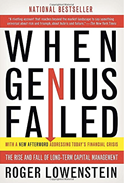
When Genius Failed is a book that lends some credit to my point. It’s the story of a fund called Long Term Capital Management (LTCM). The fund virtually eclipsed every other Wall Street financial institution in the 1990s. At its peak, LTCM controlled bigger asset base than other behemoths like Morgan Stanley and Lehman brothers.
The rise of LTCM was nothing short of spectacular. So was its fall. If it’s not yet clear to you, LTCM is now a long defunct fund management company. Prima facie the LTCM debacle seems like an unfortunate story of a bunch of over smart guys blowing up big time. But underneath, it’s a lesson on dangers of hubris.
The hedge fund was the brainchild of John Meriwether, a Wall Street trader. But Meriwether was only the public face of the fund. The reins were in the hands of a group of brainy, Ph.D. certified folks. Many of them had been professors. Two of them, Myron Scholes and Robert Merton, were 1997 Nobel Prize winners in Economics.
All of them were very smart, writes Lowenstein, “And they knew they were very smart.”
So what went wrong? LTCM’s downfall was brought about by what Charlie Munger calls a lollapalooza of multiple forces acting in the same direction. Derivatives, debt, inherent risk associated with hedge funds and hubris were some of those factors.
Hedge Funds
Unlike a mutual fund, which is constrained by a lot of rules and regulations, a hedge fund gets a pretty much free hand in how they invest their investor’s money. They even get to keep the contents of their portfolio hidden and they are allowed to concentrate portfolio with absolutely no regard to diversification.
LTCM exploited this to full extent. Saving for broad generalities, the fund never disclosed anything about how and where their money was invested. Meriwether’s letter to investors, writes Lowenstein, “were saturated with statistics on volatilities but mute on what the firm was actually doing.”
In addition to that, hedge funds are free to dabble into the more exotic financial tools, such as options, derivatives, shorting and extremely high leverage. This unrestrained operation, on one hand, bestows these funds an opportunity to generate impressive returns.
On the other hand, the lack of regulations makes these hedge funds a ripe environment for experiments with risky financial instruments like derivatives and hence creates a greater likelihood of grave errors not excluding the possibility of complete blow-up.
In return for the extreme freedom, hedge funds are required to limit their access to few select investors including high net worth individuals and other large financial institutions. This creates a private club kind of operation which makes them even more enticing.
As an aside, Nike’s founder Phil Knight was one of the clients of LTCM. The logic for exemption from the regulatory net is that if a fund is open to only a small group of millionaires and institutions, then regulators need not trouble to monitor it. Presumably, millionaires know what they are doing, and if they don’t their losses are nobody’s business but their own.
Hedge funds became the new stock market fad in the 1990s. Lowenstein writes –
Hedge funds became a symbol of the richest and the best. Paradoxically, the princely fees that hedge fund managers charged enhanced their allure, for who could get away with such gaudy fees except the exceptionally talented?
Not only did hedge fund managers pocket a fat share of their investors’ profits, they greedily claimed a percentage of the assets. For such reasons, the number of hedge funds in the United States exploded. In 1968, when the SEC went looking, it could find only 215 of them. By the 1990s there were perhaps 3,000 (no one knows the exact number), spread among many investing styles and asset types.
Lack of transparency, an absence of regulatory eyes and a dash of psychological biases (envy, greed, overconfidence) creates the perfect recipe for triggering perverse incentives in the subconscious mind of a hedge fund manager. From there it doesn’t take too long before the so called sound investment operations transform into reckless gambling.
To make matters worse for LTCM, there was no concept of devil’s advocate to question the investment decisions taken by fund’s top managers.
For all its attention to risk, Long-Term’s management had a serious flaw. Unlike at banks, where independent risk managers watch over traders, Long-Term’s partners monitored themselves.
Though this enabled them to sidestep the rigidities of a big organization, there was no one to call the partners to account.
Arbitrage and Debt
At the heart of LTCM’s strategy were two things – Arbitrage and Debt.
The secret of this magical foretelling was breathtakingly simple. Just as the key number in the dice bet was the typical variance from 7, the key number for Long-Term was the usual variance, or volatility, in bond prices. By plugging tens of thousands of bond prices into its SPARC computers, Long-Term’s traders knew the historic volatility—that is, how much bonds had fluctuated in the past. And that one number (calculated over thousands of daily, monthly, and yearly intervals and for numerous types of bonds) was the basis of their assessment of risk in the future.
Peter Rosenthal, Long-Term’s press spokesman, glibly explained, “Risk is a function of volatility. These things are quantifiable.
A team of overqualified academicians, sophisticated computer programs, and complex mathematical equations were all focused on exploiting the tiny arbitrage spread opportunities.
Now’s there’s no brilliance in exploiting minuscule spread in bond prices. In fact, it doesn’t even make sense as a viable investment strategy for the return on capital with such trades is less than what one would make in risk-free treasury bonds. But at LTCM, these tiny returns on capital were amplified by deploying insane levels of debt. Meriwether stroke of genius was converting his investment operations into a financing house. Almost all of LTCM’s heady 40-50 percent return on equity was due to the remarkable power of leverage.
Of course, taking the debt into account, the return on total assets – both those that it owned and those it had borrowed – was less than 3 percent. Nothing spectacular there. This minuscule figure is what Long-Term would have earned had it invested only its own money.
In simple words, LTCM model was to scoop nickels. Availability of large amounts of cheap debt made this nickel picking operation very profitable. Though with debt, it was akin to picking those nickels in front of an oncoming road roller.
In less than two years from its inception, LTCM’s equity capital (investor’s money) had grown to $3.6 billion. However, their assets had grown to an extraordinary sum of $102 billion. The huge chasm between assets and equity was bridged by debt.
At the end of 1995, the fund was leveraged 28 to 1. By 1996, they had an astounding $140 billion in assets, thirty times its underlying capital. To put this into perspective, Long-Term was two and a half times as big as Fidelity Magellan, the largest mutual fund, and four times the size of the next largest hedge fund.
If the debt itself wasn’t sufficient, use of derivatives was the second factor that multiplied risk in LTCM.
Derivatives
Panics are as old as markets, but derivatives are relatively new. Derivatives have their own place and they do help in bringing some degree of efficiency in the markets. But at the end of the day, it’s just a tool. How useful, futile or lethal a tool is, depends on the person wielding it.
…for the most part, Long-Term built its equity positions without buying actual securities. Rather, the fund entered into derivative contracts that mimicked the behavior of stocks. If, for instance, Long-Term wanted to earn the return on $100 million of CBS stock over a three-year period, it would strike a “swap” contract with, say, Swiss Bank.
Long-Term would agree to make a fixed annual payment, calculated as an interest rate on $100 million. And Swiss Bank would agree to pay Long-Term whatever profit would have been earned had Long-Term actually purchased the stock. (If the stock fell, Long-Term would pay Swiss Bank.) Most likely, Swiss Bank would hedge its risk by buying actual shares. But that was no concern of Long-Term’s.
What mattered to Meriwether and company was that they could make a huge investment in CBS with no money down and without having to make all of the usual disclosures. And despite Reg T, it was perfectly legal. The Fed, after all, merely restricted loans toward the purchase of stocks. Long-Term wasn’t purchasing anything; it was making side bets on the direction of stocks—which amounted to the same thing.
Derivatives, by their very nature, are pretty risky but when you add debt to the equation, it’s like driving a car through a landmine-infested territory with a dagger attached to the steering wheel. Warren Buffett has openly declared derivatives as weapons of mass destruction.
Long-Term’s derivative trades weren’t recorded on its balance sheet. But derivatives most certainly increased Long-Term’s exposure. (Whether you buy a bond or simply bet on its price, you are exposed to the same potential gain or loss.) And these off-balance-sheet trades most definitely increased Long-Term’s riskiness.
What Went Wrong?
Imagine a swing. No matter how hard you push it, like a pendulum it comes back to its stable position after some time. LTCM bet on the swing coming back to the neutral position, no matter how long the swing stays in each extreme position. They ignored that the rope holding the swing can snap right at the time the swing is at one of the extreme positions.
According to LTCM’s models, the probability of losing everything in a single year was only in a septillion (ten to the power of twenty-four). In other words, it was virtually impossible. And yet, on 17th August 1998, the impossible happened. The Russian government defaulted on its debt and devalued its currency. By the end of August, LTCM has lost 45 percent of its capital. At this time, their leverage ratio was 55 to 1 and they were stuck with $125 billion of illiquid assets.
While reading the book I took note of several psychological biases that popped up in LTCM’s story. Here are few of them.
Authority Bias – LTCM wouldn’t have been able to grow so big without support from banks who lent cheap money to them. Banks saw the fund as a luminous firm of celebrated scholars and brilliant traders. The lenders were totally blinded by authority bias.
Liking Bias – Meriwether had a good relationship with several people who held top positions in Wall Street banks and institutions. This helped him greatly in negotiating cheap rates for the debt.
Also, many of the banks’ heads, such as Corzine and Merrill Lynch’s Tully, liked Meriwether personally, which tilted their organizations in Long-Term’s favor.
Being approximately right vs being precisely wrong – Attaching a number on risk doesn’t make one immune to it. LTCM gave in to this fallacy.
While [Meriwether’s letter] heartily acknowledged risk, it banished uncertainty by putting numerical odds on its likelihood of loss. To J.M. and his traders, money management was less an “art” requiring a series of judgments than it was a “science” that could be precisely quantified. “Roughly, over a long period of time,” the letter stated, “investors may experience a loss of 5 % or more in about one month in five, and a loss of 10% or more in about one month in ten.” Only one year in fifty should it lose at least 20 percent of its portfolio—and the Merton-Scholes encyclical did not entertain the possibility of losing more.
Venturing outside the circle of competence – As LTCM’s AUM grew bigger, they started venturing into areas where they had very little or no expertise. They knew bond arbitrage but stock arbitrage (special situations arising out of corporate events like mergers and spin offs) wasn’t something that they understood.
The partners [at LTCM] debated hiring a risk-arbitrage specialist but didn’t. Meanwhile, Hilibrand bought deal stock after deal stock. And he confidently bought them in very big size, despite the growing discomfort of a half dozen of his partners.
Scholes and Merton argued that merger arbitrage—particularly on such a scale—was excessively risky for the obvious reason that Long-Term was playing in a field in which it had absolutely no expertise. Meriwether and his traders knew the bond world inside out. In merger arbitrage, J.M. had no edge; indeed, it was Long-Term’s rivals who had the advantage.
Envy – When UBS got into complicated and risky derivative contracts with LTCM, the big shots at Swiss bank couldn’t ignore it. They too jumped in. Similarly, the banking world desperately wanted to be a part of this money-making behemoth precisely because they could not stand their rivals doing business with LTCM and making money. Meriwether exploited this envy and created a virtual competition among banks.
Greed – As LTCM posted impressive returns in first few years, the partners realized that all their returns came primarily because of cheap debt and not the original equity capital they had collected. Since they were overconfident about their ability to keep generating such high return, the greed set in. In 1997 the partners started returning their investor’s money, citing reasons that the markets offered diminished prospects. LTCM returned money not out of prudence but out of greed to keep their profits to themselves.
Hubris – Meriwether had approached Warren Buffett also for investing in LTCM which politely declined by Buffett. Only a few years after that meeting, the traders in LTCM were shorting the Berkshire’s stock. Can you imagine?
Conclusion
The author summed it up well –
Long-Term’s saga of riches to rags was replete with lessons for investors. Its astonishing profits looked less impressive in the light of the losses that followed.
As with an insurer who collects heady premiums but gives them back when a big storm hits, Long-Term’s profits were not, in a sense, all “earned”; in part, they were borrowed against the day when the cycle would turn.
I think you would agree that LTCM was an accident waiting to happen. But that conclusion comes with the benefit of hindsight. However, as Lowenstein writes, there are a lot of important lessons for investors in this.
Roger Lowenstein has done a great job in researching the LTCM story. It’s a fascinating tale of failure. I hope you’ll read the book and not forget the lessons.
[/show_to]
[hide_from accesslevel=’almanack-all’]
- Spotlight: Big ideas from Value Investing and why applying them in your investment decision making will be a great deal
- InvestorInsights: Interviews with experienced value investors, learners, and deep thinkers
- StockTalk: Thorough analysis of business models of companies (without any recommendations)
- Behaviouronomics: Deep analysis of human behaviour and how it impacts investment decision making
- BookWorm: Reviews of the best books on Value Investing and related subjects
- Free Course – Financial Statement Analysis for Smart People (otherwise priced at Rs 5,900)
- Archives: Instant access to our huge archive from the past three years