
There are as many ways to make money in the markets as there are people participating in the markets, but there are relatively few ways to lose money in the markets. For a majority of the people, all the losses come from the same few source. Jim Paul’s cautionary tale is a testimony to the importance of studying the patterns of failure than the ways of success.
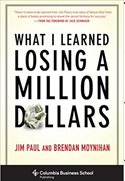
The backdrop of this book is the true story of a trader called Jim Paul. His career in stock market started with a string of unusual successes that vaulted him from a dirt-poor country boy to jet-setting-millionaire. However, after 15 years of uninterrupted success, all of Jim’s wealth was wiped out in a matter of few weeks when he lost $1.6 million in a speculative trade. This devastating failure led him to intense self-reflection and discovery of some unusual insights about success and failure.
[show_to accesslevel=’almanack-all’]
Success has a tendency to lay the foundation of failure. But only if you let it. And you let it by being ignorant to the psychological distortions that inevitably come with success. Morgan Housel, in his recent blog post, wrote –
The more successful you are at something, the more convinced you become that you’re doing it right. The more convinced you are that you’re doing it right, the less open you are to change. The less open you are to change, the more likely you are to tripping in a world that changes all the time.
This is particularly true in financial markets where meteoric success plants the seeds of a precipitous fall. Which means the success should make you extra-vigilant than overconfident. Jim writes –
…the rise sets up the fall; the winning sets up the losing. You can’t really be set up for disaster without having it preceded by success. If you go into a situation in a neutral position having neither successes nor failures beforehand, you acknowledge that your odds are maybe fifty-fifty; you may have a winner, you may have loser. But if you start from scratch and have a run of successes, you are setting yourself up for the coming failure, because the successes lead to a variety of psychological distortions. This is particularly true if you have unknowingly broken the rules of the game and won anyway. Once that happens to you, you think that you are somehow special and exempt from following the rules.
All new investors want to know how the wealthy investors made their money in stock market. They want to know the winning strategies. And it’s not their fault because in most other fields, studying the patterns of success is a standard way to learn. Not in financial markets. In his search, Jim discovered that listening to success strategies led to further confusion. All successful investors and traders made money in widely varying ways and more often than not, their strategies contradicted each other. If one market pro swore by his winning method, another successful market pro opposed it ardently.
Jim’s Aha! moment arrived when it finally occurred to him that studying losses, losing and how not to lose was more important than studying how to make money. He writes –
Why was I trying to learn the secret to making money when it could be done in so many different ways? I knew something about how to make money; I had made a million dollars in the market. But I didn’t know anything about how not to lose. The pros could all make money in contradictory ways because they all knew how to control their losses. While one person’s method was making money, another person with an opposite approach would be losing — if the second person was in the market. And that’s just it; the second person wouldn’t be in the market. He’d be on the sidelines with a nominal loss. The pros consider it their primary responsibility not to lose money.
The moral, of course, is that just as there is more than one way to deal blackjack, there is more than one way to make money in the markets. Obviously, there is no secret way to make money because the pros have done it using very different, and often contradictory, approaches. Learning how not to lose money is more important than learning how to make money. Unfortunately, the pros didn’t explain how to go about acquiring this skill. So I decided to study loss in general, and my losses in particular, to see if I could determine the root causes of losing money in the markets.
Charlie Munger, Buffett’s partner, adds his own spin to this idea. He says, “All I want to know is where I am going to die so that I will never go there.”
You can discover immense wisdom in Charlie’s “Inversion Principle” provided you can understand and appreciate what Munger is trying to convey through his wisecrack.
And this is what Jim’s book is all about – understanding why it’s much more important to learn from common causes of failure than studying the successes.
As the saying goes – success is a bad teacher. You only learn from your failures.
Don’t Lose Money
Warren Buffett’s first rule of investing says – Don’t lose money. Buffett didn’t mean that one should avoid all kinds of losses. In investing, business and especially in life, some losses are simply unavoidable and some are even essential. Jim writes –
You don’t win every point in every game in every set in every match in tennis; you win some and you lose some. There will be lots of losses, just as there are losses in any business. Former Citicorp CEO Walter Wriston said that a lender who doesn’t have loan losses isn’t doing his job. And it’s the truth. Trying to avoid taking losses altogether is the loser’s curse. But the losses you are trying to avoid are the ones for which you hadn’t made allowances, the ones which sneak up on you and the ones which ultimately put you out of business.
Winning is overwhelmingly a mastery of losing, writes Morgan Housel, in his post on this very same book. He adds –
It’s true as well for businesses. Few companies have mastered failure as well as Amazon. It views loss as an inevitable part of trying something new, and something to learn from. Jeff Bezos said of its flopped Fire phone: “If you think that’s a big failure, we are working on far bigger failures. I am not kidding. Some of them are going to make the Fire Phone look like a tiny little blip.” The trick is a combination of ensuring that no single investment can wipe you out, and learning to deal with the psychological torment that comes from being humbled by the majority of your decisions turning against you. It’s learning how to lose, and accepting loss as a normal part of the process.
The losses which are unexpected and have the potential to bankrupt you are the ones which need to be avoided. In investing, it means not putting all your money on a single stock and being aware of the primary sources of risk in a business.
Anatomy of A Loss
There are negative connotations attached to the word loss. It’s considered as a synonym to failure. The words loss, wrong, bad, and failure are all regarded as same. So when someone loses money in the stock market, he invariably equates it to being wrong.
Somehow, the concepts profit and loss get confused with win and lose, and right and wrong. But if you lose as a participant of a game, you weren’t wrong; you were defeated. If you lose as a spectator of a game, you must have placed a bet (or expressed an opinion) on the game’s outcome and you lost money (or were wrong); but you were not defeated.
Similarly, when someone makes a profit, it’s assumed that the person was right. But in the stock market, being right and making a profit aren’t necessarily the same thing. And being wrong and incurring a loss aren’t same either.
Success can be built upon repeated failures when the failures aren’t taken personally; likewise, failure can be built upon repeated successes when the successes are taken personally…Personalizing successes sets people up for disastrous failure. They begin to treat the successes totally as a personal reflection of their abilities rather than the result of capitalizing on a good opportunity, being at the right place at the right time, or even being just plain lucky. They think their mere involvement in an undertaking guarantees success. This phenomenon has been called many things: hubris, overconfidence, arrogance. But the way in which successes become personalized and the processes that precipitate the subsequent failure have never been clearly spelled out.
In other words, successes and failures get personalised when the ego gets involved.
Right and wrong are inappropriate for the description of business operations and market participation, and so are the terms win and lose. Participating in markets is not about being right or wrong, nor is it about defeat; it’s about making decisions. Decision-making is a process of reaching a conclusion after careful consideration; it is a judgment; a choice between alternatives when all the facts are not yet, and cannot yet, be known because they depend on events unfolding in the future. In 20-20 hindsight decisions might be good or bad, but not right or wrong. With regard to the markets, only expressed opinions can be right or wrong. Market positions are either profitable or unprofitable, period. But due to the vocabulary quirks, it is easy to equate losing money in the market with being wrong. In doing so, you take what had been a decision about money (external) and make it a matter of reputation and pride (internal). This is how your ego gets involved in the position. You begin to take the market personally, which takes the loss from being objective to being subjective. It is no longer a loss of money, but a personal loss to you. An example of personalizing market positions is people’s tendency to exit profitable positions and keep unprofitable positions. It’s as if profits and losses were a reflection of their intelligence or self-worth; if they take the loss it will make them feel stupid or wrong. They confuse net-worth with self-worth.
When you decouple the ego from a failure, it creates an opportunity for you to learn from it. In the same vein, separating the ego from success saves you from future disasters.
Conclusion
Nassim Taleb, the author of widely popular book Fooled by Randomness, is my favorite author and probably one of the smartest investment thinker alive. He likes to use the word Charlatan a lot. Charlatans, according to Taleb, are recognizable in that they give you positive advice, and only positive advice. Yet, in practice, it is the negative that’s used by the pros. Taleb is a big proponent of the Via Negative philosophy which says – the learning of life is about what to avoid.
The greatest and most robust contribution to knowledge, says Taleb, “consists in removing what we think is wrong…negative knowledge (what is wrong, what does not work) is more robust to error than positive knowledge (what is right, what works)..disconfirmation is more rigorous than confirmation…via negativa is part of the classical wisdom.”
True to his own philosophy this is what Taleb had to say about Jim’s book – One of the rare non-charlatanic books in finance. That’s Taleb’s way of saying, “If you want to increase your odds of failure, skip this book.”
To that, I have nothing to add.
[/show_to] [hide_from accesslevel=’almanack-all’]- Spotlight: Big ideas from Value Investing and why applying them in your investment decision making will be a great deal
- InvestorInsights: Interviews with experienced value investors, learners, and deep thinkers
- StockTalk: Thorough analysis of business models of companies (without any recommendations)
- Behaviouronomics: Deep analysis of human behaviour and how it impacts investment decision making
- BookWorm: Reviews of the best books on Value Investing and related subjects
- Free Course – Financial Statement Analysis for Smart People (otherwise priced at Rs 5,900)
- Archives: Instant access to our huge archive from the past three years