
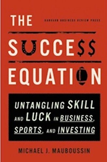
 In the last fifty years, Warren Buffett has recommended quite a few books in his lectures and writings. But there is one book that can boldly claim to have found its way to Warren Buffett’s reading desk. And that book is The Success Equation, authored by Michael Mauboussin.
Michael belongs to the breed of those rare investment strategists who have spent their life puzzling over the really crucial questions in the world of decision making. He is an expert in one of the most debatable topic in the field of business strategy i.e., role of luck in defining the success for an individual as well as an organization.
Apart from being a successful investor, Michael also teaches at Columbia Graduate School of Business. He has authored three other books out of which I have read two and found both of them equally insightful.
Let’s dive straight into the book first.
Many of us have heard the biblical story of David and Goliath. It tells how David, a young shepherd was pitted against a ferocious warrior named Goliath. David accepted the challenge when Goliath invited him for one to one fight. David was clearly an underdog. However, everybody was stunned when David killed the giant Goliath with a slingshot.
The truth is that it’s not easy to recognize the remarkable war strategy hidden inside the story. What strategy?
I’ll let you live with the curiosity for few more minutes and reveal the secret little later in this article.
The world we live in today has become terribly interconnected. This introduces a high degree of complexity which in turn leads to lot of randomness and unpredictability in the outcomes of events. When this randomness operates at an individual level, it translates to either good or bad luck.
[show_to accesslevel=’almanack-all’]
But before you accuse me for generalizing everything, allow me to accept that not everything is complex and convoluted. There are still many situations which are fairly simple and usually have predictable outcomes.
The real trick however is to not only differentiate between the two kinds of situations but to acknowledge that this differentiation doesn’t usually come with recognizable boundaries. The complexion of reality is a blend of skill and luck both.
Skill Luck Continuum
Let’s meet our first protagonist here i.e., luck. Michael defines luck as –
Luck is a chance occurrence that affects a person or a group. Luck can be good or bad. Furthermore, if it is reasonable to assume that another outcome was possible, then a certain amount of luck is involved. In this sense, luck is out of one’s control and unpredictable.
Skill is defined as the ability to apply one’s knowledge readily and execution to performance. Some activities like playing musical instruments or chess allow almost no luck. Other activities like poker or investing are embedded with large quantities of luck, and skill here mostly pertains to an ability to make sound decisions. The litmus test to find out any involvement of skill in an activity is this: ask whether you can lose on purpose.
Skill-luck continuum is an imaginary linear scale where on the far right are activities that rely purely on skill such as running, swimming, chess, etc. On the far left are activities that depend on luck and involve no skill. Roulette or the lottery are few examples.
In skill dominated situations, following a good process almost always leads to a good outcome. In a luck dominated world, a good process also leads to a good outcome but only over time.
On the skill side of the continuum, feedback is clear and accurate, because there is a close relationship between cause and effect. Feedback on the luck side is often misleading because cause and effect are poorly correlated in the short run. Good decisions can lead to failure, and bad decisions can lead to success.
This is the reason why history turns out to be a poor teacher in making a sense out of socio-economic events, because of luck being a dominant force. For that matter most of the history is nothing more than a bunch of manufactured stories polluted by narrative fallacy. The blindness to alternate histories is quite evident in most of the history books.
Reversion to Mean
Another important observed phenomenon in the world of skill and luck is mean reversion. Michael writes –
This [mean reversion] means that you should expect a result that is above or below average to be followed by one that is closer to the average…the expected rate of reversion to the mean is a function of the relative contributions of skill and luck to a particular event. If what happens is mostly the result of skill, then reversion toward the mean is scant and slow…If the outcome is mostly due to luck, reversion to the mean will be pronounced and quick.
Interesting thing to note here is that activities lying on extreme left of the continuum, i.e., luck heavy, revert to the mean faster than the one which are somewhere in the middle. Similarly, skill heavy activities are going to display almost zero reversion to the mean. In other words a chess grandmaster playing against any number of normal players is going to win every single time with no variation in results.
This is a very helpful heuristic in thinking about markets and business performance. If you can place the situation on the continuum with reasonable accuracy, you can be little more confident about predicting the future outcomes.
Paradox of Skill
Dealing with skill is counterintuitive. We just saw that skill side activities in the continuum aren’t affected by luck much. However, if everyone gets better at something, luck plays a more important role in determining who wins.
The paradox of skill is very evident in the field of investing. With thousands of equally smart, knowledgeable and skillful investors pitted against each other, luck has started calling the shots as to who comes out with market beating performance figures especially in short term.
The Arc of Skill
When it comes to tracking the lifecycle of skill in individuals the pattern you discover is interesting. For most of the activities involving physical skill the peak comes at the age of mid to late twenties and then it goes down.
However in activities involving cognitive skills the peak comes much later in one’s life. Statistics say that a typical institutional investor achieves his peak performance around the age of 42 to 45 years.
Interestingly, corporate performance and company lifecycle also follow an arc of skill. Recent researches have validated that in spite of some companies enjoying sustained superior performance, the rate of reversion to the mean seems to be accelerating. This is a valuable insight for estimating the future cash flows of companies.
Power Law and Luck
Unlike professional team sports where we saw that luck plays a dominant role, there are certain situations where luck can distort the outcome by a disproportionately large margin. Things like book sales, website popularity, and few other similar socially driven phenomena follow something called power law.
So less than one percent of the books published command more than ninety five percent of overall book sales, or less than two percent of the people control more than ninety percent of the wealth in the world. This kind of distribution is called power law distributions. In these cases an initial small lead created by luck followed by strong positive feedback loops ends up creating huge cumulative advantages.
…it should be clear that when forces of social influence are at work, we get positive feedback that makes the strong get stronger and the weak get weaker. Who benefits from this process of amplification has a lot to do with luck…so luck also manipulates our perception of skill.
The “Living in alternate universes with Music Labs” experiment described in the book is a remarkable piece of research. It reveal a shocking fact that most of experts in music industry have very little clue about the next hit singer or album.
People who work in businesses where social influence operates are often paid for good luck, although they generally don’t suffer symmetrically from bad luck…Many finance professional including bankers, traders, and brokers, collected outsized pay when the markets were ascending [2007-2009 financial crisis], capitalizing on good luck.
The above text from the book underscores our fallibility for fundamental attribution error, i.e. our tendency to base our explanation of what happens on an individual’s skill rather than the situation.
Improving Performance
It should be obvious by now that the approach you should adopt to get better in a particular task depends a lot on where that task lies on the skill-luck continuum.
When you are dealing with skill heavy tasks, deliberate practice improves skill because here the environment is stable and you get instant and reliable feedback. Reliable feedback a strong link between cause and effect is essential.
The concept of deliberate practice was made popular by Malcolm Gladwell in his book Outliers where he spoke about the 10,000 hour rule for achieving mastery in any activity. Of course most people who tout endlessly about the deliberate practice model forget to talk about its scope i.e., availability of effective feedback.
As you start sliding down in the continuum towards luck you have lesser and lesser control which necessitates that you stick to a process and hope to do well over time. A good process includes a sound analysis along with an awareness of human irrationality.
Checklists are another great discovery in the recent times which has proved to be tremendously useful in reducing the randomness caused by avoidable human errors.
Checklists have firmly established their relevance and tremendous utility by improving the results in multiple fields including aviation, surgery and of course investing
Turning Randomness into Good Luck
I hope you haven’t forgotten about the David and Goliath, and the secret war strategy. Here is the essential point of that story –
David did not engage in hand-to-hand combat as Goliath expected. He saw that getting close to the giant would be suicidal. So he changed his strategy. The lesson of David’s success and Goliath’s failure is even more general. When competing one-on-one, follow two simple rules: If you’re the favorite, [Goliath] simplify the game. If you are the underdog, make it more complicated. David’s chance of success going toe-to-toe with Goliath would have been very slim. But by competing in a different way he shifted the odds in his favor.
So the trick is that randomness dilutes the advantage of skill in a competitive interaction. This is very useful approach in sports, business and war, and yet many people are either unaware of it or afraid of failure in trying out an unconventional strategy.
Reminds me of this internet joke -”How do you defeat Tiger Woods? Well, the first step is to avoid playing Golf with him.”
Conclusion
In this superbly written book, Michael Mauboussin has gone beyond the general notion that luck is important. He has provided a blueprint to enhance the understanding about limitations of skill and the role of luck in real life situations. The book is full of deep analytical insights to explain the central point. For that matter, you might have to read the book more than once to completely grasp the ideas presented.
It’s a fascinating book that forces you to reflect on your decision making process.
Let me remind you this book review should not be replacement for the book itself. My intention here is to merely expose you to few key ideas from the book and arouse sufficient curiosity in your mind. I hope you get your own copy of the book and read it cover to cover.
If this book deserves to be on Buffett’s desk, there is no reason you shouldn’t have this in your bookshelf too.
[/show_to] [hide_from accesslevel=’almanack-all’]- Spotlight: Big ideas from Value Investing and why applying them in your investment decision making will be a great deal
- InvestorInsights: Interviews with experienced value investors, learners, and deep thinkers
- StockTalk: Thorough analysis of business models of companies (without any recommendations)
- Behaviouronomics: Deep analysis of human behaviour and how it impacts investment decision making
- BookWorm: Reviews of the best books on Value Investing and related subjects
- Free Course – Financial Statement Analysis for Smart People (otherwise priced at Rs 5,900)
- Archives: Instant access to our huge archive from the past three years