
This collection of stories of 8 terrific CEOs proves that the outsider approach to resource allocation offers a proven method for navigating the unpredictable, untidy world of business. These outsiders have generated exceptional results across a wide variety of industries and market conditions.
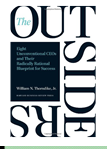
It’s a known fact that Warren Buffett reads hundreds of books every year but when it comes to making book recommendation publicly, he’s very conservative. However, every once in a while he comes out with few book recommendations in his annual letters.
In his 2013 letter to shareholders, Buffett recommended –
“The Outsiders, , by William Thorndike, Jr., is an outstanding book about CEOs who excelled at capital allocation. It has an insightful chapter on our director, Tom Murphy, overall the best business manager I have ever met.
One of the most important questions that an investor needs to answer while making an investment decision is – How to measure a CEO’s performance? Conventional wisdom says, it’s active oversight of business operations, regular communication with research analysts, and an intense focus on stock price. But is it right?
[show_to accesslevel=’almanack-all’]
Thorndike argues that it’s the increase in a company’s per share value, however, not growth in sales or earnings or employees, that offers the ultimate barometer of a CEO’s greatness. He writes –
CEOs need to do two things well to be successful: run their operations efficiently and deploy the cash generated by those operations. Most CEOs focus on managing operations, which is undeniably important…CEOs have five essential choices for deploying capital – investing in existing operations, acquiring other businesses, issuing dividends, paying down debt, or repurchasing stock—and three alternatives for raising it – tapping internal cash flow, issuing debt, or raising equity.
As Buffett has observed, very few CEOs come prepared for this critical task of efficient capital allocation –
The heads of many companies are not skilled in capital allocation. Their inadequacy is not surprising. Most bosses rise to the top because they have excelled in an area such as marketing, production, engineering, administration, or sometimes, institutional politics. Once they become CEOs, they now must make capital allocation decisions, a critical job that they may have never tackled and that is not easily mastered. To stretch the point, it’s as if the final step for a highly talented musician was not to perform at Carnegie Hall, but instead, to be named Chairman of the Federal Reserve.
In this book, Thorndike writes about eight terrific CEOs who did these two things – running operations efficiently and deploying the cash generated – well for a long time and hence made their shareholders very wealthy.
These are the 8 CEOs who feature in Thorndike’s book –
1. Tom Murphy (Capital Cities Broadcasting)
2. Henry Singleton (Teledyne)
3. Bill Anders (General Dynamics)
4. John Malone (TCI)
5. Katharine Graham (The Washington Post Company)
6. Bill Stiritz (Ralston Purina)
7. Dick Smith (General Cinema)
8. Warren Buffett (Berkshire Hathaway)
Let’s look at few of them and their approach to shareholder value creation.
Henry Singleton
Singleton ran Teledyne for almost thirty years, and the annual compound return to his investors was an extraordinary 20.4 percent. This is what Warren Buffett said about Singleton –
Henry Singleton has the best operating and capital deployment record in American business…if one took the 100 top business school graduates and made a composite of their triumphs, their record would not be as good as Singleton’s.
To say that Singleton had an unusual background for a CEO, would be an understatement.
A world-class mathematician who enjoyed playing chess blindfolded, he had programmed MIT’s first computer while earning a doctorate in electrical engineering.” writes Thorndike. “During World War II, he developed a “degaussing” technology that allowed Allied ships to avoid radar detection, and in the 1950s, he created an inertial guidance system that is still in use in most military and commercial aircraft. All that before he founded a conglomerate, Teledyne, in the early 1960s and became one of history’s great CEOs.”What made him a great shareholder value creator? This –
…he aggressively repurchased his stock, eventually buying in over 90 percent of Teledyne’s shares; he avoided dividends, emphasized cash flow over reported earnings, ran a famously decentralized organization, and never split the company’s stock, which for much of the 1970s and 1980s was the highest priced on the New York Stock Exchange (NYSE). He was known as “the Sphinx” for his reluctance to speak with either analysts or journalists, and he never once appeared on the cover of Fortune magazine.
Singleton eschewed detailed strategic plans, preferring instead to retain flexibility and keep options open.
I know a lot of people have very strong and definite plans that they’ve worked out on all kinds of things,” explained Singleton in one of his annual meetings, “but we’re subject to a tremendous number of outside influences and the vast majority of them cannot be predicted. So my idea is to stay flexible. My only plan is to keep coming to work. … I like to steer the boat each day rather than plan ahead way into the future.
When the share price was below the intrinsic value Singleton bought back shares. If it was overvalued, he used it as a currency to acquire other businesses.
Many of the distinctive tenets of Warren Buffett’s unique approach to managing Berkshire Hathaway were first employed by Singleton at Teledyne. Phil Fisher, a famous investor, once compared companies to restaurants—over time through a combination of policies and decisions (analogous to cuisine, prices, and ambience), they self-select for a certain clientele. By this standard, both Buffett and Singleton intentionally ran highly unusual restaurants that over time attracted like-minded, long-term-oriented customer/shareholders.
The Turnaround
When Bill Anders assumed the helm at General Dynamics in January 1991, General Dynamics had $600 million of debt, had negative cash flow, and faced conjecture about a possible bankruptcy. The company had revenues of $10 billion and a market capitalization of just $1 billion. It was an ill positioned company in a declining US defence industry.
In other words, the only thing it needed was a turnaround. Unfortunately, turnarounds seldom turn, opines Buffett.
But Bill Anders had a background of an astronaut and served as the lunar module pilot on the 1968 Apollo 8 mission. After orbiting the moon, mundane business problems did not faze him.
In less than three years, Anders had dramatically streamlined operations, sold off over half of his company, generated $5 billion in proceeds, and, rather than re-deploying the cash into R&D or new acquisitions, returned most of it to shareholders, using innovative, tax-efficient techniques.
Each of these moves were unheard of in the defense industry and created tremendous value for shareholders. It is extremely rare to see a public company willingly shrink itself in a systematic manner. It is similarly rare to see a company take the route of special dividends and share repurchases to systematically return proceeds to shareholders.
There were two key factors behind General Dynamics’ turnaround. Decentralizing the organization and aligning management compensation with shareholders’ interests.
“When it came to capital allocation, Anders and his successors made consistently, often radically, different decisions than their largest peers,” writes Thorndike, “time when his peers were on an acquisition binge, Anders, as we’ve seen, was an active seller. He made no acquisitions, spent very little on capital expenditures, and made savvy use of dividends and share repurchases, both of which were new to the industry.”
A dollar invested when Anders took the helm would have been worth $30 seventeen years later. With Ander’s leadership and shareholder focus, General Dynamics’ resurrection was not only exceptional but an impeccable blueprint for businesses needing a turnaround.
A Widow Takes the Helm
After her husband’s tragic death in 1963, Katharine Graham found herself thrust unexpectedly into the role of CEO of The Washington Post Company. She inherited a business that had a portfolio of media assets, including the Post itself, Newsweek magazine, and three television stations.
Early in her career, she started taking bold decisions. In spite of a threat from Richard Nixon administration she went ahead and published highly controversial (and negative) internal Pentagon assessment of the war in Vietnam which even New York Times was barred from publishing. She even covered the extraordinary Watergate scandal and Post’s intensive investigative coverage won a Pulitzer prize. She believed in doing the right thing.
Her approach was characterized by industry-low levels of dividends and debt, an industry-high level of stock repurchases, relatively few acquisitions, and a careful approach to capital expenditures. Under Warren Buffett’s tutelage Graham made the unconventional decision of aggressively repurchasing 40% of company’s shares at rock bottom prices.
Graham was generally averse to debt, and during her tenure, the Post consistently maintained the most conservative balance sheet among its peers. Graham raised significant debt only a few times during her tenure, most notably to finance the 1986 purchase of the Capital Cities cable systems. The Post’s strong cash flow, however, allowed the bulk of this debt load to be paid down in less than three years.
Most of the Post’s acquisitions under Graham would lead the company into new businesses, unrelated to newspapers or broadcasting, where competition was less intense and valuations more reasonable.
Like Buffett’s Berkshire, Post Company very rarely sold operating businesses preferring the long-term direct ownership model. Throughout her tenure, Graham maintained a minimal level of dividends, believing them to be tax inefficient.
Defying all the odds – from the time of the company’s IPO in 1971 until she stepped down as chairman in 1993 – the compound annual return to shareholders was a remarkable 22.3 percent.
If you want to learn more from this outsider CEO, you should consider reading her Pulitzer Prize winning autobiography –Personal History.
The Outsider Checklist
To aid in making effective resource allocation decision, here is a checklist based on the experience of these outsider CEOs –
• The allocation process should be CEO led, not delegated to finance or business development personnel.
• Start by determining the hurdle rate—the minimum acceptable return for investment projects. Hurdle rates should be determined in reference to the set of opportunities available to the company, and should generally exceed the blended cost of equity and debt capital.
• Calculate returns for all internal and external investment alternatives, and rank them by return and risk (calculations do not need to be perfectly precise). Use conservative assumptions. Projects with higher risk (such as acquisitions) should require higher returns.
• Calculate the return for stock repurchases. Require that acquisition returns meaningfully exceed this benchmark. Repurchases can also destroy value if they are made at exorbitant prices.
• Focus on after-tax returns, and run all transactions by tax counsel.
• Determine acceptable, conservative cash and debt levels, and run the company to stay within them.
• Consider a decentralized organizational model. What is the ratio of people at corporate headquarters to total employees—how does this compare to your peer group?
• Retain capital in the business only if you have confidence you can generate returns over time that are above your hurdle rate.
• If you do not have potential high-return investment projects, consider paying a dividend. Be aware, however, that dividend decisions can be hard to reverse and that dividends can be tax inefficient.
• When prices are extremely high, it’s OK to consider selling businesses or stock. It’s also OK to close under-performing business units if they are no longer capable of generating acceptable returns.
Conclusion
When you compare the value of a dollar invested with the outsider CEOs, numbers speak for themselves.
The outsider approach to resource allocation offers a proven method for navigating the unpredictable, untidy world of business, one that has generated exceptional results across a wide variety of industries and market conditions.
If you are an investor, all you need to do is find one such outsider and initiate a long term partnership with him. There couldn’t be a way simpler than this to secure your financial future.
Let me wrap up here with my standard disclaimer.
Reading this book review is by no means a replacement for the book. This is meant to rekindle the fire of curiosity inside you. I am sure the bookworm in you will find this book worth reading.
The importance of reading books can never be overemphasized. The purpose of reading isn’t just for becoming more knowledgeable but to become a better human being. Remember, there is no secret to reading more. It’s all about the game of setting the right priorities. You just have to change your perception so that reading becomes an extension of who you are and what you do.
Happy reading!
[/show_to] [hide_from accesslevel=’almanack-all’]- Spotlight: Big ideas from Value Investing and why applying them in your investment decision making will be a great deal
- InvestorInsights: Interviews with experienced value investors, learners, and deep thinkers
- StockTalk: Thorough analysis of business models of companies (without any recommendations)
- Behaviouronomics: Deep analysis of human behaviour and how it impacts investment decision making
- BookWorm: Reviews of the best books on Value Investing and related subjects
- Free Course – Financial Statement Analysis for Smart People (otherwise priced at Rs 5,900)
- Archives: Instant access to our huge archive from the past three years