
Pat Dorsey’s book is one of the most important text that you can read to untangle the puzzle of moat and competitive advantages.
 Warren Buffett, in his 1987 letter to shareholders, while talking about GEICO, gave a new meaning to the word ‘Moat’. He wrote –
“The difference between GEICO’s costs and those of its competitors is a kind of moat that protects a valued and much-sought-after business castle…He [Bill Snyder, chairman of GEICO] continually widens the moat by driving down costs still more, there by defending and strengthening the economic franchise.”
Moat is a metaphor for companies having durable competitive advantage. Pat Dorsey, in this wonderful book The Little Book That Builds Wealth, explains –
“There are lot of ways to make money in the stock market. You can play the Wall Street game, keep a sharp eye on trends, and try to guess which companies will beat earnings estimates each quarter, but you’ll face quite a lot of competition.
You can buy strong stocks with bullish chart patterns or superfast growth, but you’ll run the risk that no buyers will emerge to take the shares off your hands at a higher price. You can buy dirt-cheap stocks with little regard for the quality of the underlying business, but you’ll have to balance the outsize returns in the stocks that bounce back with the losses in those that fade from existence.
Or you can simply buy wonderful companies at reasonable prices, and let those companies compound cash over long periods of time. Surprisingly, there aren’t all that many money managers who follow this strategy, even though it’s the one used by some of the world’s most successful investors. (Warren Buffett is the best-known.)”
[show_to accesslevel=’almanack-all’]
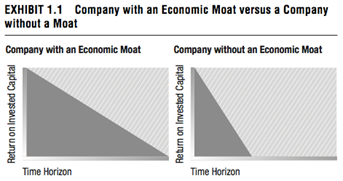
Just as moats around medieval castles kept the opposition at bay, economic moats protect the high returns on capital enjoyed by the world’s best companies.
If you want to understand the concept of economic moats, I suggest, read this book as soon as possible. However, to get your feet wet, let me highlight some of the ideas discussed in the book. But you have to promise me that you will get your own copy of the book and read it cover to cover. Deal?
Why Moat?
So why investors should be worried about moat? Here are few reasons Mr. Dorsey has listed out in his book –
• When you invest your money in strong moats, the likelihood of permanent capital loss is extremely low.
• Companies with moats have greater resilience and are more likely to recover from temporary troubles.
• Moats can help you define your circle of competence. Restricting your universe of investable companies to high quality moats makes the investment process much simpler.
And the biggest reason for investing moats is that it increases the value of companies, as shown in this exhibit
 Before you get over-charmed with the goodness of moat, it’s important to be aware of illusionary competitive advantage also.
False Moats
If you think a great management can create a strong moat, you’re wrong. In business world, unlike horse racing, jockey is less important than the horse.
A strong management team may very well help a company perform better – and all else equal, you’d certainly rather own a company run by good managers than one managed by an incompetent leader – but having a smart person at the helm is not a sustainable competitive advantage.
There is no fool proof way to measure that the CEO’s actions had a direct impact on a company’s performance. That’s why assessing managerial brilliance is far easier with the advantage of hindsight. Picking great managers is unlikely to be a useful forward-looking endeavour.
Similarly, great products, strong market share, great executing, etc., are all mistaken moats. All these characteristics are nice to have but not enough.
So what should you look for when you’re searching for moat? Moat comes from…
Intangible Assets
A company can have intangible assets, like brands, patents, or regulatory licenses that allow it to sell products or services that can’t be matched by competitors. These kinds of assets create a mini-monopoly like situation. However, it may not be easy to spot this because brands can lose their lustre, patents can be challenged, and licenses can be revoked by the same government that granted them.
Also, popular brands aren’t always profitable brands. For a brand to be a formidable moat, the owner of the brand should be able to charge more for the same product that its peers.
When it comes to patents as moats, consider only those companies which have diverse patent portfolios and innovative track records. Companies whose future hinge on a single patented product are risky bets.
Licenses or regulations can be source of moat because it artificially limits the competition. The best kind of regulatory moat is one created by a number of small-scale rules, rather than one big rule that could be changed overnight.
Switching Costs
The products or services that a company sells may be hard for customers to give up, which creates customer switching costs that give the firm pricing power. This is an elegant solution to the complex problem of developing an edge.
One obvious example is your bank. Switching banks isn’t something that you would want to do frequently because of the cumbersome process.
Another way switching costs create moat is when companies make it tough (intentionally or unintentionally) for customers to use a competitor’s product or service. There are several examples of such businesses in various industries. You can find such businesses from financial services to energy sector to health care.
In the software industry, Oracle is a great example of strong moat. It’s not only difficult but expensive (and potentially very risky) for enterprise customers to switch to another database.
However, consumer-oriented firms such as retailers, restaurants, and packaged-goods companies have low switching costs, which make it very hard for them to create moats. They can always create moats by virtue of economies of scale or brand power but switching costs don’t help them.
Network Effect
Some lucky companies benefit from network economics, which is very powerful type of economic moat that can lock out competitors for a long time.
Businesses that benefit from the network effect are such, where the value of their product or service increases with the number of users. Network based businesses tend to create natural monopolies and oligopolies.
A prime example would be credit card networks like Visa, MasterCard, or Amex. The more places you can use your Visa card, the more valuable that card becomes to you. The huge network of merchants is what gives Visa a competitive advantage against new entrants.
Do you remember the social networking sites of yesteryears? Orkut and Myspace? If all your friends are on Facebook, you have no choice but to switch to Facebook. It’s next to impossible for any new player to compete with Facebook. Huge network effect moat!
Think about Microsoft. Lots of people use MS Word, Office, and Windows because, well, lots of people use Word, Office, and Windows. The massive user base means that you pretty much have to know how to operate a Windows-based PC to survive in corporate world.
Network effect is much more common among businesses based on information or knowledge transfer than among businesses based on physical goods.
Cost Advantages
Companies can dig moats around their businesses by having sustainable lower costs than competition. Cost advantages matter most in industries where price is a big part of the customer’s purchase decision.
Some companies have cost advantages, stemming from process, location, scale, or access to a unique asset, which allow them to offer goods or services at a lower cost than competitors.
Be warned for what one company can invent, another can copy. That’s why process based cost advantages are less durable as compared to location-based cost advantages. For that matter, low costs based on ownership of some unique assets are much more durable (like ownership or oil wells supports, not just a business but whole countries in the Middle East)
Eroding Moats
The world is not a static place. This is why it is critical to continually monitor the competitive position of the companies in which you have invested, and watch for signs that the moat may be eroding.
One of the threats that you should be on a lookout for is the threat of technological disruption. For example Kodak’s dominance for photographic film was destroyed by digital photography. Similarly, Internet has done irrevocable damage to the business of distributing daily news, or for that matter think about the impact Internet has had on the music industry and the long distance telephony.
Growth is not always good. It’s better for a company to make lots of money doing what it is good at, and give the excess back to shareholders, than it is to throw the excess profits at a questionable line of business with no moat. Sometimes companies start venturing out in unrelated areas, which can hurt the original moat.
Another sign of an eroding moat is a pushback from customers against raise in prices (look at Noida Toll Bridge).
Finding Moats
Some industries are brutally competitive and have awful economics, and creating a competitive advantage is extremely hard. Other industries are much less competitive, and even average companies are able to sustain solid returns on capital.
So keep in mind that as an investor, you’ll have better odds hunting for ideas in such less competitive industries.
Another point worth noting is that moats are absolute, not relative. The fourth-best company in a structurally attractive industry may very well have a wider moat than the best company in a brutally competitive industry.
What use is a moat if you don’t know when to buy it? So the most important question, after you identify a moat, is – what price to pay for the moat? Even the best company will hurt your portfolio if you pay too much for it. Dorsey writes –
Buying stocks with low valuations helps insulate you from the market’s whims, because it ties your future investment returns more tightly to the financial performance.
There are couple of useful ideas about importance of few metrics like yield, price-to-sales, price-to-book and P/E ratios to approach the valuation.
Any investment process is incomplete without knowing “when to sell” and there are few interesting insights about it in the penultimate chapter.
Conclusion
Pat Dorsey’s book is a superbly written one which helps you create a framework around competitive advantages. Prof. Sanjay Bakshi said this about Dorsey’s book in his interview with Safal Niveshak in 2012 –
Many years ago, I co-authored a paper on Eicher Motors, which I think your readers would agree is a fantastic company. At the time, in 2008, the stock was selling at a ridiculously low price of Rs 200 per share even though the company had Rs 147 per shares in cash and no debt. That stock now sells at 5,500.
I presented that paper to two investors — both offshore funds. One of them bought it promptly and, over time, Eicher Motors became its best performing position. The other fund bought it too but sold out in less than a year when the stock went up a bit. So, you get two vastly different outcomes from the same stock. The fund that sold out did not have the patience. The other one did. And the fact that I had much more influence over the one which did not, or perhaps could not, exercise patience at the time, tells us something isn’t it?
I learnt a very important lesson from that one. Be patient with great businesses. Let them do the hard work for you. Just sit there.
So, a few years ago, I decided to increase my focus on moats. I enjoyed the process (and the proceeds) so much that last year I decided to exclusively focus on moats.
In this decision, apart from my own experience of investing in moats over the last 20 years, I was also influenced by….Pat Dorsey, the author of a wonderful book on moats.
Finally, here are a few closing thoughts from Pat Dorsey –
…investing is not just a numbers game…understanding financial statements is necessary, but by no means sufficient…to be a truly good investor, you need to read widely…one annual report is worth 10 speeches by a Federal Reserve Chairman.
A short review like this is definitely not a substitute for the book itself. So please get a personal copy for yourself and read it not just once but multiple times because any book worth reading is worth reading twice. This one surely is!
[/show_to] [hide_from accesslevel=’almanack-all’]- Spotlight: Big ideas from Value Investing and why applying them in your investment decision making will be a great deal
- InvestorInsights: Interviews with experienced value investors, learners, and deep thinkers
- StockTalk: Thorough analysis of business models of companies (without any recommendations)
- Behaviouronomics: Deep analysis of human behaviour and how it impacts investment decision making
- BookWorm: Reviews of the best books on Value Investing and related subjects
- Free Course – Financial Statement Analysis for Smart People (otherwise priced at Rs 5,900)
- Archives: Instant access to our huge archive from the past three years