
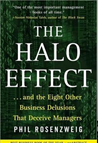
A book about Halo Effect and eight other business delusions that deceive managers. It attempts to answer the question why is it so hard to understand the high performance of an organization or individual.
Rajiv Bajaj, MD of Bajaj auto, said this in one of his talks –
I joined the company [Bajaj Auto] twenty years back. In my college I was trained to think ‘Just in Time’ because it was supposed to be one solution for all the problems. And then somebody said, Just in Time is not enough. They said there must be Kaizen, World class manufacturing, Toyota production system, Kawasaki system, automation and robotics. Then they said you must also know CAD, CAM, simultaneous engineering, re-engineering, six-sigma, TQM, and you must wear six hats, follow seven habits, look for blue oceans, be a bit of a maverick and indulge in management by walking around. Every time I learnt something I found myself back at the starting point. There was always the new book on the shelf, and there was always the new consultant on the seminar circuit. And these guys would do anything to keep themselves in demand and keep all of us confused. So I decided to ignore all of these.
Rajiv Bajaj turned around Bajaj Auto from a loss making company in the year 2000 to the most profitable auto company in world and it’s pretty clear from his talk that he didn’t do it by listening to those management experts and celebrity CEOs who claim to have the next new thing.
[show_to accesslevel=’almanack-all’]
Complexity is the fabric that underlies the world of business today. As a result, in spite of all the secrets formulas and all the self-proclaimed thought leadership, success in business is as elusive as ever. Unlike hard sciences there are no immutable laws in management because managing business isn’t a science. Most theories and expert advice in this field are either anecdotal or riddled with hindsight bias.
So how do you decode the secret behind a company’s performance? This is one of those problems which is better solved backwards. You need to invert the problem. How?
Phil Rosenzweig has the answer. In his book, The Halo Effect,, Phil stands the problem on its head and asks a different question –
Why is it so hard to determine the factors that lead to high performance? Why is it that even clever minds that earnestly want to uncover the secrets of success don’t find solid answers — even when they gather huge amounts of data about hundreds of companies over many years?
Our thinking about business is shaped by a number of delusions, argues Phil, “that distort our understanding of company performance, that make it difficult to know why
one company succeeds and another fails. These errors of thinking pervade much that we read about business, whether in leading magazines or scholarly journals or management bestsellers. They cloud our ability to think clearly and critically about the nature of success in business.”
Most of the so called scientific research in business is nothing but pseudoscience in the garb of storytelling. The author reasons –
…some of the biggest business blockbusters [books, research papers, etc.] of recent years contain not one or two, but several delusions. For all their claims of scientific rigor, for all their lengthy descriptions of apparently solid and careful research, they operate mainly at the level of storytelling. They offer tales of inspiration that we find comforting and satisfying, but they’re based on shaky thinking. They’re deluded.
Once you understand these delusions you would see why the experts — gurus, consultants, professors, and journalists — are so often wrong. It isn’t easy to identify these delusions but they are all around us — in the business press, in academic research, and in recent bestsellers. Let’s explore some of these delusions.
The Halo Effect
Halo effect is the tendency to make inferences about specific traits on the basis of a general impression. It’s a way for the mind to create and maintain a coherent and consistent picture, to reduce cognitive dissonance. .
A simple example would be when you meet a person who looks sharp, handsome and has a great posture, (which are all positive external qualities) it might lead you to make a subconscious judgement about his internal qualities also i.e. you’d think this person to be intelligent and extrovert.
Another example is the way we get influenced by brands. We may not know if a new product is good, but if it comes from a well-known company with an excellent reputation, we might reasonably infer it should be of good quality. That’s what brand building is about.
Rosenzweig writes –
Perhaps nothing lends itself to the Halo Effect more than leadership. Good leaders are often said to have a handful of important qualities: clear vision, effective communication skills, self-confidence, personal charm, and more. Most people would agree these are elements of good leadership. But defining them is a different matter altogether, since several of these qualities tend to be in the eye of the beholder — which is affected by company performance.
And when the fortune turns for the company, experts opine that those very same leaders had lost their focus, became complacent and arrogant.
…you can always find good things to say about leaders at successful companies, and you can always find reasons to criticize leaders of failing firms. A critical reader ought to ask if any successful companies have inauthentic leaders, and if any unsuccessful companies are run by authentic leaders, because if not, it’s quite possible we’re just throwing around Halos.
Put simply, Halo effect is the manifestation of human desire to tell a coherent story.
The Delusion of Correlation and Causality
Even if researchers somehow manage to avoid the Halo effect, they may still not be able to pin down the drivers of high performance. Rosenzweig argues –
Inferring causality from correlation trips up many studies about business. Take something as basic as, say, the relationship between employee satisfaction and company performance. It’s logical to think that having satisfied employees ought to lead to high performance. After all, satisfied employees might be willing to work harder and longer, and might care more about keeping their customers happy. It sounds right. We know not to measure employee satisfaction simply by asking employees, “Are you satisfied?” since the answers will likely be colored by the Halo Effect. But suppose we look at a measure that is not tainted by Halos — say, the rate of employee turnover — and we find a high correlation with performance. Now the challenge is to untangle the direction of causality. Does lower employee turnover lead to higher company performance? Perhaps, since a company with a stable workforce might be able to provide more dependable customer service, spend less on hiring and training, and so forth. Or does higher company performance lead to lower employee turnover? That could be true as well, since a profitable and growing company might offer a more stimulating and rewarding environment as well as greater opportunities for advancement. Knowing which leads to which is critical if managers want to know what to do — how much they should invest in greater levels of satisfaction versus other objectives.
Does X cause Y or Y cause X? Or X and Y are caused by a third variable Z? People don’t realize how difficult it is to determine the direction of the arrow of causality.
Psychologist Edwin Locke made the point emphatically: “While the method of correlation may be useful for the purposes of suggesting causal hypotheses, it is not a method of scientific proof. A correlation, by itself, explains nothing.”
The Delusion of Connecting the Winning Dots
In 1982, Tom Peters and Bob Waterman published a book called In Search of Excellence. . It was based on the study of 43 of the best American companies and prescribed eight common principles that these successful companies were supposedly employing. The book became not just an instant bestseller but a megahit. But how good was their research?
Peters and Waterman studied a sample made up entirely of outstanding companies. The scientific term for this is sample selection based on the dependent variable — that is, based on outcomes. It’s a classic error. Suppose we want to find out what leads to high blood pressure. We’ll never find out if we only examine patients who suffer from high blood pressure; we’ll only know if we compare them to a sample of people who don’t have high blood pressure. The same applies to companies: By looking only at companies that perform well, we can never hope to show what makes them different from companies that perform less well. I call this the Delusion of Connecting the Winning Dots, because if all we compare are successful companies, we can connect the dots any way we want but will never get an accurate picture. Under ideal conditions, of course, we might like to conduct an experiment where we assign different treatments to various subjects and compare results. That’s the ideal way, but it’s not easily done when we’re trying to study company performance. We can’t take 100 companies, ask half to manage according to one set of principles and the other half to manage by a different set, and then compare results. It’s understandable that Peters and Waterman selected their sample after the fact, but if the only companies we study are successful, we have no way of knowing what distinguishes a successful company from an unsuccessful one. All we’ll do is find out the sorts of Halos that people place on successful companies. Which is not a bad way to describe what In Search of Excellence is really all about.
Peters admitted in 2001 that the quantitative data analysis came after they had reached their findings. In simple words, they cherry picked the data to prove their pre-conceived ideas.
The Delusion of Rigorous Research
Jim Collins and Jerry Porras understood that Tom Peters had made a critical error in simply looking for commonality among successful companies. So for their book, Built to Last, which was again about principles derived from best practices of eighteen visionary companies, they went a step further in their research. For each of their visionary companies, they identified a comparison company from the same industry. But they fell for another delusion –
Yet for all their promises of exhaustive research, writes Rosenzweig, Collins and Porras didn’t address a basic problem: the Halo Effect. Much of the data they gathered came from the business press, from books, and from company documents, all sources that are likely to contain Halos. They also conducted interviews with managers, who were asked to look back on their experience and explain the reasons for success, a method likely to be tinged by Halos. And if your data contain Halos, it really doesn’t matter how many cartons you fill.
No wonder, in the ten years from 1991 to 2000, only six out of those visionary companies kept pace with the S&P 500; the other ten didn’t even match the market. You would have been better off investing randomly, concludes Rosenzweig, “than putting your money on Collins and Porras’s Visionary companies.”
Conclusion
The need of the hour for business managers is to think for themselves and independent thinking requires a strong bullshit filter. Knowing about Halo effect and its associated delusions helps you build such a filter.
Some of the other delusions that are discussed in this book include the delusion of lasting success, delusion of absolute performance and the delusion of organizational physics.
The names that Phil has chosen for these delusions give a clue about their nature but you’d have to read the book to understand how exactly these delusions play out in the real world.
Let me wrap up here with my standard disclaimer.
I have selected a very small subset of ideas from the book, so this book review is by no means a replacement for the book. This is meant to rekindle the fire of curiosity inside you. I am sure the bookworm in you will find this book worth reading.
The importance of reading books can never be overemphasized. The purpose of reading isn’t just for becoming more knowledgeable but to become a better human being.
Remember, there is no secret to reading more. It’s all about the game of setting the right priorities. You just have to change your perception so that reading becomes an extension of who you are and what you do.
Happy reading!
[/show_to] [hide_from accesslevel=’almanack-all’]- Spotlight: Big ideas from Value Investing and why applying them in your investment decision making will be a great deal
- InvestorInsights: Interviews with experienced value investors, learners, and deep thinkers
- StockTalk: Thorough analysis of business models of companies (without any recommendations)
- Behaviouronomics: Deep analysis of human behaviour and how it impacts investment decision making
- BookWorm: Reviews of the best books on Value Investing and related subjects
- Free Course – Financial Statement Analysis for Smart People (otherwise priced at Rs 5,900)
- Archives: Instant access to our huge archive from the past three years