
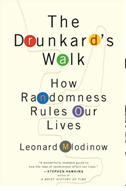
All through our lives, we’re incessantly nudged in unexpected directions by random events. The Drunkard’s Walk is a deep exploration of the subjects of chance, uncertainty, luck, randomness, and probability. It offers useful mental models that will give you a totally new vantage point to look at many aspects of our everyday lives.
[show_to accesslevel=’almanack-all’] If you leave everything to chance you realize that suddenly you don’t have any more luck, goes the adage. The old saying is instructing us that blaming things to luck doesn’t help. But is it a recommendation for ignoring luck, putting our heads down and work hard to change everything? Unfortunately, that wouldn’t work either.
Randomness and uncertainty surround every aspect of our lives and it’s truer today than any other time in the human history. The complexity of the modern world has thrust us into an environment that’s not suited for our natural instincts.
Although, we can’t fight our natural instincts, what we can do is bring awareness towards our vulnerability to randomness.
The first step to create that awareness is to understand the nature of uncertainty that pervades our lives. Leonard Mlodinow’s book The Drunkard’s Walk is a deep exploration of the subjects of chance, uncertainty, luck, randomness and probability.
It offers useful mental models that will give you a new vantage point to look at many aspects of our everyday lives, from winning the lottery to road safety, the truth about the success of sporting heroes and film stars, and even how to make sense of a blood test.
When the famous theoretical physicist Stephen Hawkins, who wrote the massively popular book A Brief History of Time, was bombarded with requests to write a sequel, Hawkins chose Mlodinow as the co-author for the next book called A Briefer History of Time. That’s one more reason why you should read Mlodinow’s books.
Drunkard’s Walk
When a man starts walking, after having one too many shots of tequila, there’s hardly any pattern in his footsteps. Neither there’s any certainty in the direction he would take the next moment. Drunkard’s Walk exemplifies the unpredictability of chance events. Mlodinow explains –
The title The Drunkard’s Walk comes from a mathematical term describing random motion, such as the paths molecules follow as they fly through space, incessantly bumping, and being bumped by their sister molecules.
That can be a metaphor for our lives, our paths from college to career, from single life to family life, from first hole of golf to eighteenth. The surprise is that the tools used to understand the drunkard’s walk can also be employed to help understand the events of everyday life. The goal of this book is to illustrate the role of chance in the world around us and to show how we may recognize it at work in human affairs.
All through our lives, like the granules of pollen floating and jiggling in the air, we’re incessantly nudged in unexpected directions by random events.
The social data and statistics on collective human behaviour may tell you that humans are predictable but when it comes to the future of particular individuals, it’s impossible to predict. For our particular achievements, our jobs, our friends, our finances, we all owe more to chance than many people realize.
Human Perception
Randomness is the fabric of nature. Organisms have evolved over millions of years by thriving on mother nature’s love for randomness. Human perception is a brilliant example of that.
Our senses capture an incomplete picture of what they encounter but when our brain receives the data, it fills the gaps by manufacturing the missing information. Mlodinow writes –
Perception requires imagination because the data people encounter in their lives are never complete and always equivocal. For example, most people consider that the greatest evidence of an event one can obtain is to see it with their own eyes, and in a court of law little is held in more esteem than eyewitness testimony. Yet if you asked to display for a court a video of the same quality as the unprocessed data captured on the retina of a human eye, the judge might wonder what you were trying to put over.
For one thing, the view will have a blind spot where the optic nerve attaches to the retina. Moreover, the only part of our field of vision with good resolution is a narrow area of about 1 degree of visual angle around the retina’s center, an area the width of our thumb as it looks when held at arm’s length. Outside that region, resolution drops off sharply.
To compensate, we constantly move our eyes to bring the sharper region to bear on different portions of the scene we wish to observe. And so the pattern of raw data sent to the brain is shaky, badly pixilated picture with a hole in it. Fortunately the brain processes the data, combining the input from both eyes, filling in gaps on the assumption that the visual properties of neighbouring locations are similar and interpolating. The result a happy human being suffering from the compelling illusion that his or her vision is sharp and clear.
This tendency of our brain – receive noisy data, find patterns and derive a meaningful picture – gave us an evolutionary advantage in the hostile environment of African Savanna. But the same tendency, when applied in today’s modern environment, albeit involuntarily, leads to serious errors of judgement.
Pascals’ Wager and Expected Value
For an investor, the purpose of understanding the concepts of probability is to apply it for making smart bets. One founding pillar for the science of making bets is the idea of expected value.
The 17th-century mathematician, Blaise Pascal is credited for coming with the concept of expected value. He used his discovery to solve a dilemma that he was going through. Pascal reasoned –
Suppose you concede that you don’t know whether or not God exists and therefor assign a 50 percent chance to either proposition. How should you weight these odds when deciding whether to lead a pious life? If you act piously and God exists, Pascal argued, your gain – eternal happiness – infinite. If, on the other hand, God does not exist, your loss, or negative return, is small – the sacrifices of piety.
To weigh these possible gains and losses, Pascal proposed, you multiply the probability of each possible outcome by its payoff and add them all up, forming a kind of average or expected payoff. In other words, the mathematical expectation of your return on piety is one-half infinity (your gain if God exists) minus one-half a small number (your loss if he does not exist). And the expected return on piety is infinitely positive.
Every reasonable person, Pascal concluded, should therefore follow the laws of God. Today this argument is known as Pascal’s wager.
I think Pascal’s wager is the simplest way to explain the idea of expected value.
Randomness and Close Calls
Mlodinow once wrote an English essay for his fifteen-year-old son Alexie’s homework. Being an author of multiple books, he was sure that his essay would fetch his son the highest grade in the class.
Surprisingly, Mrs. Finnegan, the English teacher, didn’t think so and awarded Alexie a lower grade. To comfort his father, Alexie told him about two of his friends who had submitted identical essays and the overworked teacher gave one of the essays an A and the other a C.
Numbers always seem to carry the weight of authority, explains Mlodinow, “If a teacher awards grades on a 100-point scale, those tiny distinctions must really mean something. But if ten publishers could deem the manuscript for the first Harry Potter book unworth of publication, how could poor Mrs. Finnegan distinguish so finely between essays as to award one a 92 and another a 93?
If we accept that the quality of an essay is somehow definable, we must still recognize that a grade is not a description of an essay’s degree of quality but rather a measurement of it, and one of the most important ways randomness affects us is through its influence on measurement. In the case of the essay the measurement apparatus was the teacher, and a teacher’s assessment, like any measurement, is susceptible to random variance and error.”
So next time your kid brings home a report card showing grades little less than what you expected you should tell him that those grades aren’t a measure of his worthiness. Many a time grades tell more about the one who awarded those grades rather than the one who received.
One of the most astonishing places where randomness confuses is election voting. Especially in the close elections where people demand recounts. In 2004 governor’s race in the state of Washington (U.S.), the Democrat candidate won by 261 votes where total 3 million people cast their votes. State law required that in such close cases a recounting should be done. In the recounting, the results reversed when Republican candidate came out ahead by 42 votes. As a result, another recounting was done, this one entirely “by hand.”
The 42-vote victory amounted to an edge of just one vote out of each 70,000 cast, argues Mlodinow, “so the hand-counting effort could be compared to asking 42 people to count from 1 to 70,000 and then hoping they averaged less than one mistake each.
Not surprisingly, the result changed again. This time it favoured the Democrat by 10 votes…Elections, like all measurements, are imprecise, and so are the recounts, so when elections come out extremely close, perhaps we ought to accept them as is, or flip a coin, rather than conducting recount after recount.
The Grave Consequences of Misunderstanding Probability
Probability is a subject which stumps most people. Wearing a probabilistic lens is not easy. It’s very counterintuitive. So, most people ignore it. Who cares? But they don’t realize that experts in critical fields like medical diagnosis and legal judgment are given very little training on probability.
When Sally Clark’s first child died at 11 weeks, doctors reported the cause as sudden infant death syndrome (SIDS) – a diagnosis when an infant dies unexpectedly and post-mortem doesn’t reveal anything.
When Clark gave birth to her second baby, the baby died at 8 weeks, again reportedly of SIDS. When that happened, she was arrested and accused of smothering both children. SIDS being a rare cause, the prosecution argued, the odds of both children dying from it was 1 in 73 million. There was no substantive evidence against Sally Clark but based on just this argument she was sent to prison.
It is not the probability that two children will die of SIDS that we seek but the probability that the two children who died, died of SIDS. Two years after Clark was imprisoned, the Royal Statistical Society weighed in on this subject with a press release, declaring that the jury’s decision was based on “a serious error of logic known as the Prosecutor’s Fallacy.
The jury needs to weigh up two competing explanations for the babies’ deaths: SIDS or murder. Two death by SIDS or two murders are each quite unlikely, but one has apparently happened in this case. What matters is the relative likelihood of the deaths…, not just how unlikely…
Mrs. Clark appealed the case and hired their own statisticians as expert witnesses. Unfortunately, they lost the appeal. Fortunately, they continued to seek medical explanations for the deaths and in the process uncovered the fact that the pathologist working for the prosecution had withheld the fact that the second child had been suffering from a bacterial infection at the time of death, an infection that might have caused the infant’s death.
Based on that discovery, a judge quashed the conviction and Sally Clark was released after having served three years in prison.
Sally Clark’s case doesn’t augur well for common people like us. What if we find ourselves on the wrong side of the mistake committed by these probability-blind medical and legal professionals.
Conclusion
The Drunkard’s Walk is a fascinating read. Mlodinow has not only elaborated the concepts but included historical details about how those ideas took shape and who were the people involved in refining those discoveries. The book is nothing less than a crash course in randomness.
[/show_to] [hide_from accesslevel=’almanack-all’]- Spotlight: Big ideas from Value Investing and why applying them in your investment decision making will be a great deal
- InvestorInsights: Interviews with experienced value investors, learners, and deep thinkers
- StockTalk: Thorough analysis of business models of companies (without any recommendations)
- Behaviouronomics: Deep analysis of human behaviour and how it impacts investment decision making
- BookWorm: Reviews of the best books on Value Investing and related subjects
- Free Course – Financial Statement Analysis for Smart People (otherwise priced at Rs 5,900)
- Archives: Instant access to our huge archive from the past three years