
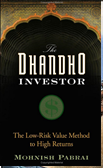
 I am sure most of you already know about Mohnish Pabrai. We had reviewed one of his books “Mosaic” in the previous VIA issue. For the benefit of those who haven’t heard about him, Mohnish runs US$ 850+ million US based hedge fund and is a true Munger-Buffett disciple. He is one of those rare money managers who have structured their funds mimicking the Buffett Partnership.
Mohnish has an eclectic background. He has built three successful businesses in last 25 years including a technology company, a hugely profitable hedge fund and a remarkable philanthropic organization called Dakshana Foundation, which educates talented underprivileged children to qualify for IITs. His success across varied fields is clearly the result of his multi-dimensional thought process which is pretty evident from the insights that he shares in his book.
He is a natural storyteller and has an exceptional skill of making the art of value investing look simple and doable.
The Dhandho Investor was one of the very first few books that I read during my initiation into the world of value investing.
Before diving into the book let’s first demystify the strange word called “Dhandho”. Dhandho is a Gujarati word which is best described as – endeavours that create wealth while taking virtually no risk. Like many other value investors, Mohnish too prescribes a low risk betting strategy.
The Patel Motel Dhandho
The book starts with a fascinating description of “Patel Motel” business. The Gujarati community in the US make up less than 0.2% population but they control more than 50% of the motel business employing nearing a million people and owning over US$ 40 billion in motel assets. The distressed motel industry, low initial investment, easy mortgage and free accommodation were reasons compelling enough to attract the Patel community to motel business. With frugality and extremely low operating costs, Patels turned motels into cash generating machines.
The cash generated by one motel was used to buy another motel and very soon Patels began applying their low cost model to higher-end hotels, gas stations, convenience stores (7-Elevens) etc. The snowball effect over time ended up creating amazing results for the Patel community.
The book includes an explanation of this idea with a simplistic DCF analysis (taking into account various possible outcomes) for a motel business and proves that it was a typical “Heads, I win; tails, I don’t lose much!” bet – a dominating theme in this book.
Other Dhandho Investors
Mohnish goes on to chronicle the adventures of few more well known businessmen like Richard Branson and Lakshmi Mittal. Both of them personify the Dhandho approach.
[show_to accesslevel=’almanack-all’]
The common ingredient in all 200+ businesses under Richard Branson’s Virgin group is that there was very little money invested in any of them at the start-up phase. With minimal downsides, failure rates didn’t matter to him. It was of little concern to him even if half of these ventures failed to scale up. There was no money put into them to begin with.
Mohnish himself applied the Dhandho approach in his career. While continuing his day job, he used his early mornings and after-office hours to build his software company. His company which started with a modest US$ 100,000 of initial investment was sold for US$ 20 million dollars few years later.
Let’s look at some of the principles that constitute the Dhandho framework.
Existing Businesses
Focus on buying an existing business with a well-defined business model, one with a long history of operations. This is far less risky than doing a start-up. Mohnish presents a strong case in favour of buying businesses through stock markets. He believes –
Having an ownership stake in a few businesses is the best path to building wealth. And with no heavy lifting required, bargain buying opportunities, ultra-low capital requirements, ultra-large selection, and ultra-low frictional costs, buying stakes in a few publicly traded existing businesses is the no-brainer Dhandho way to go.
Simple Businesses
Calculating intrinsic value for a given business may not be so simple. The Dhandho way to deal with this problem is to invest in businesses that are simple – ones where conservative assumptions about future cash flows are easy to figure out. How to know that a business is simple? A simple business experiences ultra-slow long-term change. A simple business makes mundane products that everyone needs.
Another hack suggested by Mohnish is quite simple –
I always write the thesis down. If it takes more than a short paragraph, there is fundamental problem. If it requires me to fire up Excel, it’s a big red flag that strongly suggests that I ought to take a pass.
Distressed Situation
Humans are subject to extreme fear and extreme greed, which occasionally creates pockets of inefficiency in the markets. To exploit this inefficiency, all we need to do is to narrow the universe of candidate businesses down to ones that are understood well and are in distressed state.
When you stumble upon distressed businesses in distressed industries, the odds are high that an investor can pick up assets at steep discounts to their underlying value.
How do you find such distress situations? Business headlines are one such source. Especially negative news, or scams/scandals in certain industry or business. Don’t stop when you find distressed businesses. What’s the next step?
We begin by eliminating all businesses that are either not simple businesses or fall squarely outside our circle of competence. What’s left is a very small handful of simple, well-understood businesses under distress. We are now ready to apply the rest of the Dhandho framework to this select group.
Durable Moats
Patels’ and Mittal’s moats were created by being the lowest-cost producers. Branson’s moat comes from his brand, innovative offering and a brilliant execution. Mohnish writes –
In the overwhelming majority of businesses, the various moats are mostly hidden or only in partial view. It takes some digging to get to the moat…How do we know when a business has a hidden moat and what that moat is? The answer is usually visible from looking at its financial statements. Good businesses with good moats, generate high returns on invested capital.
However, even strongest of moats can wither away. Mohnish warns –
There is no such thing as a permanent moat. Even such invincible businesses today like eBay, Google, Microsoft, Toyota, and American Express will all eventually decline and disappear…Even businesses with durable moats don’t last forever.
Hence estimating future cash flows for more than 10 years is a dubious exercise.
Few Bets, Big Bets, Infrequent Bets
In investing, there is no such thing as sure bet. It’s all about the odds. What’s peculiar about all Dhandho entrepreneurs is that they concentrate their capital and their bets. Most of the time they do nothing but once they encounter overwhelming odds in their favour, they act decisively and place a large bet. Mohnish deploys 5-10% of his assets on each bet.
Joel Greenblatt, an exceptional money manager and inventor of the famous magic formula, typically invests 80% of his assets in his top five portfolio positions. Bottom line, according to Mohnish, is –
If the odds are overwhelmingly in your favour, bet heavily.
Charlie Munger would agrees –
The wise ones bet heavily when the world offers them that opportunity. They bet big when they have the odds. And the rest of the time, they don’t. It’s just that simple.
Prefer Low-Risk High-Uncertainty Business
Dhandho entrepreneurs think through the range of possibilities and draw comfort from the fact that the odds of a permanent loss of capital are extremely low. What does that mean? Well, markets sometimes get confused between risk and uncertainty. Mohnish writes –
Always take advantage of a situation where Wall Street gets confused between risk and uncertainty. The results will usually be quite acceptable…Savvy investors like Buffett and Graham have been taking advantage of Mr Market’s handicap for decades with spectacular results. Take advantage of Wall street’s handicap by seeking out low-risk, high-uncertainty bets.
Mohnish discusses three different case studies (Stewart Enterprises, L3 bonds and Frontline) from his personal portfolio to explain this peculiar characteristic of inefficient markets. And how do you find these interesting risk-uncertainty kinds of opportunities? He recommends –
Read voraciously and wait patiently, and from time to time these amazing bets will present themselves.
Be a Cloner
One of the mental models which Mohnish swears by is cloning i.e., copying the proven strategies that have been tried and tested by other successful people. Cloning is a recurrent theme that you would notice in all his talks and writings.
According to Mohnish, it’s better to be copycat than an innovator. Innovation is a difficult and risky game, but lifting and scaling existing ideas carries far lower risk and decent to great rewards. Thousands of Patels simply copied the motel business model from the first few Patels who had figured it out. Most entrepreneurs lift their business ideas from other existing businesses or from their last employer. In Mohnish’s words –
In seeking to make investments in the public equity markets, ignore the innovators. Always seek out businesses run by people who have demonstrated their ability to repeatedly lift and scale. It is the Dhandho way.
Mohnish himself cloned the Buffett partnership fee structure for Pabrai Funds. It wasn’t something that could be adopted by most mutual funds and hedge funds – even if they recognized the competitive advantage it would bring.
Having a moat that your competitors can see in broad daylight but never ever cross is just fantastic.
Mohnish not only copied the fee structure but copied many other aspects of Buffett’s investing style like not disclosing the portfolio positions and discussing the performance only once a year, very small investment team size, a concentrated portfolio etc.
Conclusion
Apart from the ideas highlighted above, the book is filled with many more nuggets of wisdom including some interesting insights on the art of selling.
There aren’t many people in the hedge fund industry who can match Pabrai’s experience as a successful entrepreneur and astute investor. And he is very humble too. In a recent conversationwith University of Auckland Investment Club, when he was asked what he would like to change in his book, he didn’t shy away from accepting the shortcoming of some of the ideas discussed in the book. He said –
If I were writing the book today, I would add some of the things that I have since learned, such as the investor checklist and the importance of conversations with peers. I would also add the concepts of “cannibals”, “cloning” and spinoffs. I would take out the discussion on the Kelly criterion. It makes sense when you have the ability to make thousands of bets in rapid succession and the law of averages plays out, but if you use that criterion to make two bets a year it doesn’t work. I would keep the rest of the book the same, including the premise that the book is based on, that you are a better investor if you think like a businessman and vice versa.
Please don’t consider this review as a replacement for the book itself. In fact, I guarantee that relying only on this short review will be a risky proposition. This is my attempt to create a nudge for you to get your personal copy and read it from cover to cover.
So buy The Dhandho Investor, read it, re-read it, underline and highlight the text, scribble your thoughts on the margins, make your own notes, and basically own the book. That would be the most effective way to assimilate the learnings.
Note: This book was written in the year 2007 so all the facts and figures quoted are latest up to 2007. Mohnish invests primarily in US markets so some of the things which he has mentioned may not be applicable in Indian context.


- Spotlight: Big ideas from Value Investing and why applying them in your investment decision making will be a great deal
- InvestorInsights: Interviews with experienced value investors, learners, and deep thinkers
- StockTalk: Thorough analysis of business models of companies (without any recommendations)
- Behaviouronomics: Deep analysis of human behaviour and how it impacts investment decision making
- BookWorm: Reviews of the best books on Value Investing and related subjects
- Free Course – Financial Statement Analysis for Smart People (otherwise priced at Rs 5,900)
- Archives: Instant access to our huge archive from the past three years