
When you give yourself permission to steal from the great artists, it takes away the huge burden of the need to be original. And that relief itself, ironically, makes space for original ideas.
Investing, they say, is more of an art than science. And, art by definition, stands on the shoulders of creativity. Where there’s art, there’s creativity. So, any insights that can inject some creativity into one’s life and work, including investing, are worth paying attention.
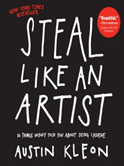
Austin Kleon’s book – Steal Like An Artist– is an illustrated guide that gently touches the various aspects of how creativity takes shape. It’s a manifesto for writers, artists, entrepreneurs, designers, photographers, musicians, and anyone attempting to make things, especially in the digital age.
[show_to accesslevel=’almanack-all’]
The masses believe that creativity and originality are synonymous but nothing can be further from the truth if you listen to the greatest creative artists of the world.
What a good artist understands is that nothing comes from nowhere. All creative work builds on what came before. Nothing is completely original. As the French writer André Gide put it, “Everything that needs to be said has already been said. But, since no one was listening, everything must be said again.
David Bowie, the famous English musician who deliberately reinvented his style multiple times during his five-decade long career, said, “The only art I’ll ever study is stuff that I can steal from.”
When you give yourself permission to steal from the great artists, it takes away the painful burden of the need to be original. And that sense of relief fertilizes the soil on which all innovations, the so-called originality, germinate.
So here are few steal-worthy ideas from Kleon’s book –
Re-Connecting the Dots
Bible says, “There is nothing new under the sun.” (Ecclesiastes 1:9)

Unless you’re a theoretical physicist trying to unravel the secrets of the universe, the problems that you tackle on daily basis don’t require ground breaking solutions. They just need different eyes to look at the same grid of dots and discovering new ways to connect them.
Most new ideas, writes Kleon, “are just mashup or remix of one or more previous ideas. You are, in fact, a mashup of what you choose to let into your life. You are the sum of your influences.”
In investing, cloning is a very useful mental model. It was popularized by Mohnish Pabrai, a very successful value investor. Cloning says that instead of generating original stock ideas to invest in, an investor should find out what other smart investors are investing in and then take those ideas for further investigation. Pabrai has used cloning not just for finding investment ideas but also for how to structure his hedge fund and how to run his philanthropic organization (Dakshana Foundation). He writes –
I have very few original ideas. Virtually everything has been lifted from somewhere.
Cloning doesn’t mean that you should invest only in copied ideas (and without doing your homework) but it’s a very effective strategy to learn about good businesses and finding success patterns. It also reduces the odds of making serious mistakes in investment decision making.
Cloning provides a huge inventory of high-quality dots. All you’ve got to do is find fresh patterns and figure out what works best for you. And unlike other artistic pursuits, in investing, not giving credit to the original source doesn’t have the risk of being accused of plagiarizing.
Capture the Moments of Inspiration
When I was a kid my mother used to tell me that for everyone, once in every 24 hours, goddess Saraswati, who according to Hindu mythology is considered the goddess of knowledge, blesses the tongue. So, whatever a person is uttering in those moments comes true. That was a nice trick to make me understand the importance of choosing our words carefully.
I think that idea of Saraswati is perhaps true when it comes to our thoughts. The thoughts that appear on our mind’s screen are ephemeral and constantly changing. But amid this rapid flux of thoughts, once in a while, everyone encounters astonishingly creative ideas – a gift from goddess Saraswati if you will. Don’t let those unique ideas get washed away with other mundane thoughts. Capture those gems immediately.
Carry a notebook and a pen with you wherever you go. Get used to pulling it out and jotting down your thoughts and observations. Copy your favorite passages out of books. Record overheard conversations. Doodle when you’re on the phone. Go to whatever lengths necessary to make sure you always have paper on you.
Keep a swipe file. It’s just what it sounds like — a file to keep track of the stuff you’ve swiped from others. It can be digital or analog—it doesn’t matter what form it takes, as long as it works…or you can just take pictures of things with your camera phone.
If you’re reading a book with deep concentration, it’s impossible to not get hit with relevant insights every few pages. Capture those moments of inspiration. Make notes in the book itself or use some other productivity tool like Evernote. Technology has made this extremely easy these days.
Heard about the creativity hack of the legendary Indian music composer R.D. Burman? It’s said that he used to sleep with a tape recorder next to his pillow. Sometimes, in the middle of the night, he would wake up humming a totally new tune, which he would promptly record in his tape recorder. He knew that he would forget the tune in the morning. If R.D. Burman in 1980s could do that with his ancient tape recorder, you have no excuse with that super-smartphone clinging to you 24×7.
Who Vs What
Kleon write in his book –

Who to copy is easy. You copy your heroes — the people you love, the people you’re inspired by, the people you want to be….And you don’t just steal from one of your heroes, you steal from all of them. The writer Wilson Mizner said if you copy from one author, it’s plagiarism, but if you copy from many, it’s research. I once heard the cartoonist Gary Panter say, “If you have one person you’re influenced by, everyone will say you’re the next whoever. But if you rip off a hundred people, everyone will say you’re so original!
What to copy is a little bit trickier. Don’t just steal the style, steal the thinking behind the style. You don’t want to look like your heroes, you want to see like your heroes. The reason to copy your heroes and their style is so that you might somehow get a glimpse into their minds. That’s what you really want — to internalize their way of looking at the world.
I once read a fascinating explanation about the importance of copying the work of your heroes. If you are a writer, pick up a piece of writing from your favourite author and write those exact words with your hands. You must experience how it feels when those amazing words flow from your own fingers. It’s called tactical learning. It takes your mind to the state where that author must have been when he was penning down those words. This is how you train your subconscious. This is when your mind starts believing that you too can produce that kind of work.
Here’s an idea for an investor to deploy this trick. Imagine yourself in place of Warren Buffett when he was thinking of buying Coca-Cola stock in 1987. Perhaps he was going through past 10 years of annual reports. Do that. Read Coke’s annual reports from 1977 to 1987.
Creativity is Subtraction
Telling yourself you have all the time in the world, all the money in the world, all the colors in the palette, anything you want—that just kills creativity.
Most lives are filled with too much stuff but what do you really need, not want, to live a happy life? Let’s invert the question. What can you live without?
People think of constraints as giving something up instead of gaining something. But if you give away your TV, you gain back all the hours it used to suck from your life. So, embrace your constraints because they can weed out the non-essential noise from your life. Consider Twitter. What makes it the world’s most effective communication medium? It’s the constraint of squeezing your thoughts into 140 characters. Kleon writes –
…those who get ahead will be the folks who figure out what to leave out, so they can concentrate on what’s really important to them. Nothing is more paralyzing than the idea of limitless possibilities. The idea that you can do anything is absolutely terrifying…It seems contradictory, but when it comes to creative work, limitations mean freedom.
A deadline, even if it’s an artificially self-imposed one, is perhaps the most useful hack for creative artists.
Conclusion
More important than stealing someone else’s work is stealing his state of mind. And the first step towards that is to steal the work first. The idea is not to plagiarize or rip off other’s work but to transform the original work by adding your unique style to it. The product of this would be something that only you could have created. And don’t forget to give appropriate credit to the guy you’re stealing from.
We want you to take from us. We want you, at first, to steal from us, because you can’t steal. You will take what we give you and you will put it in your own voice and that’s how you will find your voice. And that’s how you begin. And then one day someone will steal from you. ~ Francis Ford Coppola
Steal Like an Artist is a delightful read. It’s concise, direct, and visually interactive with numerous illustrative anecdotes. And most importantly it hashes out practical actions readers can take to unleash their own creative spirits.
[/show_to] [hide_from accesslevel=’almanack-all’]- Spotlight: Big ideas from Value Investing and why applying them in your investment decision making will be a great deal
- InvestorInsights: Interviews with experienced value investors, learners, and deep thinkers
- StockTalk: Thorough analysis of business models of companies (without any recommendations)
- Behaviouronomics: Deep analysis of human behaviour and how it impacts investment decision making
- BookWorm: Reviews of the best books on Value Investing and related subjects
- Free Course – Financial Statement Analysis for Smart People (otherwise priced at Rs 5,900)
- Archives: Instant access to our huge archive from the past three years