
An effective decision making process needs two things. Reducing errors and gaining insights. What if you could find a way to gain more insights than most people.
 Two cops were stuck in traffic. They were on a routine patrol. As they waited for the light to change, the younger cop glanced at the fancy new BMW in front of them. The driver took a long drag on his cigarette, took it out of his mouth and flicked the ashes onto the upholstery.
The younger cop couldn’t believe it. He exclaimed, “That’s a new car and he just ashed his cigarette in that car. Who would ash his cigarette in a brand new car? Not the owner of the car. Not a friend who borrowed the car. Possibly a guy who had just stolen the car.”
Upon quizzing the driver, it did turn out to be a stolen car. The cop noticed something which wasn’t obvious to others. He had a brilliant Insight.
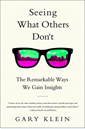
The example comes from the book Seeing What Others Don’t by Gary Klein, a renowned cognitive psychologist.
Charlie Munger, the inimitable partner of Warren Buffett, likes to quote,
A lot of success in life and success in business comes from knowing what you really want to avoid.” He favours the attitude where one is consistently trying to avoid stupidity instead of running after brilliance.
On other hand, the key to success, according to Munger, is “Work, work, work and hope to have a few insights.”
What I infer from above two statements is that, in life and in business, reducing errors is good strategy but one shouldn’t forget about generating new insights too. The following illustration from the book captures the idea very well.
[show_to accesslevel=’almanack-all’]

The whole discipline of behavioural economics is focussed on identifying the cognitive biases and minimize their impact on human decision making, i.e. reducing errors. However, we know very little about when, why, or how insights are formed—or what blocks them. Klein unravels mystery the in his book. He writes –
Ideally, reducing mistakes would at least help us gain insights but I don’t believe that’s how it works. I suspect the relation between the arrows runs the other way. When we put too much energy into eliminating mistakes, we’re less likely to gain insights. Having insights is a different matter from preventing mistakes.
Before we can answer that, let’s quickly understand what do we mean by ‘Insight’ here. Klein defines it as –
Insights are disruptive. They come without warning, take forms that are unexpected, and open up unimagined opportunities.
Insight isn’t just about moving from an impasse state to a solution state. Insights shift us towards, says Klein, “a new story a new set of beliefs that are more accurate, more comprehensive, and more useful. They change how we understand, act, see, feel, and desire.”
Another criterion for the kind of insights we are interested in here, is that others with the same information somehow miss the discovery.
Naturalistic decision making, the study of human decision making under natural settings rather than in laboratory experiments using artificial tasks, is Klein’s forte. This makes Klein’s study on insights, which uses the same naturalistic investigation, particularly interesting.
The Five Strategies
These are the five strategies, for gaining insights, that Klein came up with after a careful study of 120 case studies (similar to the BMW story) where people gained insights: connections, coincidences, curiosities, contradictions, and creative desperation.
Connection is when the person making the discovery gets some new piece of information and sees how it combines with other prior information to form a new idea. Charles Darwin’s theory of evolution is classic example of connection strategy. Darwin connected the idea of Malthus’s competition for resources with what he already knew about variations of species to come up with an insight for natural selection. Darwin gathered a lot of data about animal species during his five-year long voyage along the South American coast. Upon reading Thomas Malthus’ essays, Darwin connected the idea of Malthus’s competition for resources with what he already knew about variations of species to come up with an insight for natural selection.
Coincidences are chance occurrence which sometimes provide us an early warning about a new pattern leading to unique insight. Klein recounts the story of Jocelyn Bell Bernell, an Irish astrophysicist who turned a coincidence into a Nobel Prize.
Unlike coincidences, some insights are sparked by single event or observation rather than repetition of a pattern. The discovery of penicillin, an antibiotic, was the result of Alexander Fleming’s curiosity about an odd pattern observed in his petri dishes. Not ignoring rare outliers in your process of search can sometimes lead to remarkable insights.
Contradiction insights spark the emotional reaction of disbelief. When you encounter a popular wisdom that just don’t make sense. Klein tells the story of five people who predicted the 2008 financial crisis based on their insights about home mortgage industry. When the whole financial industry was euphoric about growth of subprime mortgage business, these people adopted a suspicious mind set and dug out contradicting information. This contradiction not only led these five people to unconventional insight but also made billions of dollars of profit for some of them.
My personal favourite story in this book is about Wagner Dodge, a firefighter, who survived a wildfire by starting another fire called escape fire. The insight about lighting a new fire to escape the 60 feet firewall was a result of what Klein calls creative desperation. It was an indeed a desperate situation which ended up killing 13 other firefighters who didn’t agree to Dodge’s idea.
After sorting out the insight strategies, Klein introduces the Triple Path model of insight, which tries to capture the similarities between the strategies. It’s an interesting model to study and the insight-stories. This model is the lens through which naturalistic investigation can demystify the anatomy of human insights.
Knowing the structure of insights is a good starting point. However, a more useful question that needs to be answered is – What stops people from having insights?
What Kills An Insight?
This can be answered by looking at the thought process of those who failed to gain the insight in spite of being exposed to the same information that insightful people were given.
Klein believes that there are four things that stifle the process of insight generation. They are flawed beliefs, lack of experience, a passive stance, and a concrete reasoning style.
People gripped by a flawed theory can ignore, explain away, or distort evidence that could lead to insights. As they say, “It ain’t what you don’t know that gets you in trouble. It’s what you know for sure that just ain’t so.”
The second factor, experience, isn’t just about having necessary knowledge. Klein writes –
Experience is about how we use our knowledge to tune our attention. Our background can sensitize us to cues or patterns that others might miss. This notion of being attuned, of being sensitized, fits with the concept of generally prepared mind. People with a generally prepared mind haven’t done specific homework to get ready for their insight. Rather, their efforts and their interests have prepared them to notice things others miss.
This is what Charlie meant when he said, “Work, work, work [prepare the mind] and hope to have few insights.”
For passive stance and concrete reasoning style, well, read the book!
Does technology, specifically the software which help users perform their jobs better, affect the process of gaining new insights? Klein says it does, though in a negative way –
The goal of helping people perform their jobs better makes sense only if they have well-defined and stable jobs. It doesn’t apply to people whose jobs may shift as a result of insights…The system we design to help people do their current jobs may lock them into the original job concept and reduce the chance for insights…A powerful search engine such as Google can be too helpful. It learns our preferences and shows us matches that are likely to satisfy us, but we don’t get exposed to other kinds of options…Google is wrapping us in a cocoon of our own beliefs.
The observation about Google search is an eye opener. Google search systematically removes the element of serendipity, finding something useful which we weren’t looking for, and deprives us of potential insights.
The chapter on how organizations obstruct insights, will strongly resonate with people who have some experience working in large organizations. Klein says –
Organizations stifle insights because of forces locked deep inside their DNA: they value predictability, they recoil from surprises, and they crave perfection, the absence of errors…Too often they [organizations] become imbalanced and overemphasize the down arrow. They care more about reducing errors and uncertainty than about making discoveries. They fall into the predictability trap and the perfection trap.
When Steve Jobs started working on the Macintosh, he housed the Mac team in a different location. When asked his rationale for this decision, he said, “Better be a pirate than join the Navy.” He clearly understood that Mac needed an insight driven environment which could get polluted by rest of the Apple, a large organization by then, culture.
To strike the balance between insight driven environment and predictability driven organization structure, Google came up with their own strategy of asking employees to devote 20 percent of their official time working on personal creative hobby projects.
Fostering Insights
The five strategies can help you generate insights but you need to understand the right context under which these strategies become useful. If you want to exploit the connection path, then exposing yourself to lots of different ideas is important. Klein writes –
The connection path thrives on having lots of ideas swirling around and on making accidental linkages. The more swirl and turbulence, the greater the chance for a discovery…We can try to have more varied experiences ourselves, or we can increase our encounters with different kinds of people, working in a variety of areas, peppering us with new ideas…we should find ways to increase the density of ideas to which we are exposed and to increase our contact with creative people…We should foster serendipity…take on multiple hobbies.
However, this trick will produce the burden to screen out lots of useless ideas too. That’s an another interesting problem to solve.
It’s one thing to gain insights yourself but to help others gain insights isn’t so easy. People are more likely to take actions on their own insights rather than on those which are spoon fed to them. So to inspire action in others you need to find a way to help people discover ideas on their own.
Helping people correct their flawed beliefs doesn’t mean offering unsolicited advice. We don’t always have to tell other people what we think they need to know, which usually entails trying to convince them that they need to know it. We know how tedious and irritating that can be. It’s much better to be patient and plug in to the person’s desire for insights rather than trying to push information.
Conclusion
Klein’s book is really about three things – What sparks an insight; what prevents us from grasping them; and how can we improve the flow of insights?
An above average performance, says Howard Marks, the super investor who has won praise from Warren Buffett, “in stock market requires either good luck or superior insight.”
Since you can’t bank on luck all the time, the key is to focus on gaining superior insight.
Klein’s book is loaded with real and fascinating stories of insightful discoveries. It’s an entertaining and fun to read book revealing remarkable patterns about how people generate insights.
This review is meant to rekindle the fire of curiosity inside you. I am sure the bookworm in you will find this book worth reading.
The importance of reading books can never be overemphasized. The purpose of reading isn’t just for becoming more knowledgeable but to become a better human being.
Remember, there is no secret to reading more. It’s all about the game of setting the right priorities. You just have to change your perception so that reading becomes an extension of who you are and what you do.
Happy reading
[/show_to]
[hide_from accesslevel=’almanack-all’]
- Spotlight: Big ideas from Value Investing and why applying them in your investment decision making will be a great deal
- InvestorInsights: Interviews with experienced value investors, learners, and deep thinkers
- StockTalk: Thorough analysis of business models of companies (without any recommendations)
- Behaviouronomics: Deep analysis of human behaviour and how it impacts investment decision making
- BookWorm: Reviews of the best books on Value Investing and related subjects
- Free Course – Financial Statement Analysis for Smart People (otherwise priced at Rs 5,900)
- Archives: Instant access to our huge archive from the past three years