From health risks to financial decisions, it’s often hard to make decisions because the statistics are usually presented to us by experts who misinterpret the data themselves. This remarkably intelligent book simplifies the world of probability, risk, and uncertainty. Plus, the book contains many simple (but powerful) rules to avoid the grave consequences of risk illiteracy.

Stories lie but numbers don’t, goes the adage. However, evolution has wired the human brain in such a way that our neural machinery isn’t optimized to have an intuitive feeling for numbers. As a result, numbers mislead us. Sometimes in shocking ways.
[show_to accesslevel=’almanack-all’]
Lives have been destroyed because of wrong interpretation of numbers.
In the early days of HIV testing, twenty-two blood donors in Florida (USA) were notified that they had tested HIV-positive on the ELISA (a preliminary test); seven of them committed suicide. Unfortunately, they were unaware of the frequency of false positives in ELISA. The Internet is brimming with stories of people who were unnecessarily subjected to extreme stress and misery because they were not aware of the false positive HIV tests.
Benjamin Franklin warned – In this world, nothing can be said to be certain, except death and taxes. So when an astrologer calculates an expert horoscope for you and foretells that you will develop a serious illness and might even die at age forty-nine, will you tremble when the date approaches? No, right?
But when technology is involved, the illusion of certainty is amplified, writes Gerd Gigerenzer in Risk Savvy, “Sixty-three percent of people surveyed think that the result of HIV test is certain.”
What does a positive HIV test mean? The answer depends on the two factors. The prevalence of HIV and the false-positive rate. The prevalence rates are different for different risk profiles, i.e., a person who has multiple partners and indulges in unprotected sex and/or is exposed to infected needles (drug abuse, etc.) falls in high-risk profile. The HIV prevalence is about 1 in 10,000 for those with no known risk factors. Which means in a population of 100,000 you could expect ten people to be carrying HIV and 99,990 others to be free of it. When tested, out of these 10 HIV infected people all will be tested positive. And among other 99,990 about five will be tested positive (most HIV testing procedures have a false-positive rate of 5 in 100,000) even though they don’t have HIV.
So that adds up to ten correct positives and five incorrect ones, resulting in a 67 percent chance of being infected, far from an absolute certainty. Only if the person had practiced a high-risk lifestyle would the odds be poor.
The lesson: If you are not at risk, and tested positive for HIV, don’t panic. Think about what the number means, and go back for a second, independent test.
From health risks to financial decisions, we often find it hard to make decisions because the statistics have been presented to us by ‘experts’ who misinterpret the data themselves. In his remarkably intelligent book, Gerd’s has simplified the world of probability, risk, and uncertainty. And adding a cherry on the cake, he offers many simple (but powerful) rules to avoid the grave consequences of risk illiteracy.
Fooled by Relative Risk
Some time back the UK Committee on Safety of Medicines issued a warning that third generation oral contraceptive pills increased the risk of thrombosis by 100 percent, i.e., a woman is twice likely to suffer from thrombosis with the new contraceptive. This scary statement created a panic and distressed women stopped taking the pill.
Result? Thousands of unwanted pregnancies and abortions. But no one stopped to ask the most important question.
Just how big is 100 percent? The studies on which the warning was based had shown that of every seven thousand women who took the earlier, second-generation pill, about one had a thrombosis; and that this number increased to two among women who took third-generation pills. That is, the absolute risk increase was only one in seven thousand, whereas the relative risk increase was indeed 100 percent. As we see, in contrast to absolute risks, relative risks appear threateningly large and can cause a great stir.
This pill scare led to an estimated thirteen thousand additional abortions and an equal number of extra births in the following year in England. Ironically, pregnancies and abortions are associated with a risk of thrombosis that exceeds that of the third-generation pill.
Men! Stop Worrying About Prostate Cancer
UK and US are both developed countries and leading the world in technological advancements in every field including medicine. But in 2007, US statesman Rudy Giuliani revealed a shocking discrepancy in prostate cancer survival rates between US and UK. An Englishman who was detected with prostate cancer had only 42 percent chance of surviving the next five years. For Americans, it was 82 percent. That was big news and also a big mistake.
Ironically, despite the impressive difference in survival rates, the mortality rates for prostate cancer were same in US and UK, i.e., the percentage of men who died of prostate cancer was about the same in the America and England. How can survival rates be so different when mortality is the same?
The first reason is called Lead Time Bias. Imagine two groups of men with invasive prostate cancer. The first consists of men in Britain, where screening for prostate-specific antigens (PSA) is not routinely used and most cancer is diagnosed by symptoms. The second group is made up of men in the United States, where routine use of the test began in the late 1980s and spread rapidly, despite the lack of evidence that it saves lives.
In the British group, prostate cancer is detected by symptoms, say at age sixty-seven. All of these men die at age seventy. Everyone survived only three years, so the five-year survival is 0 percent. In the U.S. group, prostate cancer is detected early by PSA tests, say at age sixty, but they too die at age seventy. According to the statistics, everyone in that group survived ten years and thus their five-year survival rate is 100 percent. The survival rate has improved dramatically, although nothing has changed about the time of death: Whether diagnosed at age sixty-seven or at age sixty, all patients die at age seventy.
Survival rates are inflated by setting the time of diagnosis earlier. Contrary to what many people have been told, there is no evidence that early detection and subsequent treatment of prostate cancer prolongs or saves lives.”
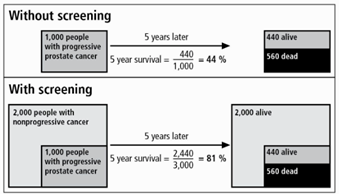
“The second reason why survival rates tell us nothing about living longer is Overdiagnosis Bias. Overdiagnosis happens when doctors detect abnormalities that will not cause symptoms or early death.
For instance, a patient might correctly be diagnosed with cancer but because the cancer develops so slowly, the patient would never have noticed it in his lifetime. These cancers are called slow-growing or nonprogressive cancers. PSA screening detects both progressive and nonprogressive cancers but, like most other cancer screening tests, cannot tell the difference between them.
Figure-2 above shows 1,000 British men with progressive cancer who do not undergo screening. After five years, 440 are still alive, which results in a survival rate of 44 percent. The same figure shows 1,000 Americans who participate in PSA screening and have progressive cancer. The test, however, also finds 2,000 people with nonprogressive cancers—meaning that they will not die from them. By adding these 2,000 to the 440 who survived progressive cancer, the survival rate leaps to 81 percent. Even though the survival rate increases dramatically, the number of men who die remains exactly the same.

Risk, Uncertainty, and Rules of Thumb
In everyday language, we clearly understand the distinction between certainty and risk, but the terms risk and uncertainty are mostly used interchangeably. They aren’t the same.
Risk means the alternatives, consequences, and the range of outcomes are known with their respective probabilities. Lotteries and roulettes are examples. Good decisions, in the face of such risks, require logic and statistical thinking. However, we live in a changing world where it’s impossible to determine all the possibilities and probabilities. Real world, unlike a casino, is uncertain.
Who to marry? Whom to trust? What to do with the rest of one’s life? In an uncertain world, it is impossible to determine the optimal course of action by calculating the exact risks. We have to deal with “unknown unknowns.” Surprises happen. Even when calculation does not provide a clear answer, however, we have to make decisions.
To make right decisions in the environment of unknown risks, i.e., uncertainty, one needs intuition and smart rules of thumb. The application of probability theory and statistics doesn’t always work in the real world.
In the March 2018 issue of Value Investing Almanack, we had explored the power of simple ideas in investing. In that post, one of the examples that I included was the emergency landing of US Airways flight on Hudson river in 2009. It was a classic example of dealing with a situation of unknown risk. Immediately after the take-off from LaGuardia airport, the flight lost both the engines.
The captain and the co-pilot had to make good judgment. Could the plane actually make it to LaGuardia, or would they have to try something more risky, such as a measured speed, wind, altitude, and distance and fed this information into a calculator. Instead, they simply used a rule of thumb: Fix your gaze on the tower: If the tower rises in your windshield, you won’t make it. No estimation of the trajectory of the gliding plane is necessary. No time is wasted. And the rule is immune to calculation errors. In the words of co-pilot Jeffrey Skiles: “It’s not so much a mathematical calculation as visual, in that when you are flying in an airplane, things that – a point that you can’t reach will actually rise in your windshield. A point that you are going to overfly will descend in your windshield. This time the point they were trying to reach did not descend but rose. They went for the Hudson.
The Thumb Rule for Finance
In last few decades, the rate at which financial institutions have started faltering has gone up dramatically. In the 1970s, the world witnessed only nine major banking crises. The decades of the 1980s and 1990s saw fifty such crises, each. And then the 2008 financial tsunami grabbed the world economy by the neck and shook it violently. Mighty banks defaulted, and entire countries found themselves at the brink of collapse.
Gerd writes –
So how can we minimize the risk of another financial crisis? Finance needs a scientific revolution. We need to break away from the traditional risk models and find new tools.
As with the Basel regulations, the traditional way is to introduce complex regulatory systems and, if they don’t work, make them more complex. This is the way taken by many governments and organizations. A different vision is to ask: Is there a set of simple rules that can solve this complex problem?
One such rule is about leverage; that is, the ratio of a bank’s assets, or liabilities, to its capital. Don’t use leverage ratios above 10:1. A leverage ratio is a rule of thumb that aims at being roughly right instead of precisely wrong. It would force banks to become less fragile by acquiring more capital.
This thumb rule is not just for large financial institutions. It’s a great heuristic for personal finance too. As an investor, the best way to avoid financial ruin is to employ minimum debt. In fact, stay away from it altogether. You can never go bankrupt if you have not borrowed money.
Conclusion
Risk savviness is the basic knowledge required to deal with a modern technological society. It is no more a nice-to-have skill. Risk illiteracy can have severe consequences in our life.
Gerd Gigerenzer is Director of the Center for Adaptive Behavior and Cognition at the Max Planck Institute for Human Development in Berlin and former Professor of Psychology at the University of Chicago. He is the author of several books on heuristics and decision making, all of which I have added to my anti-library. I hope you’ll too.
[/show_to] [hide_from accesslevel=’almanack-all’]- Spotlight: Big ideas from Value Investing and why applying them in your investment decision making will be a great deal
- InvestorInsights: Interviews with experienced value investors, learners, and deep thinkers
- StockTalk: Thorough analysis of business models of companies (without any recommendations)
- Behaviouronomics: Deep analysis of human behaviour and how it impacts investment decision making
- BookWorm: Reviews of the best books on Value Investing and related subjects
- Free Course – Financial Statement Analysis for Smart People (otherwise priced at Rs 5,900)
- Archives: Instant access to our huge archive from the past three years