
Today, anyone can be in business. You can do it without working miserable 80-hour weeks or depleting your life savings. That’s because tools that used to be out of reach are now easily accessible. Rework is about a new paradigm for anyone who’s ever dreamed of building something.
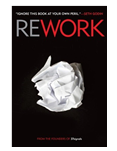
This is one book which can prove to be risky for you especially if you’re into a job and contemplating doing something of your own. I personally know few people who got so inspired from the book Rework by Jason Fried and David Hansson, that they actually quit their job. So before saying anything, let me issue this warning – read this book at your own risk. And let me also tell you this – ignore the book at your peril.
The authors are people who run one of the most unconventional software company in the world – 37signals – known for their innovative products. It’s a company which has only sixteen employees who almost never see each other and are spread across 8 cities on two continents. And for the information of techies who are reading this, David Hansson is the creator of Ruby on Rails, an open-source web framework on which hundreds of thousands of web applications have been built – including Twitter.
[show_to accesslevel=’almanack-all’]
These are the guys who are redefining the way work is done. They write –
You don’t have to work miserable 60/80/100-hour weeks to make it work. 10–40 hours a week is plenty. You don’t have to deplete your life savings or take on a boatload of risk. Starting a business on the side while keeping your day job can provide all the cash flow you need. You don’t even need an office. Today you can work from home or collaborate with people you’ve never met who live thousands of miles away. It’s time to rework work.
It’s a book not only for entrepreneurs and small business owners but even for people stuck in day jobs who have always dreamed about doing their own thing. So without wasting much time let’s dive in and look at few quick ideas from the book.
The Planning Fallacy
Unless you’re a fortune-teller, long-term business planning is a fantasy…Writing a plan makes you feel in control of things you can’t actually control…You have the most information when you’re doing something, not before you’ve done it. Yet when do you write a plan? Usually it’s before you’ve even begun. That’s the worst time to make a big decision…Working without a plan may seem scary. But blindly following a plan that has no relationship with reality is even scarier.
The conch-shaped Sydney Opera House was planned in 1957 and was expected to be completed in 1963. A scaled-down version opened in 1973, a decade later. The original
cost was estimated at $7 million, but its delayed completion led to a cost of $102 million – 14 times the original estimate. History is replete with such examples of failed planning.
…we’re all terrible estimators. We think we can guess how long something will take, when we really have no idea…Reality never sticks to best-case scenarios.
So should we abandon planning altogether? Of course not. The solution is to…
Break the big thing into smaller things. The smaller it is, the easier it is to estimate. You’re probably still going to get it wrong, but you’ll be a lot less wrong than if you estimated a big project. If something takes twice as long as you expected, better to have it be a small project that’s a couple weeks over rather than a long one that’s a couple months over.
One of the buzz words in IT industry today is Agile. The idea is to make plan for 2-3 weeks with small goals and quickly adapt to the outcomes and learnings based on the result of those few weeks of work. Fail fast, fail often, and fail forward.
Scratch Your Own Itch
A great product or service is something which addresses a real human need and you can’t figure that out sitting in a room thinking about what other people may need.
The easiest, most straightforward way to create a great product or service is to make something you want to use…When you build a product or service, you make the call on hundreds of tiny decisions each day. If you’re solving someone else’s problem, you’re constantly stabbing in the dark. When you solve your own problem, the light comes on. You know exactly what the right answer is…When you build what you need, you can also assess the quality of what you make quickly and directly, instead of by proxy.
In fact, that’s the simplest way to find passion in your work.
…this ‘solve your own problem’ approach lets you fall in love with what you’re making. You know the problem and the value of its solution intimately. There’s no substitute for that. After all, you’ll (hopefully) be working on this for years to come. Maybe even the rest of your life. It better be something you really care about.
No Time is No Excuse
Saying that you don’t have time for the work you love, is effectively stating that you don’t give priority to it. Isn’t it?
There’s always enough time if you spend it right. And don’t think you have to quit your day job, either. Hang onto it and start work on your project at night…Instead of watching TV or playing World of Warcraft, work on your idea. Instead of going to bed at ten, go to bed at eleven. We’re not talking about all-nighters or sixteen-hour days – we’re talking about squeezing out a few extra hours a week. That’s enough time to get something going…Once you do that, you’ll learn whether your excitement and interest is real or just a passing phase.
In fact, that’s a great way to find your calling. Observe yourself. Is there some activity which you never miss irrespective of how busy you are? In spite of a dead busy schedule, if you aren’t working on your passion at least few hours a week, may it’s not your passion at all.
Startup Vs Business
Ah, the startup. It’s a special breed of company that gets a lot of attention (especially in the tech world)…The start up is a magical place. It’s a place where expenses are someone else’s problem. It’s a place where that pesky thing called revenue is never an issue. It’s a place where you can spend other people’s money until you figure out a way to make your own. It’s a place where the laws of business physics don’t apply.
Of course the idea is not to generalise the above statement, but don’t forget that a startup needs to be a business first else it’s probably a glorified form of charity where the beneficiaries aren’t necessarily the underprivileged. So don’t use the idea of a startup as a crutch. Instead, start an actual business.
Anyone who takes a “we’ll figure out how to profit in the future” attitude to business is being ridiculous. That’s like building a rocket ship but starting off by saying, “Let’s pretend gravity doesn’t exist.” A business without a path to profit isn’t a business, it’s a hobby.
Embrace Constraints
People think of constraints as giving something up instead of gaining something. But if you give away your TV, you gain back all the hours it used to suck from your life. So embrace your constraints because they can weed out the non-essential noise from your life.
Consider Twitter. What makes it the world’s most effective communication medium? It’s the constraint of squeezing your thoughts into 140 characters. It was the constraint of the two-week hackathon that led to the creation of Twitter, say Biz Stone, co-founder of Twitter, “One of the first decisions we made about Twitter, something that never changed, was that each message would be limited to 140 characters or fewer.
Constraints are advantages in disguise. Limited resources force you to make do with what you’ve got. There’s no room for waste. And that forces you to be creative…Writers like Ernest Hemingway and Raymond Carver found that forcing themselves to use simple, clear language helped them deliver maximum impact.
You think lack of money is stopping you? It may sound ironical but one of the most interesting problems that many rich people face is to control their urge to solve every problem by throwing money at it. Solving problems with money is the most inefficient brute force approach and it poses a threat for your creativity at being resourceful.
Limiting the options gives you a place to start and scarce resources make you focus on the most important aspect of your work.
Focus on What Won’t Change
The core of your business should be built around things that won’t change. Things that people are going to want today and ten years from now. Amazon.com focuses on fast (or free) shipping, great selection, friendly return policies, and affordable prices. These things will always be in high demand.
And how do you find out the things that won’t change? Look at history. There are few obvious examples which give you a clue about things that are not going to change. Right now, as you read this, you’re probably sitting in a chair, an invention from ancient Egypt. You wear pants developed about 5000 years ago and adapted by Germanic tribes around 750 B.C. The idea behind your leather shoes comes from the last ice age. Your bookshelves are made of wood, one of the oldest building materials in the world.
Nassim Taleb argues that most of the technology that has existed for the past fifty years will serve us for another half century. And the recent technology will be passé in a few years’ time. Think of these inventions as if they were species, writes Taleb, “Whatever has held its own throughout centuries of innovation will probably continue to do so in the future, too. Old technology has proven itself; it possesses an inherent logic even if we do not always understand it. If something has endured for epochs, it must be worth its salt.” It’s called Lindy Effect, which we covered in our Latticework of Mental Models series few weeks back.
Remember, fashion fades away. When you focus on permanent features, you’re in bed with things that never go out of style.
Sell Your By-Products
When you make something, you always make something else. You can’t make just one thing. Everything has a by-product. Observant and creative business minds spot these by-products and see opportunities. Sharing his own experience, Jason writes-
“Our last book, Getting Real, was a by-product. We wrote that book without even knowing it. The experience that came from building a company and building software was the waste from actually doing the work. We swept up that knowledge first into blog posts, then into a workshop series, then into a .pdf, and then into a paperback. That by-product has made 37signals more than $1 million directly and probably more than another $1 million indirectly. The book you’re reading right now is a by-product too.”
There’s probably something you haven’t thought about that you could sell too.
Don’t Focus on Competition
In the end, it’s not worth paying much attention to the competition anyway. Why not? Because worrying about the competition quickly turns into an obsession. What are they doing right now? Where are they going next? How should we react?
…If you’re just going to be like everyone else, why are you even doing this? If you merely replicate competitors, there’s no point to your existence. Even if you wind up losing, it’s better to go down fighting for what you believe in instead of just imitating others.
Learn to Say No
Steve Jobs famously said –
People think focus means saying yes to the thing you’ve got to focus on. But that’s not what it means at all. It means saying no to the hundred other good ideas that there are. You have to pick carefully. I’m actually as proud of the things we haven’t done as the things I have done. Innovation is saying no to 1,000 things.
Every time you say yes to something unimportant, you’re effectively saying no to something important. The difference between successful people and really successful people is, says Warren Buffett, “that really successful people say no to almost everything.”
Start getting into the habit of saying no—even to many of your best ideas. Use the power of no to get your priorities straight. You rarely regret saying no. But you often wind up regretting saying yes…People avoid saying no because confrontation makes them uncomfortable. But the alternative is even worse. You drag things out, make things complicated, and work on ideas you don’t believe in.
Conclusion
When I read this book it reminded me of another awesome book, Anything You Want by Derek Sivers. Rework should be paired with Derek’s book. In fact, pairing up books i.e., reading them simultaneously is called the syntopical reading. It’s a trick discussed by Mortimer Adler in his book How to Read a Book. Check it out.
As an investor, this book holds very useful insights about what one should look for in company’s management. If the CEO’s working and thinking style shows his inclination towards any of the Rework’s ideas, you probably have found a smart guy.
The duo, Jason and David, have written another wonderful book called Remote, another gem which shouldn’t be missed.
Let me wrap up here with my standard disclaimer.
I have selected a very small subset of ideas from the book, so this book review is by no means a replacement for the book. This is meant to rekindle the fire of curiosity inside you. I am sure the bookworm in you will find this book worth reading.
The importance of reading books can never be overemphasized. The purpose of reading isn’t just for becoming more knowledgeable but to become a better human being.
Remember, there is no secret to reading more. It’s all about the game of setting the right priorities. You just have to change your perception so that reading becomes an extension of who you are and what you do.
Happy reading!
[/show_to]
[hide_from accesslevel=’almanack-all’]
- Spotlight: Big ideas from Value Investing and why applying them in your investment decision making will be a great deal
- InvestorInsights: Interviews with experienced value investors, learners, and deep thinkers
- StockTalk: Thorough analysis of business models of companies (without any recommendations)
- Behaviouronomics: Deep analysis of human behaviour and how it impacts investment decision making
- BookWorm: Reviews of the best books on Value Investing and related subjects
- Free Course – Financial Statement Analysis for Smart People (otherwise priced at Rs 5,900)
- Archives: Instant access to our huge archive from the past three years