
The VIA veterans, i.e., the long time readers of Value Investing Almanack newsletter would perhaps be surprised to see the name of this book because we had already covered it in Nov 2016 issue.
So why am I writing about it again? Because Deep Work is such an important book that it needs to be read and reread.
Nassim Taleb, one of my all time favourite author, writes —
A good book gets better at the second reading, a great book at the third. Any book not worth rereading isn’t worth reading.
Plagiarising Taleb’s words, I say any work worth doing is worth doing deeply. And a book about deep work is worth reading deeply, isn’t it?
So if you haven’t read this book, I am going to hard sell it to you and make a strong case why you need to read, reread, and implement its ideas in your work.
[show_to accesslevel=’almanack-all’]
Deep work happens when one engages himself with an activity in a state of distraction free concentration that push his cognitive abilities to their limits. These efforts create new value, improve your skill, and are hard to replicate.
Earlier, dis-traction would mean we got off the track from the main work. Unfortunately, today distraction has become the main work and we usually take break from the distraction to do the real work.
Drowning in distraction we are. Aren’t we?
Shane Parrish, in his awesome blog Farnam Street, argues —
Whether it’s building a new product, writing a book, learning a hard subject, building a keynote speech, or writing a complicated piece of software, it doesn’t happen by saying ‘I’ll get to it’, and then allocating 15 minutes here or there in between checking your email and going to meetings. It happens by stringing together sessions of deep, focused effort. Hours at a time, over and over. The intense kind where you sort of lose yourself and wake up later with a lot of awesome work done.
Achieving unbroken concentration is not like brushing your teeth — a task you can just choose to do any time — it’s instead a mindset. And it doesn’t come naturally to us. To slip into a state of depth, we need external help.
Newport’s book is full of tricks and hacks to make it easier to enter the deep work zone without much friction. Setting up the right environment and building routines are the founding principles for reducing the friction.
Depth Rituals
Newport writes —
You have a finite amount of willpower that becomes depleted as you use it. Your will, in other words, is not a manifestation of your character that you can deploy without limit; it’s instead like a muscle that tires. Distractions drain the finite pool of willpower.
The key to developing a deep work habit is to move beyond good intentions and add routines and rituals to your working life designed to minimize the amount of your limited willpower necessary to transition into and maintain a state of unbroken concentration. If you suddenly decide, for example, in the middle of a distracted afternoon spent Web browsing, to switch your attention to a cognitively demanding task, you’ll draw heavily from your finite willpower to wrest your attention away from the online shininess. Such attempts will therefore frequently fail. On the other hand, if you deployed smart routines and rituals— perhaps a set time and quiet location used for your deep tasks each afternoon— you’d require much less willpower to start and keep going. In the long run, you’d therefore succeed with these deep efforts far more often.
The purpose of depth rituals is to quickly shift the brain into a state of concentration. Many people use headphones to listen to non-distracting meditative music to thrust their minds straight into the deep working zone and then keep it there as long as the music is playing. Some writers and bloggers use minimalist writing tools in full-screen mode to minimize the distraction. I personally use a tool called Self-Control which can block all the social media websites on my laptop for specified number of hours.
One of Newport’s students shared an interesting ritual. He created a template containing set of seven questions about the deep task he’s about to begin. The questions were designed to force him to think about why the task was important and how he was going to tackle it. Here’s the template.
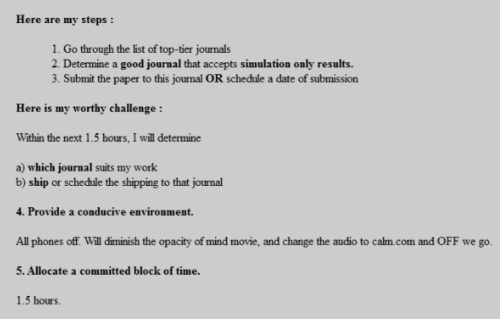
The seven-question-template hack works brilliantly because it creates a very low barrier to entry, i.e., filling out the template. Filling the template would hardly take five minutes and brings immediate clarity and momentum to the task ahead.
Scheduling Deep Work
Like any other item in a typical to-do list, a task get done when it gets scheduled. Deep work also requires conscious scheduling. But mere scheduling doesn’t work. You have to first zero down to your scheduling philosophy.
The one extreme of this scheduling philosophy is something called monastic philosophy of deep work scheduling. Newport cites two people as examples who employ this philosophy. Famous computer scientist Donald Knuth and acclaimed science fiction writer Neal Stephenson.
Knuth’s website at Stanford doesn’t have his e-mail address. Instead, you’ll find the following note:
I have been a happy man ever since January 1, 1990, when I no longer had an email address. I’d used email since about 1975, and it seems to me that 15 years of email is plenty for one lifetime. Email is a wonderful thing for people whose role in life is to be on top of things. But not for me; my role is to be on the bottom of things. What I do takes long hours of studying and uninterruptible concentration. (emphasis mine)
Similarly, talking about his communication policy, Stephenson writes –
Persons who wish to interfere with my concentration are politely requested not to do so, and warned that I don’t answer e-mail… lest [my communication policy’s] key message get lost in the verbiage, I will put it here succinctly: All of my time and attention are spoken for— several times over. Please do not ask for them.
The productivity equation is a non-linear one, in other words. This accounts for why I am a bad correspondent and why I very rarely accept speaking engagements. If I organize my life in such a way that I get lots of long, consecutive, uninterrupted time-chunks, I can write novels. But as those chunks get separated and fragmented, my productivity as a novelist drops spectacularly. (emphasis mine)
The pool of individuals to whom the monastic philosophy applies is limited, writes Newport, “and that’s okay. If you’re outside this pool, its radical simplicity shouldn’t evince too much envy. On the other hand, if you’re inside this pool— someone whose contribution to the world is discrete, clear, and individualized— then you should give this philosophy serious consideration, as it might be the deciding factor between an average career and one that will be remembered.”
Thinkers and Their Rituals
The towering genius of scientist like Charles Darwin was a result of his routine based approach towards his work, thinking, and creativity. This is how Francis, Darwin’s son, described the working life of his father when he was writing his seminal work On The Origin of Species as —
He would rise promptly at seven to take a short walk. He would then eat breakfast alone and retire to his study from eight to nine thirty. The next hour was dedicated to reading his letters from the day before, after which he would return to his study from ten thirty until noon. After this session, he would mull over challenging ideas while walking on a prescribed route that started at his greenhouse and then circled a path on his property. He would walk until satisfied with his thinking then declare his workday done.
Mason Currey, in his book Daily Rituals where he has catalogued the habits of famous writers and thinkers, explains —
There is a popular notion that artists work from inspiration— that there is some strike or bolt or bubbling up of creative mojo from who knows where … but I hope [my work] makes clear that waiting for inspiration to strike is a terrible, terrible plan. In fact, perhaps the single best piece of advice I can offer to anyone trying to do creative work is to ignore inspiration.
Someone put it wisely — Great creative minds think like artists but work like accountants. Deep work requires discipline. It requires grit. Deep work separates men from the boys.
Newport again —
To make the most out of your deep work sessions, build rituals of the same level of strictness and idiosyncrasy as the important thinkers mentioned previously. There’s a good reason for this mimicry. Great minds like Caro and Darwin didn’t deploy rituals to be weird; they did so because success in their work depended on their ability to go deep, again and again— there’s no way to win a Pulitzer Prize or conceive a grand theory without pushing your brain to its limit. Their rituals minimized the friction in this transition to depth, allowing them to go deep more easily and stay in the state longer. If they had instead waited for inspiration to strike before settling in to serious work, their accomplishments would likely have been greatly reduced.
Conclusion
Naval Ravikant, a silicon valley entrepreneur and venture capitalist, recently wrote –
Books read is just a vanity metric. If you read one book a year that changes your life, that’s all it takes.
I hope you take the business of reading books seriously and consciously avoid getting into the trap of turning books into ego boosting device. At first, it’s hard to differentiate between someone who has read a lot of books and someone who is really wise. The only way to differentiate between a shallow thinker and a deep thinker (or between chauffeur knowledge and plan knowledge), is to become a deep thinker yourself.
Thinking is work. Deep work. [/show_to] [hide_from accesslevel=’almanack-all’]
- Spotlight: Big ideas from Value Investing and why applying them in your investment decision making will be a great deal
- InvestorInsights: Interviews with experienced value investors, learners, and deep thinkers
- StockTalk: Thorough analysis of business models of companies (without any recommendations)
- Behaviouronomics: Deep analysis of human behaviour and how it impacts investment decision making
- BookWorm: Reviews of the best books on Value Investing and related subjects
- Free Course – Financial Statement Analysis for Smart People (otherwise priced at Rs 5,900)
- Archives: Instant access to our huge archive from the past three years