
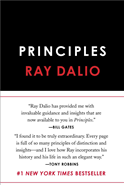
There are few books that have the capacity to change your life, if you were to practice the lessons shared therein diligently. Ray Dalio’s Principles is one such book. This post contains some of the key life and investment principles and lessons Dalio writes about.
“Some books are to be tasted, others to be swallowed, and some few to be chewed and digested: that is, some books are to be read only in parts, others to be read, but not curiously, and some few to be read wholly, and with diligence and attention.” ~ Sir Francis Bacon, English author, courtier, & philosopher
There are few books that have the capacity to change your life, if you were to practice the lessons shared therein by the author. For me, Peter Kaufman’s Poor Charlie’s Almanack was one of them, and so was Peter Bevelin’s All I Want to Know. Ray Dalio’s Principles, , which I got my hands to recently, is another such book I believe, for reasons you will soon know.
[show_to accesslevel=’almanack-all’]
For starters, Ray Dalio is an American investor and hedge fund manager, and the founder of investment firm Bridgewater Associates, one of the world’s largest hedge funds. Bridgewater, founded by Ray in 1975, is currently manages about $160 billion for approximately 350 clients, which include public and corporate pension funds, university endowments, charitable foundations, sovereign wealth funds, and central banks.
Why Principles?
Everyone lives by certain principles which Ray defines as “the fundamental truths that serve as the foundations for behaviour that gets you what you want out of life.”
Essentially, principles and values are beliefs which guide our decisions as well as influence how we view the world. From the time we’re born, these beliefs mould us and define who we are and what we do. Some people live by the principles and values of the religion they were taught since birth. Others choose someone as their example and follow that person’s principles, like those of Gandhi, Mandela, Steve Jobs, or Mother Theresa.
The good thing about principles is that, as Ray writes, “They can be applied again and again in similar situations to help you achieve your goals.”
Without principles we would be forced to react to all the thongs life throws as us individually, as if we were experiencing each of them for the first time. If instead we classify these situations into types and have good principles for dealing with them, we will make better decisions more quickly and have better lives as a result.
Take investing, for example. Warren Buffett is widely considered one of the greatest investors of all time. But if you were to ask him whom he thinks is the greatest investor, he would probably mention one man: his teacher, Benjamin Graham. The reason is not far to fathom. As Buffett has confessed several times over his career, his investment philosophy and practices have been greatly influenced by two most timeless principles he learned from Graham. The first was that of treating Mr. Market or stock prices as a servant than a master, and thus trying to profit from stock price volatility. The second principle was what Graham called the three most important words in investing – margin of safety.
“Having a good set of principles,” Ray writes, “is like having a good collection of recipes for success. All successful people operate by principles that help them be successful, though what they choose to be successful at varies enormously, so their principles vary.”
Anyways, Principles is a big book – in terms of the lessons it imparts – and summarizing its key principles in a single post won’t be a good idea. As such, what I have done in this post is stitch together the principles outlined by Ray in just the initial part of the book. I will take up the remaining principles in forthcoming posts. So, let’s get started with some of Ray’s key principles of life and investing – in his own words.
On Dealing with Bad Patches
All great investors and investment approaches have bad patches; losing faith in them at such times is as common a mistake as getting too enamored of them when they do well. Because most people are more emotional than logical, they tend to overreact to short-term results; they give up and sell low when times are bad and buy too high when times are good. I find this is just as true for relationships as it is for investments—wise people stick with sound fundamentals through the ups and downs, while flighty people react emotionally to how things feel, jumping into things when they’re hot and abandoning them when they’re not.
On the Big Investment Problems
Making money in the markets is tough. The brilliant trader and investor Bernard Baruch put it well when he said, “If you are ready to give up everything else and study the whole history and background of the market and all principal companies whose stocks are on the board as carefully as a medical student studies anatomy—if you can do all that and in addition you have the cool nerves of a gambler, the sixth sense of a clairvoyant and the courage of a lion, you have a ghost of a chance.
Ray writes about the bets he made during the Mexican debt crisis of 1982, which he had seen coming and that subsequently brought him into the limelight. As it finally turned out, he was wrong in his assessment of the crisis and the bets he had made to benefit from the same. “Being so wrong,” he writes, “and especially so publicly wrong – was incredibly humbling and cost me just about everything I had built at Bridgewater. I saw that I had been an arrogant jerk who was totally confident in a totally incorrect view.”
He then goes on to explain the key mistakes he made that led to the crash in his, and his clients’ investments post the crisis –
First, I had been wildly overconfident and had let my emotions get the better of me. I learned (again) that no matter how much I knew and how hard I worked, I could never be certain enough to proclaim things like what I’d said on Wall Street Week: “There’ll be no soft landing. I can say that with absolute certainty, because I know how markets work.” I am still shocked and embarrassed by how arrogant I was.
Second, I again saw the value of studying history. What had happened, after all, was “another one of those.”
Third, I was reminded of how difficult it is to time markets. My long-term estimates of equilibrium levels were not reliable enough to bet on; too many things could happen between the time I placed my bets and the time (if ever) that my estimates were reached.
My final lesson was perhaps the most important one, because it has applied again and again throughout my life. At first, it seemed to me that I faced an all-or-nothing choice: I could either take on a lot of risk in pursuit of high returns (and occasionally find myself ruined) or I could lower my risk and settle for lower returns. But I needed to have both low risk and high returns, and by setting out on a mission to discover how I could, I learned to go slowly when faced with the choice between two things that you need that are seemingly at odds. That way you can figure out how to have as much of both as possible. There is almost always a good path that you just haven’t discovered yet, so look for it until you find it rather than settle for the choice that is then apparent to you.
“Staring at these failings,” Ray writes –
I realized that if I was going to move forward without a high likelihood of getting whacked again, I would have to look at myself objectively and change—starting by learning a better way of handling the natural aggressiveness I’ve always shown in going after what I wanted.
Imagine that in order to have a great life you have to cross a dangerous jungle. You can stay safe where you are and have an ordinary life, or you can risk crossing the jungle to have a terrific life. How would you approach that choice? Take a moment to think about it because it is the sort of choice that, in one form or another, we all have to make. Even after my crash, I knew I had to go after the terrific life with all its risks, so the question was how to “cross the dangerous jungle” without getting killed. In retrospect, my crash was one of the best things that ever happened to me because it gave me the humility I needed to balance my aggressiveness. I learned a great fear of being wrong that shifted my mind-set from thinking “I’m right” to asking myself “How do I know I’m right?” And I saw clearly that the best way to answer this question is by finding other independent thinkers who are on the same mission as me and who see things differently from me. By engaging them in thoughtful disagreement, I’d be able to understand their reasoning and have them stress-test mine. That way, we can all raise our probability of being right. In other words, I just want to be right—I don’t care if the right answer comes from me.
On Dealing with Failures
Successful people change in ways that allow them to continue to take advantage of their strengths while compensating for their weaknesses and unsuccessful people don’t. Later in the book I will describe specific strategies for change, but the important thing to note here is that beneficial change begins when you can acknowledge and even embrace your weaknesses. Over the years that followed, I found that most of the extraordinarily successful people I’ve met had similar big painful failures that taught them the lessons that ultimately helped them succeed. Looking back on getting fired from Apple in 1985, Steve Jobs said, “It was awful-tasting medicine, but I guess the patient needed it. Sometimes life hits you in the head with a brick. Don’t lose faith. I’m convinced that the only thing that kept me from going was that I loved what I did.”
On Pushing Your Limits
I saw that to do exceptionally well you have to push your limits and that, if you push your limits, you will crash and it will hurt a lot. You will think you have failed—but that won’t be true unless you give up. Believe it or not, your pain will fade and you will have many other opportunities ahead of you, though you might not see them at the time. The most important thing you can do is to gather the lessons these failures provide and gain humility and radical open-mindedness in order to increase your chances of success. Then you press on.
On Dealing with Reality
There is nothing more important than understanding how reality works and how to deal with it. Understanding, accepting, and working with reality is both practical and beautiful.
On Adaptation
Adaptation through rapid trial and error is invaluable. Natural selection’s trial-and-error process allows improvement without anyone understanding or guiding it. The same can apply to how we learn. There are at least three kinds of learning that foster evolution: memory-based learning (storing the information that comes in through one’s conscious mind so that we can recall it later); subconscious learning (the knowledge we take away from our experiences that never enters our conscious minds, though it affects our decision making); and “learning” that occurs without thinking at all, such as the changes in DNA that encode a species’ adaptations. I used to think that memory-based, conscious learning was the most powerful, but I’ve since come to understand that it produces less rapid progress than experimentation and adaptation.
To give you an example of how nature improves without thinking, just look at the struggle that mankind (with all its thinking) has experienced in trying to outsmart viruses (which don’t even have brains). Viruses are like brilliant chess opponents. By evolving quickly (combining different genetic material across different strains), they keep the smartest minds in the global health community busy thinking up countermoves to hold them off. Understanding that is especially helpful in an era when computers can run large numbers of simulations replicating the evolutionary process to help us see what works and what doesn’t.
On the Two Big Barriers to Good Decision Making
The two biggest barriers to good decision making are your ego and your blind spots. Together, they make it difficult for you to objectively see what is true about you and your circumstances and to make the best possible decisions by getting the most out of others. When I refer to your “ego barrier,” I’m referring to your subliminal defense mechanisms that make it hard for you to accept your mistakes and weaknesses…Even the most intelligent people generally behave this way, and it’s tragic.
To be effective you must not let your need to be right be more important than your need to find out what’s true. If you are too proud of what you know or of how good you are at something you will learn less, make inferior decisions, and fall short of your potential.
…In addition to your ego barrier, you (and everyone else) also have blind spots—areas where your way of thinking prevents you from seeing things accurately.
To make it even harder, we don’t like to see ourselves or others as having blind spots, even though we all have them. When you point out someone’s psychological weakness, it’s generally about as well received as if you pointed out a physical weakness. If you’re like most people, you have no clue how other people see things and aren’t good at seeking to understand what they are thinking, because you’re too preoccupied with telling them what you yourself think is correct. In other words, you are closed-minded; you presume too much. This closed-mindedness is terribly costly; it causes you to miss out on all sorts of wonderful possibilities and dangerous threats that other people might be showing you—and it blocks criticism that could be constructive and even lifesaving.

On Humility

It is a great paradox that individually we are simultaneously everything and nothing. Through our own eyes, we are everything—e.g., when we die, the whole world disappears. So to most people (and to other species) dying is the worst thing possible, and it is of paramount importance that we have the best life possible. However, when we look down on ourselves through the eyes of nature we are of absolutely no significance. It is a reality that each one of us is only one of about seven billion of our species alive today and that our species is only one of about ten million species on our planet. Earth is just one of about 100 billion planets in our galaxy, which is just one of about two trillion galaxies in the universe. And our lifetimes are only about 1/3,000 of humanity’s existence, which itself is only 1/20,000 of the Earth’s existence. In other words, we are unbelievably tiny and short-lived and no matter what we accomplish, our impact will be insignificant. At the same time, we instinctually want to matter and to evolve, and we can matter a tiny bit—and it’s all those tiny bits that add up to drive the evolution of the universe. The question is how we matter and evolve.
Conclusion
Principles is one book that I have been keeping by my bedside and read a page first thing in the morning and the last thing before sleeping at night. It’s not a book that you must rush through. But like a piece of delicious cake, it must be enjoyed in small bites. And like Sir Francis Bacon said, with diligence and attention.
[/show_to] [hide_from accesslevel=’almanack-all’]- Spotlight: Big ideas from Value Investing and why applying them in your investment decision making will be a great deal
- InvestorInsights: Interviews with experienced value investors, learners, and deep thinkers
- StockTalk: Thorough analysis of business models of companies (without any recommendations)
- Behaviouronomics: Deep analysis of human behaviour and how it impacts investment decision making
- BookWorm: Reviews of the best books on Value Investing and related subjects
- Free Course – Financial Statement Analysis for Smart People (otherwise priced at Rs 5,900)
- Archives: Instant access to our huge archive from the past three years