
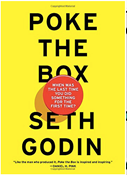
When was the last time you did something for the first time? It’s a powerful question because it would make most people very uncomfortable. Poke the Box could be the wake-up call that you’ve been waiting for till now to start something new.
In last two decades, Java has emerged as the most widely used programming language. Developers at Sun Microsystem created Java and it was later acquired by Oracle Corporation. Java 9, the latest version, has something called REPL feature. It stands for Read, Evaluate, Print, and Loop. REPL facilitates a quicker way to test few lines of code with minimal keystrokes.
[show_to accesslevel=’almanack-all’] Java experts are hoping that REPL will make programming a very accessible skill for the masses.
Every programmer learns to code by tinkering, i.e., slapping together few lines of code and giving it a spin. Then they modify it and run it again. This goes on in a loop until the program does exactly what the programmer wanted it to do.
You couldn’t use this approach in the many traditional industries. Imagine a civil engineer trying to build a bridge by REPL way. It would be expensive and dangerous.
However, in the modern world, where computers pervade almost every human activity, the tinkering approach has become more and more relevant. Today, with sophisticated simulation tools one can actually test a new design for a bridge with trial and error. The cost of iteration is next to zero and no one gets injured.
This means, starting new things and trying new ideas have become accessible to the common man, to you and me. Godin’s book is the wake-up call. He writes –
When my cousin was born, my uncle (who has a Ph.D. from MIT) built a buzzer box. It was a heavy metal contraption, with a thick black cord that plugged into the wall. It looked like something from a nuclear power plant, not a kid’s toy, but that didn’t dissuade him from tossing it into the crib. The box had two switches, some lights, and a few other controls on it. Flip one switch and a light goes on. Flip both switches and a buzzer sounds. All terrifying, of course, unless you are a kid. A kid sees the buzzer box and starts poking it.
If I do this, that happens! Mathematicians call this a function. Put in one variable, get a result. Call and response.
Life is a buzzer box. Poke it.
Poke the Box by Seth Godin is a manifesto for those who want to start, who want to make a ruckus, who want to create things, who want to poke. The buzzer box is a metaphor. And poking is no ordinary word either.
Steve Jobs, unarguably the world’s greatest storyteller, liked using it. Jobs said –
When you grow up you, tend to get told that the world is the way it is and your life is just to live your life inside the world, try not to bash into the walls too much, try to have a nice family, have fun, save a little money. That’s a very limited life. Life can be much broader, once you discover one simple fact, and that is that everything around you that you call life was made up by people that were no smarter than you. And you can change it, you can influence it, you can build your own things that other people can use. Once you learn that, you’ll never be the same again.
The minute that you understand that you can poke life and actually something will, you know if you push in, something will pop out the other side, that you can change it, you can mold it. That’s maybe the most important thing. It’s to shake off this erroneous notion that life is there and you’re just gonna live in it, versus embrace it, change it, improve it, make your mark upon it.
I think that’s very important and however you learn that, once you learn it, you’ll want to change life and make it better, cause it’s kind of messed up, in a lot of ways. Once you learn that, you’ll never be the same again.
Godin has the remarkable talent of picking up a simple idea that we all intuitively understand and transform it into an irresistible call for action.
The box might be a computer or it might be a market or it might be a customer or it might be your boss. It’s a puzzle, one that can be solved in only one way—by poking. When you do this, what happens? When you do that, what happens? The box reveals itself through your poking, and as you get better at it, you not only get smarter but also gain ownership.
Only by poking, testing, modifying, and understanding can we truly own anything, truly exert our influence.
Start Small
The abuse of the word startup has created the biggest mental block for people to start something. The billion-dollar unicorn startups and their larger than life founders have scared the shit out of a tinkerer sitting in a corner cubicle. But you don’t have to be Mark Zuckerberg to be an initiator.
People have come to the erroneous conclusion that if they’re not willing to start something separate, world-changing, and risky, they have no business starting anything. Somehow, we’ve fooled ourselves into believing that the project has to have a name, a building, and a stock ticker symbol to matter.
In fact, people within organizations are perfectly situated to start something. The third person in the four-person inbound customer service team can do it. The receptionist can do it. The assistant foreman can do it.”
The entrepreneurship chamber is ricocheting with chatters about the need for VC money and the support from a network of smart people. The truth is, the first and the most important thing you need is instigation capital, says Godin, “The desire to move forward. The ability and the guts to say yes.
The Tyranny of “Pick Me!”
The industrial revolution has trained people to take permission and wait for instructions. We’ve been brainwashed into thinking that someone else will come and pick us to do the job. The seduction of being the “chosen one” is the biggest killer of dreams.
Authors, wait to be chosen by an agent, and then by a publisher. Entrepreneurs often find themselves waiting to be chosen by a venture capitalist or investor. They need that selection in order to validate their work and to get started on actually building a business. Employees wait to be picked for promotion, or to lead a meeting or to speak up at a meeting.
Pick me, pick me” acknowledges the power of the system and passes responsibility to someone else to initiate. Even better, “pick me, pick me” moves the blame from you to them. If you don’t get picked, it’s their fault, not yours. If you do get picked, well, they said you were good, right? Not your fault anymore.
Reject the tyranny of picked. Pick yourself.
Another great book that will expand your mind on this idea is James Altucher’s Choose Yourself. Highly recommended.
Ship It
Starting has no value if it doesn’t end in the form of something being shipped.
Starting means you’re going to finish. If it doesn’t ship, you’ve failed. You haven’t poked the box if the box doesn’t realize it’s been poked. To merely start without finishing is just boasting, or stalling, or a waste of time. If you don’t ship, you actually haven’t started anything at all. At some point, your work has to intersect with the market. At some point, you need feedback as to whether or not it worked. Otherwise, it’s merely a hobby.
If you keep the idea inside you, you are merely hypothetically shipping, conceptually testing the market, prototyping your concept. If you don’t finish, it doesn’t really count as starting, and if you don’t start, you’re not poking.
Imagine you worked on a prototype but never really showed anyone about it then you’ve wasted an opportunity and wasted your time. Shipping in this context could be as simple as doing a demo in front of your family, friends, and colleagues. Or publishing a blog post about it or shooting a video and putting it up on YouTube. Heck! It could even mean trying to sell it on Amazon or eBay.
Conclusion
Poking the box is about taking the initiative to do work you decide is worth doing. It’s about letting your curiosity overpower the fear of finding the unexpected.
It’s a book that everyone needs to read. I read it once every year
[/show_to]
[hide_from accesslevel=’almanack-all’]
- Spotlight: Big ideas from Value Investing and why applying them in your investment decision making will be a great deal
- InvestorInsights: Interviews with experienced value investors, learners, and deep thinkers
- StockTalk: Thorough analysis of business models of companies (without any recommendations)
- Behaviouronomics: Deep analysis of human behaviour and how it impacts investment decision making
- BookWorm: Reviews of the best books on Value Investing and related subjects
- Free Course – Financial Statement Analysis for Smart People (otherwise priced at Rs 5,900)
- Archives: Instant access to our huge archive from the past three years