
Great perspectives on a book that teaches why it all starts with one belief, one thought, one word, one action, one habit, one value, and one step at a time.
Think of the last time you set out to bring about a major change in your life – like losing weight, starting a new project or business, learning how to invest on your own, starting an exercise regime, learning to break an addiction, or building a new relationship.
What did you feel? Exhaustion? Excitement? Fear?
Most people, when faced with change, get so overwhelmed with the perceived enormity of the work required to bring the change that they either don’t get started or give up very early. But there is an alternate way to circumvent our brain’s resistance. The book I am talking about here presents an idea that creates a backdoor entry, a kind of hack for your brain.
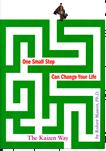
This is a small but amazing book written by Dr. Robert Maurer. It was recommended by Prof Sanjay Bakshi in his interview with Safal Niveshak in 2012. The big idea discussed in this book is of Kaizen, which is Japanese for “taking small steps to continual improvement”.
I can almost hear your mumbling, “Another big fancy jargon”. But let me assure you that Kaizen works and I am not telling you this just because I read the book. It’s a powerful idea.
[show_to accesslevel=’almanack-all’]
This saying by Lao Tzu captures the essence of Kaizen –
The journey of a thousand miles begins with the first step.
One Small Step
The idea of Kaizen is to make such small changes in your life that your brain doesn’t even know you’re changing, and therefore, doesn’t get in the way. How small? Dr. Maurer writes –
I am talking about really small steps here, ones that seemed almost embarrassingly trivial at first…spend a few seconds each day imagining the details of a dream job. If a patient wanted to cut out caffeine, we’d start by taking one less sip each day.
Let me digress a bit here and we will circle back to the Kaizen discussion in a moment. It’s worth mentioning here a tremendously useful mental model from Charlie Munger’s Latticework called boiling frog syndrome, described by Prof. Bakshi in this wonderful blog post. . He explained –
Small incremental changes tend to go unnoticed…If you put a frog in hot boiling water, it will instantly leap out of the pan and be never seen again. But, if you put a frog in a pan with room temperature water and slowly turn up the heat, it wouldn’t be able to tell the tiny incremental changes. It will boil and die….Charlie Munger once said that many businesses die just like the boiling frog. Cognition, misled by tiny changes involving low contrast, will often miss a trend that is destiny.
John Wooden, one of the most successful coaches in the history of basketball believed in Kaizen. He observed –
When you improve a little each day, eventually big things occur … Don’t look for big, quick improvement. Seek the small improvement one day at a time. That’s the only way it happens and when it happens, it lasts.
After World War II, a lot of credit for Japan’s rapid development and corporate dominance goes to the philosophy of small continuous improvements. It worked so well for them that Japanese gave it a name of their own – Kaizen.
There are six strategies Maurer talks about in his book that can help you bring about big changes in your life over a period of time. Let’s look at some of them.
Ask Small Questions
Dr. Maurer starts with the premise – “Small questions create a mental environment that welcomes creativity and playfulness.”
Doesn’t it feel counterintuitive that just the act of asking questions, especially to yourself, can solve problems? But if you try to understand how our brain works you would discover that the brain’s main criterion for storing information is repetition. As a result when you force your brain to go over a question repeatedly, the brain has no choice but to pay attention and begin to create the answers. Questions are better at engaging the brain. Dr. Maurer adds –
Ask a question often enough, and you’ll find your brain storing the questions, turning them over, and eventually generating some interesting and useful responses…I believe that the mere act of posing the same question on a regular basis and waiting patiently for an answer mobilizes the cortex…It will process and absorb the question and, in its own magical way, create answers when it is ready…which may be in that moment we are in the shower, driving, or washing the dishes.
It’s important that the questions are very small else it will trigger the fight-or-flight response in your brain and it will shut down. Asking small trivial questions is a common trick used by many successful fiction writers to overcome writer’s block. They start with a simple incident and then, by answering small questions, the whole novel takes shape.
The author quotes Sam Keen’s wonderful line – “What shapes our lives are the questions we ask, refuse to ask, or never think to ask.”
Think Small Thoughts
Dr. Maurer introduces a fascinating technique called “Mind Sculpture”. This is how it’s practiced –
.pretend that you are actually engaged in the action, not just seeing but hearing, tasting, smelling, and touching. In mind sculpture, people imagine the movement of their muscles, and the rise and fall of their emotions.
Thinking small thoughts with mind sculpture is the logical next step to asking small questions. Once you get an answer to a problem, imagine yourself implementing that solution.
Michael Phelps, one of the greatest athletes in the history of Olympics who has won 18 gold medals in swimming, uses this technique for improving his performance. Phelps rehearsed mentally every day before he actually got in the pool. Many professional athletes, including Michael Jordan and Jack Nicklaus, have used this kind of imagery to improve their skills.
Take Small Actions
Most people start the year with big resolutions. They follow it up with equally intense efforts, but in the absence of quick visible changes, they lose motivation and give up. If you see a pattern here, you aren’t alone. I have been there, done that. Every year!
I would argue that people overestimate what they can achieve in a year and underestimate what they can achieve in a decade. Consistency and persistency in taking small actions builds an emotional maturity which then carries you all the way to transformational results.
Dr. Maurer presents some wonderful examples of Kaizen actions to address problems like overspending, beginning an exercise program, managing stress, learning a foreign language etc. He writes –
By taking small steps so tiny that they seem trivial or even laughable, you’ll sail calmly past obstacles that have defeated you before.
But you may wonder, how a commitment as small as few minutes a day can get you to your goal and at this rate it will take years. But Kaizen asks us to be patient.
When the goal is to perform an activity that you deeply resist (say, exercise) or to give up an ingrained habit (perhaps smoking), you may find that one small step isn’t quite enough. But that step does lead you comfortably to a second step and then a third, and so on, until one day you discover that you have mastered the change.
In spite of your well planned small steps towards change if you hit a wall of resistance, don’t give up. Try scaling back the size of steps so small that you can barely notice an effort.
Solve Small Problems
Toyota is one of the largest car manufacturing companies in the world. It’s known for the reliability of its cars. Dr. Maurer describes how Toyota has imbibed the Kaizen philosophy in its work culture by catching and solving small problems –
When we’re trying to make a change, it can be tempting to ignore the subtle warning signs…but if we continue to avoid these small problems, they will grow and grow until we create a mess to spectacular that we are required to stop the assembly line of change, announce a recall, and proceed with the painful and time consuming process of undoing the now-big mistake.
Think about a past failure and consider whether there were any early warnings of things not going well.
Many large crises have their origins in very small problems. Every year a million children are killed by diarrhoea. Underlying cause? Dirty hands.
So, use of a simple soap can reduce these deaths by 40%. Similarly, in New York city, the rampant crime in 1980s was curtailed by 50% using the Kaizen steps i.e., focusing on small crimes and infringements first.
Bestow Small Rewards
Rewards are a valuable psychological tool and the philosophy of ‘positive reinforcement’ is a proven way to shape behaviour. However, what’s unusual about Kaizen approach is the reward size.
According to Toyota’s Chairman, every year, the company’s employees give out 1.5 million suggestions and 95 percent of them are put to practical use. Their average reward size? Only $3.88.
Most of us miss out on life’s big prizes. The Pulitzer. The Nobel. Oscars. Emmys. But we’re all eligible for life’s small pleasures. A pat on the back. A kiss behind the ear. A full moon. An empty parking space. A crackling fire. A great meal. A glorious sunset. Hot soup. Don’t fret about copping life’s grand rewards. Enjoy its tiny delights. There are plenty for all of us.
Identify Small Moments
Many of the discoveries of modern science have happened because somebody paused for a moment and took notice of what’s happening as well as what’s not happening around him. Many of the diseases like cholera, smallpox, and malaria were cured by looking at who didn’t get the disease.
Kaizen and Investing
When I first picked up this book, I wanted to know if this idea could help me become a better investor.
For somebody who is getting started in value investing, the first overwhelming task is building your circle of competence. How did Warren Buffett build his knowledge base? He read up about every single business that was available during his time.
What we can learn from Kaizen is to build our knowledge one book at a time, one annual report at a time or one page at a time. If one annual report seems too big, read just one page on the first day. Another on second day and so on.
Conclusion
By now you would have realized that Kaizen is a doubled-edged sword. If used consciously for betterment, it’s a marvellous tool. Ignore its power and you get pushed to a downward spiral of misery. Warren Buffett aptly said –
Chains of habit are too light to be felt until they are too heavy to be broken
The book has loads of practical ideas to bring the spirit of kaizen in your life. A short review like this is definitely not a substitute for the book itself. My intention is to make you curious enough about the book and nudge you to get your own copy. Any book worth reading is worth reading twice. I have read this book more than once and it deserves a read at least once every year.
The author starts the book with a quote from Mother Teresa. Let me wrap up with the same quote –
It is not how much we do, but how much love we put into the doing. And it is not how much we give, but how much love we put into the giving. To God there is nothing small.
To conclude, let me share with you a poem One Step at a Time from Jordin Sparks –
We live and we learn to take
One step at a time
There’s no need to rush
It’s like learning to fly
Or falling in love
It’s gonna happen when it’s
Supposed to happen and we
Find the reasons why
One step at a time
When you can’t wait any longer
But there’s no end in sight
when you need to find the strength
It’s your faith that makes you stronger
The only way you get there
Is one step at a time.
- Spotlight: Big ideas from Value Investing and why applying them in your investment decision making will be a great deal
- InvestorInsights: Interviews with experienced value investors, learners, and deep thinkers
- StockTalk: Thorough analysis of business models of companies (without any recommendations)
- Behaviouronomics: Deep analysis of human behaviour and how it impacts investment decision making
- BookWorm: Reviews of the best books on Value Investing and related subjects
- Free Course – Financial Statement Analysis for Smart People (otherwise priced at Rs 5,900)
- Archives: Instant access to our huge archive from the past three years